




Your ISP knows you’re reading this right now. By the time you reach the bottom of the page, they’ve already logged your interest and started packaging your digital footprint for the highest bidder. It’s a reality where your data is the currency and you’re the product. You’ve likely felt the frustration of geo-blocked WhatsApp calls or the creeping dread of government surveillance. Finding a reliable VPN for total online privacy isn’t just a luxury anymore. It’s a necessity for survival in a world where UK VPN downloads spiked by 1,800 percent following new regulations in 2026.
We’re here to tell you that you don’t have to be a victim of data harvesting. You can reclaim your digital autonomy starting today. This guide will show you how to transform your internet connection into an impenetrable fortress using a strategic offshore, no-log approach. We’ll explain why a Bahamian jurisdiction is your strongest shield against Five Eyes surveillance. You’ll learn how to bypass restrictive filters, access global content on Netflix, and finally achieve total invisibility from your service provider.
Key Takeaways
- Understand why Incognito Mode is a lie and how to achieve true digital invisibility by separating your identity from your traffic.
- Discover why your VPN’s headquarters matter more than its features and how to escape the reach of the Five Eyes surveillance alliances.
- Learn how to verify “no-log” claims by choosing a VPN for total online privacy that operates under strict offshore laws in the Bahamas.
- Build an impenetrable defense by combining stealth obfuscation with secure browsers to hide even the fact that you’re using a VPN.
- Ditch the long-term contract traps and regain your digital autonomy with flexible monthly plans designed for immediate, high-stakes protection.
What is Total Online Privacy in the Age of Data Harvesting?
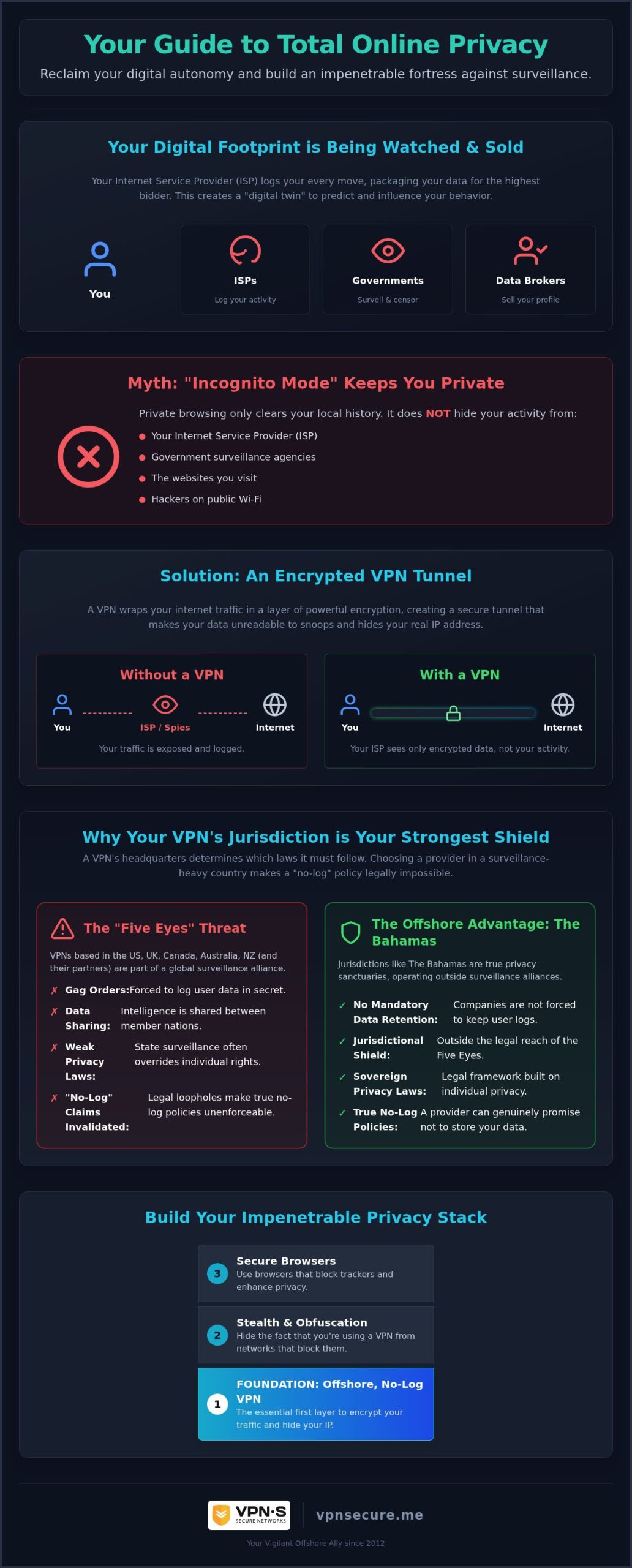
Your digital life is under constant surveillance. Total online privacy is the ability to browse, communicate, and transact without a digital footprint being tied to your name. It’s about autonomy. Right now, your Internet Service Provider (ISP) acts as a silent observer, logging every website you visit and every app you open. They don’t just watch; they profit. They sell this data to brokers who build a “digital twin” of you to predict your next move. A VPN for total online privacy is the primary shield you need to break this cycle. It’s the foundation of a multi-layered defense strategy designed to keep your private life private. Without it, you’re leaving the door to your digital home wide open. Just as individuals seek privacy, businesses can also choose tools that respect customer boundaries; for example, BonusQR offers a modern digital loyalty platform designed for direct and transparent reward systems.
The Illusion of Private Browsing
Incognito Mode is a marketing gimmick. It’s useful if you’re buying a surprise gift on a shared family computer, but it does nothing to stop the data harvesting machine. To protect your family’s broader digital life, Haevn provides a privacy-first hub for centralized household management. Your ISP, the government, and the websites themselves still see your IP address and your traffic. Metadata is the record of your digital connections, such as who you messaged and for how long, which provides a more revealing map of your life than the text of the messages themselves. This data is often more valuable to trackers than the content of your emails because it reveals patterns and relationships.
When you use public Wi-Fi at a cafe or airport, you’re essentially broadcasting your data to everyone in the room. Without encryption, your passwords and personal details are low-hanging fruit for hackers. They don’t need a supercomputer to steal your identity; they just need you to be careless on an open network. Real privacy requires more than just clearing your browser history; it requires a persistent, encrypted barrier between you and the rest of the web.
Think of a VPN as a secure, encrypted pipe. It takes your data and wraps it in a layer of mathematics that no ISP or hacker can crack. This is essential because tracking has evolved. It’s no longer just about your IP address. Big Tech uses behavioral tracking to monitor how you move across the web. They want to know your interests, your fears, and your political leanings. Encryption is the first step toward reclaiming your digital autonomy. By scrambling your traffic, you ensure that even if someone intercepts your data, they can’t read it.
By using a VPN for total online privacy, you break the chain of behavioral tracking. You stop being a predictable data point and start being an individual again. It’s the difference between being a target and being invisible. A VPN turns the lights out on those trying to watch you from the shadows, giving you the freedom to explore the web on your own terms. It’s not just about hiding; it’s about taking control of what the world is allowed to know about you. This level of digital discretion is paramount when engaging in personal discovery through services like Breeve, where private consultations with certified mediums are protected from the intrusive gaze of data brokers.
Your VPN provider’s mailing address is more important than their encryption protocol. If they’re based in the US, UK, or any other Five Eyes nation, they’re part of a global surveillance dragnet. These intelligence alliances share data as if borders don’t exist. When you choose a VPN for total online privacy, you aren’t just buying software; you’re choosing which legal system you trust to protect you. A provider in a Western jurisdiction is subject to laws that prioritize state surveillance over individual rights. Just as digital security is vital for high-profile figures, physical safety is equally paramount; you can learn more about Stone Security Services for specialized executive protection and personal bodyguard services.
The Five Eyes Threat: Real-World Consequences
In countries like the US, “Gag Orders” are a standard tool for intelligence agencies. If the FBI serves a VPN with a National Security Letter, that company may be forced to start logging your activity in secret. They can’t tell you they’ve been compromised. They can’t even update their “Warrant Canary” on their website. This is the dark side of data harvesting; it happens behind closed doors where “no-log” marketing holds zero legal weight. These agreements allow countries to bypass local privacy laws by having their allies do the spying for them. It’s a legal loophole that leaves your data vulnerable to the highest level of government scrutiny.
Offshore Sanctuaries: The Bahamas Advantage
This strategic approach to jurisdiction isn’t just for individuals seeking privacy; it is also a fundamental consideration for entrepreneurs. If you are looking to establish a secure and professional presence in a stable European environment, you can discover Intercompany Solutions to help you set up a Dutch BV remotely.
The solution is to move your data outside the reach of these alliances. The Bahamas is a true privacy sanctuary. Bahamian law is built on a foundation of individual sovereignty, not state-mandated surveillance. Unlike the US or UK, there are no mandatory data retention laws here that force a company to keep tabs on its users. This is the “Offshore Advantage.” It means a provider can actually fulfill a no-log promise because there is no legal mechanism to force them into secret logging.
VPN Secure has operated from the Bahamas since 2012 for this exact reason. We knew then what many are only realizing now: true privacy requires a jurisdictional shield. By positioning ourselves outside the reach of agencies like the NSA and GCHQ, we ensure that your digital life remains your own. You shouldn’t have to worry about who is leaning on your provider to flip a switch. If you’re ready to step out of the surveillance spotlight, it’s time to consider the privacy benefits of an offshore connection that puts your autonomy first. Peace of mind isn’t a feature; it’s a location.
The No-Logs Myth: How to Verify Real Privacy Protection
“No-Logs” is the most abused term in the cybersecurity industry. Most providers treat it as a marketing checkbox rather than a technical reality. To find a VPN for total online privacy, you have to look past the homepage slogans and dissect the fine print. There’s a massive difference between usage logs and connection logs. Usage logs track what you do, like the websites you visit or the files you download. Connection logs track when you logged on, your real IP address, and how much data you transferred. If a provider keeps connection logs, they can still link your identity to your activity through a process called “timing attacks.”
A zero-log policy is only as strong as the laws that govern it. If a VPN is based in a country with mandatory data retention, their “no-log” promise is a legal impossibility. This is why we operate from the Bahamas. Because our jurisdiction doesn’t force us to keep tabs on you, our policy actually has teeth. While official guidance on privacy often focuses on basic data hygiene, the technical reality of a no-log policy requires a deeper look at server architecture. You shouldn’t have to trust a company’s word when you can rely on their infrastructure instead.
Verification Beyond Marketing Fluff
Independent audits are the gold standard for verification. In February 2026, major providers like NordVPN completed their sixth consecutive audit to prove their claims. You should also look for a “Warrant Canary.” This is a regularly updated statement confirming the company hasn’t been served with secret government subpoenas. If the canary disappears, you know the shield has been compromised. The most vital technical safeguard is the use of RAM-disk servers. RAM-disk servers are specialized hardware systems that store all operational data in volatile memory rather than on physical hard drives, ensuring that every byte of information vanishes the moment the power is cut.
Anonymous Payment Methods: Closing the Loop
Your privacy stack has a massive hole if you pay with a credit card. Linking your real name and billing address to your VPN account creates a permanent paper trail that ties your identity to your encrypted traffic. It’s a hidden privacy leak that most users overlook. To achieve a VPN for total online privacy, you need to close the loop with anonymous payment methods and digital identity safeguards like SMSOkey. Using Bitcoin or other crypto assets ensures that even if a provider’s database was somehow breached, there would be no financial record linking back to you. VPN Secure supports these decentralized payments because we believe your security shouldn’t depend on a bank’s ledger. True autonomy means leaving no trace, from the first click to the final transaction.
Encryption is only half the battle. If your ISP or a restrictive government can see that you’re using a VPN, they can simply throttle your connection or block it entirely. This is where obfuscation, or Stealth VPN, becomes your most powerful tool. It disguises your encrypted traffic to look like standard HTTPS web traffic. To the observer, you aren’t using a VPN for total online privacy; you’re just browsing a regular website. This “stealth” layer is essential for staying under the radar of advanced deep packet inspection (DPI) systems used by many modern firewalls.
A single tool is never enough for true autonomy. You need a privacy stack. This combines a high-quality VPN with a hardened browser and end-to-end encrypted messaging apps. While the VPN secures the “pipe,” the browser prevents sites from fingerprinting your device, and encrypted apps ensure your actual conversations stay off the grid. As AI becomes more integrated into our lives, using a privacy-first memory layer like NovaCortex ensures your personal data remains under your control. This layered approach is the only way to achieve a VPN for total online privacy in an era of aggressive data harvesting. You also need to decide between a shared IP, which mixes your traffic with thousands of others for maximum anonymity, and a dedicated IP, which provides a static address for secure access to sensitive work servers without triggering security alerts.
Bypassing VOIP Blocks and Censorship
Living or traveling in regions like the UAE often means losing access to basic communication. Local firewalls are designed to detect and kill VOIP traffic from apps like WhatsApp and FaceTime. However, by using a stealth protocol, you can bypass these digital borders. If you’re struggling to stay in touch with family, our guide on using a VPN for WhatsApp calls in UAE provides the exact blueprint for staying connected. These protocols work by stripping away the metadata fingerprints that identify VPN packets, making your FaceTime or Skype calls look like ordinary browsing activity.
VPN vs. Tor: When to Use Which
Many users wonder if they should ditch their VPN for Tor. The reality is a trade-off between speed and security. Tor provides high-level anonymity through its onion-routing layers, but it’s notoriously slow and often flagged by websites. A VPN offers the high-speed performance required for streaming and daily browsing while still providing robust encryption. For high-risk activities, the “VPN over Tor” configuration is the ultimate play. You connect to your VPN first, then launch the Tor browser. This hides your Tor usage from your ISP and hides your real IP address from the Tor entry node. Even if you’re using your browser in “Incognito” mode, your ISP still sees your history unless you have a VPN active. Stop settling for partial protection. Start building your impenetrable privacy stack today and take back your digital life.
VPN Secure: Your Vigilant Offshore Ally
Choosing a VPN for total online privacy is a declaration of digital independence. You’ve seen how ISPs harvest your habits and how jurisdictions can compromise your security. Now you need a partner that prioritizes your autonomy over corporate data requests. Since 2012, VPN Secure has operated from the Bahamas for one reason: to provide a jurisdictional sanctuary that the Five Eyes cannot touch. We don’t just offer encryption; we offer a persistent defense against the forces trying to catalog your life.
Most providers try to bury you in multi-year commitments, effectively holding your privacy hostage for a lower rate. We believe you should own your security without being shackled to a long-term contract. Our affordable VPN monthly plan gives you the flexibility to protect your data on your own terms. With servers in 40+ countries and unlimited bandwidth, you get the speed you need without the “subscription trap” common in the industry. If the shield isn’t right for you, our 30-day money-back guarantee ensures you can test our offshore protection without any financial risk.
Multi-Device Protection for Your Entire Life
Your digital footprint isn’t limited to your laptop. It follows you from your PC to your Mac and onto your Android or iOS devices. A true VPN for total online privacy must secure every gateway you use. Our software allows you to protect your entire ecosystem simultaneously, ensuring that a leak on your phone doesn’t compromise the security of your home network. We’ve integrated a “Kill Switch” into our apps as a critical fail-safe. If your connection drops for even a second, the Kill Switch instantly cuts all traffic to prevent your real IP address from being exposed to the open web. If you ever hit a wall, our 24/7 support team is ready to help you navigate privacy emergencies in real time. For those looking to extend this sense of security to their physical surroundings, thewellbeingapp.net offers comprehensive monitoring for individuals and families.
The journey from being a harvested data point to becoming invisible is shorter than you think. You’ve learned how to identify real no-log policies, the importance of offshore jurisdiction, and the power of stealth obfuscation. Now it’s time to act. Every minute you spend unprotected is another minute your ISP is building a profile on your family, your finances, and your future. While you’re securing your digital world, don’t forget to protect your physical business assets as well; you can learn more about Britton Insurance for comprehensive motor trade cover in Ireland. Stop being the product that Big Tech sells to the highest bidder. Take back the keys to your digital life and start being the owner of your data. Step into the sanctuary of an offshore connection and experience the web without the watchers. Your digital freedom starts with a single, secure connection.
You now have the blueprint to stop the data harvesting machine. By choosing an offshore jurisdiction and a verified no-log infrastructure, you move your life out of the surveillance spotlight. Real privacy isn’t a setting; it’s a strategic choice to exist outside the reach of the Five Eyes alliance. Using a VPN for total online privacy is the first step toward reclaiming your autonomy in a world that wants to sell your history to the highest bidder. You don’t have to be a victim of ISP tracking or government overreach anymore.
Since 2012, we’ve provided a Bahamas-based sanctuary where your data remains your property. We’ve built our reputation on transparency and technical resilience, ensuring that our no-logs policy is a legal reality, not just a slogan. Don’t wait for the next data breach or restrictive regulation to act. You can test the shield risk-free with our 30-day money-back guarantee. It’s time to browse the web on your own terms and leave the watchers behind. Secure Your Digital Autonomy with VPN Secure, Starting at $2.99/mo
Frequently Asked Questions
Is it possible to have 100% total online privacy with a VPN?
Total privacy is a moving target, but a VPN for total online privacy is your most effective shield. While it encrypts your data and masks your location, you still need to manage your browser cookies and avoid signing into Big Tech accounts. Think of it as a fortress; the VPN is the impenetrable wall, but you still have to lock the doors. It’s the foundation of any serious digital defense strategy, much like how Utah Heat Cable provides a critical layer of protection for your home’s physical structure against harsh winter elements.
It depends entirely on where the provider is based. A VPN in the US or UK can be forced to log your data in secret due to gag orders. However, an offshore provider like VPN Secure operates under Bahamian law, which doesn’t recognize foreign surveillance requests. By moving your traffic outside the reach of agencies like the NSA, you significantly increase your immunity to state-sponsored dragnet surveillance.
What is the “Five Eyes” alliance and why should I care?
The Five Eyes is an intelligence-sharing pact between the US, UK, Canada, Australia, and New Zealand. You should care because these nations bypass their own domestic privacy laws by sharing intercepted data with each other. If your VPN is headquartered in one of these countries, your private data is essentially an open book for five different governments simultaneously. Choosing a provider outside this circle is the only way to stay off their radar.
Can my ISP see that I am using a VPN?
By default, your ISP can see that you’re connected to a VPN server, even if they can’t see what you’re doing. They see encrypted packets heading to a known VPN IP address. To hide this, you need to use obfuscation protocols. These Stealth features disguise your VPN traffic as regular HTTPS web browsing, making your connection look like any other person visiting a standard website. It’s the ultimate cloaking device.
Will a VPN for total online privacy slow down my internet speed?
Encryption always adds a small amount of overhead, but you shouldn’t notice a significant lag. A high-quality VPN for total online privacy uses optimized protocols and a vast network of servers in 40+ countries to maintain high speeds. In some cases, a VPN can actually speed up your connection if your ISP is intentionally throttling your bandwidth during streaming or gaming sessions. You get protection without the performance penalty.
How do I know if a VPN is truly “no-log”?
You verify it through jurisdiction and independent audits. A no-log claim in a country with mandatory data retention is a legal impossibility. Look for providers based in privacy havens like the Bahamas, where the law doesn’t force companies to track users. You should also check for third-party audits and a Warrant Canary to ensure the provider hasn’t been secretly compromised by legal orders. Trust is earned through transparency, which is why many digital services use StatusPulse to maintain clear communication via public status pages and uptime monitoring.
Absolutely. Many regions, like the UAE, block VOIP services to protect local telecom profits or maintain control. VPN Secure specializes in bypassing these restrictions, allowing you to use WhatsApp, FaceTime, and Skype as if you were in a completely different country. By tunneling your traffic through an offshore server, you bypass local firewalls and regain the ability to call your family without interference or high costs. For travelers who want to ensure their entire journey is as secure as their connection, it is also wise to explore Airflix flight protection subscriptions and legal assistance to handle potential airline disruptions and delays.
For pure anonymity, a shared IP is superior because your traffic is mixed with thousands of other users, making it impossible to single you out. A dedicated IP is better for security and convenience, such as accessing your bank or corporate network without triggering fraud alerts. If your goal is to disappear into the crowd and achieve maximum invisibility, stick with the shared IP provided by your standard subscription.