




You are currently living in a digital glass house where your ISP, the government, and every script-kiddie at the local cafe can watch your every move. It is a harsh reality, but ignoring it won’t make you any safer. Most people treat data encryption for internet security as a technical luxury. In reality, it is the only thing standing between your private life and total exposure in 2026.
It’s frustrating to feel like you’re being watched while struggling to understand the dense jargon that surrounds digital privacy. You want to secure your identity without needing a computer science degree. We’re here to bridge that gap. This guide masters the mechanics of encryption, transforming it from a confusing concept into a powerful shield against surveillance, hackers, and censorship. We will explore the gold standards of protection, like AES-256 bit encryption, and provide a clear roadmap to secure all your devices against snooping. By the end, you’ll know exactly how to reclaim your autonomy and navigate the web on your own terms.
Key Takeaways
- Stop living in a digital glass house by mastering how ciphertext turns your private activity into unreadable code for ISPs and hackers.
- Understand why AES-256 is the essential standard for data encryption for internet security and why it’s practically impossible to crack.
- Pinpoint the exact moments your information is most vulnerable while moving across networks and learn how to lock it down instantly.
- Learn why strict no-logs policies and safe jurisdictions like the Bahamas are the only ways to keep your keys out of government hands.
- Take back your digital sovereignty with a fast setup guide that secures every device against surveillance and restrictive censorship.
Plaintext vs. Ciphertext: Why Data Encryption is Your First Line of Defense
Your internet connection is a conversation. Without protection, it’s a conversation held through a megaphone in a crowded room. ISPs, government agencies, and malicious actors are all listening. This is the “glass house” reality of the modern web. If you aren’t using data encryption for internet security, you are essentially handing over the keys to your digital life to anyone with the tools to look. Every click, every message, and every login is visible to those who control the pipes your data travels through.
Encryption is the mathematical process of turning your readable information, known as plaintext, into a scrambled mess called ciphertext. Think of it as a high-tech shredder that only your intended recipient knows how to piece back together. The magic happens via a cryptographic key. This key is a unique string of characters used by an algorithm to lock and unlock the data. Without this specific key, the ciphertext is just useless noise. By 2026, this level of protection has become the baseline for survival. From your daily banking to private messaging apps, data encryption is the only thing ensuring your personal details don’t become public property.
The Evolution of Secrecy: From Caesar to Computers
Humans have been hiding secrets for millennia. Julius Caesar used a simple letter-substitution cipher to protect military orders. It worked then, but modern computing has turned those ancient methods into child’s play. We have moved from shifting letters on a page to complex algorithms that would take billions of years to crack. Brute force is a trial and error method where attackers use high-speed software to guess every possible combination of a key until the correct one is found. Modern encryption makes this approach mathematically impossible for even the most powerful supercomputers.
Plaintext: The Internet’s Biggest Security Flaw
The biggest threat to your privacy is the legacy of “plaintext” protocols. When you visit an outdated “HTTP” site, your data travels in the clear. This allows hackers to perform “packet sniffing,” which is a technique where they intercept and read your traffic as it moves through the network. It’s the primary way passwords and credit card numbers are stolen on public Wi-Fi networks. Implementing robust data encryption for internet security stops this threat cold. Beyond the technical safety, there is a profound psychological peace of mind. Knowing you aren’t being watched allows you to explore, communicate, and exist online without the weight of constant surveillance.
How Data Encryption Works: From Symmetric Keys to AES-256 Standards
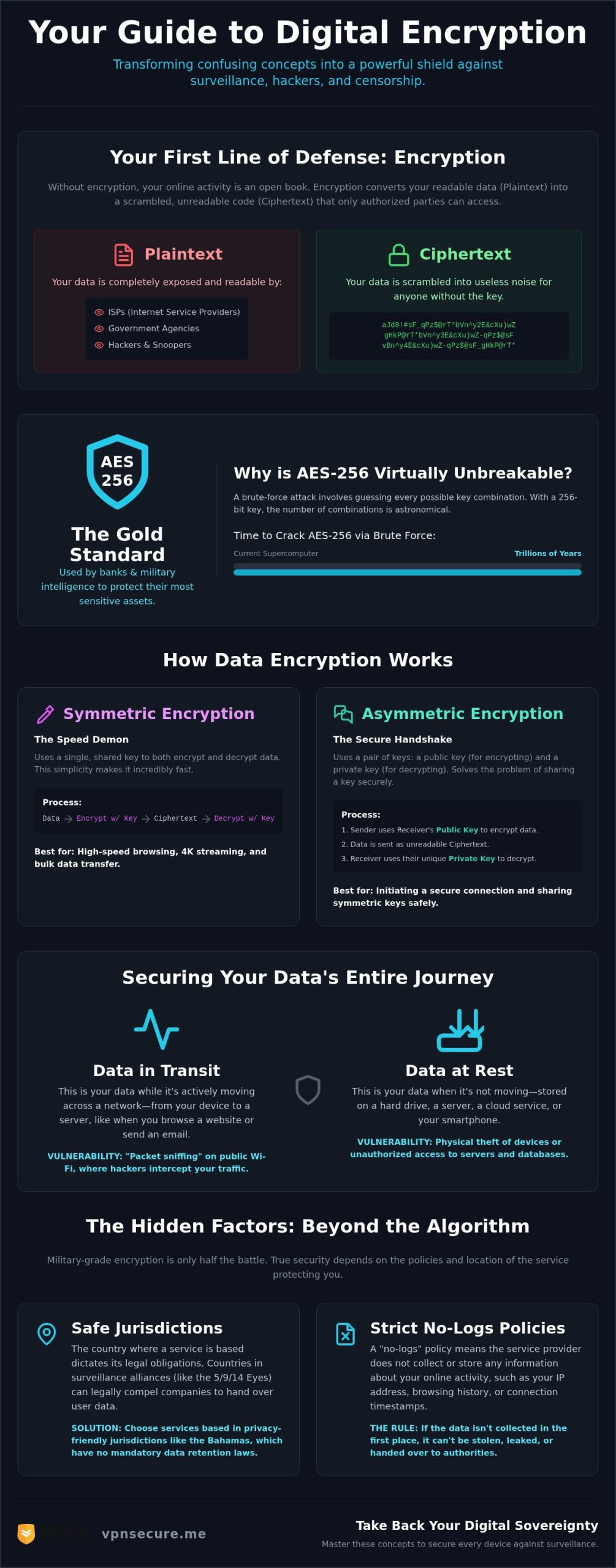
Math is your only true ally in a world of digital predators. While hackers use sophisticated tools to pry into your life, the right algorithm turns their efforts into a waste of time. Understanding How Data Encryption Works isn’t about learning code; it’s about knowing which walls are thick enough to keep the world out. The gold standard in 2026 remains AES-256. This stands for the Advanced Encryption Standard with a 256-bit key. To put its power in perspective, a supercomputer trying to crack it via brute force would need trillions of years. It’s the same level of security used by banks and military intelligence to protect their most sensitive assets.
Modern data encryption for internet security relies on two primary methods: symmetric and asymmetric. They work together to ensure your connection is both fast and bulletproof. When you use protocols like OpenVPN or WireGuard, they act as the architects using these mathematical bricks to build a secure tunnel for your data. These protocols are the reason you can browse privately without sacrificing the performance you expect from a modern connection.
Symmetric Encryption: The Speed Demon
Symmetric encryption is built for performance. It uses a single, identical key to both lock and unlock your data. This simplicity makes it incredibly fast, which is why it’s the engine behind high-speed browsing and 4K streaming. The only catch is that both parties must already have the key. If a hacker intercepts the key during the initial exchange, the whole system collapses. This is why we use it for the heavy lifting of data transfer but rely on a different method to start the conversation. It’s about balancing raw power with smart delivery.
Asymmetric Encryption: The Secure Handshake
Asymmetric encryption solves the key-sharing problem. It uses a pair of keys: a public key and a private key. Anyone can use your public key to lock a message, but only your private key can unlock it. It’s like a mailbox where anyone can drop a letter through the slot, but only you have the key to the back door. This “handshake” is how your device and a VPN server safely agree on a connection without ever meeting in person. Gatekeepers like RSA and Elliptic Curve Cryptography (ECC) manage these handshakes, ensuring no one can impersonate the server you’re trying to reach.
You deserve a connection that uses these tools without slowing you down. If you’re ready to put this math to work, you can secure your devices with a VPN subscription that prioritizes both speed and military-grade standards.
Data in Transit vs. Data at Rest: Securing Every Step of the Journey
Your digital life exists in two states: sitting still or moving. Both are under constant threat. Data at rest refers to the files on your hardware or cloud drive. Data in transit is the information currently flying across the web, like a private message or a VOIP call. Mastering data encryption for internet security means building a defense that follows your data through both phases. If you only lock your vault but leave your documents on the sidewalk, you’re just asking for trouble.
Data in transit is your moment of maximum exposure. This is the prime playground for “Man-in-the-Middle” (MITM) attacks. A hacker positions themselves between your device and the server you’re trying to reach. They don’t just watch; they can hijack your session or steal your passwords in real-time. End-to-End Encryption (E2EE) is the only way to stop this. It ensures that the message is locked on your device and only unlocked by the recipient. No one in the middle, not even the platform owner, can see what you’re doing.
The Public Wi-Fi Trap: Why Transit Security Matters
Free Wi-Fi is a predator’s favorite bait. Attackers set up “evil twin” hotspots in airports and cafes to trick you into connecting. Once you’re in, they own your connection. A VPN acts as a protective shield, wrapping your traffic in an encrypted tunnel that no one can penetrate. This tunnel hides your activity from the hotspot owner and blocks them from sniffing your data. By routing your traffic through a secure server, a VPN tunnel masks your IP address and replaces it with one from a location of your choice.
Securing the Destination: Data at Rest
Don’t make the mistake of thinking a VPN protects your physical hard drive. Even if your transit is secure, your local files need full-disk encryption. If your laptop is stolen, a thief can bypass your login screen and read your drive directly unless it’s scrambled. This logic applies to the cloud too. You must choose storage providers that offer “zero-knowledge” security, meaning they don’t hold the keys to your data. Applying data encryption for internet security to your hard drive creates a comprehensive shield that leaves no room for external interference.
The Hidden Factor: Why Jurisdiction and ‘No-Logs’ Policies Define True Security
The strongest math in the world is useless if the person holding the keys is forced to hand them over. You can have military-grade data encryption for internet security, but if your provider operates under the thumb of a hostile jurisdiction, your privacy is an illusion. Governments don’t always try to break the code. They simply subpoena the company. This is where the “Eyes” alliances come in. The Five Eyes, Nine Eyes, and 14 Eyes are international intelligence-sharing agreements. If one member country grabs your data, they all have it. It is a global surveillance dragnet designed to bypass local privacy laws.
A true “No-Logs” policy is your second line of defense. It means that even if a government knocks on the door, there is nothing to hand over. No timestamps. No IP addresses. No browsing history. If the data doesn’t exist, it cannot be decrypted. We believe that privacy isn’t a feature; it is a fundamental right that requires a provider to be physically and legally out of reach from these prying alliances.
Legal Backdoors: The Enemy of Encryption
Some governments are actively trying to weaken your protection by mandating “backdoors” in security software. They want a master key that bypasses data encryption for internet security whenever they see fit. The US CLOUD Act, for instance, allows federal law enforcement to compel tech companies to provide data regardless of where it is stored. This makes a no log vpn audit essential. Without independent proof, a zero-logs claim is just marketing fluff. You need to know that your provider’s infrastructure has been verified by experts who don’t answer to a flag.
Digital Autonomy: Operating Outside the Alliance
Jurisdiction is the final boss of internet security. By operating out of the Bahamas, we stay outside the reach of the 14 Eyes alliance. Bahamian privacy laws are built to protect the individual rather than the state. This offshore location isn’t a gimmick; it’s a strategic vault. It ensures that cross-border surveillance requests hit a legal brick wall. When you choose a provider that values digital autonomy, you aren’t just buying a service. You are choosing an ally that stands between you and the global surveillance machine. Take control of your footprint and get a VPN subscription that puts your sovereignty first.
Implementing Military-Grade Encryption with VPN Secure
You have seen the math and the legal landscape. Now it’s time to act. Setting up data encryption for internet security shouldn’t be a chore. With VPN Secure, you get AES-256 protection on all your devices in under five minutes. It is about moving from vulnerability to digital sovereignty without the technical headache. We handle the heavy lifting of cryptographic handshakes so you can focus on what matters.
While encryption scrambles your data, a Dedicated IP provides a static digital identity within your secure tunnel. This is the perfect middle ground if you need consistent access to secure corporate networks or banking systems while keeping your traffic locked down. You get the benefit of a private vault without the “noisy neighbor” problems of shared IP addresses. It’s your own private lane on the digital highway, shielded from every prying eye.
Unblocking the World: Encryption as a Key
In regions like the UAE or Saudi Arabia, VOIP services are often throttled or blocked by state-run ISPs. Encryption is the key that unlocks these digital borders. By masking your traffic type, you bypass censorship and speak freely with friends and family. This isn’t just about privacy; it’s about liberation. Whether you are streaming home content from a hotel room or bypassing regional firewalls, an affordable VPN monthly plan gives you the flexibility to test these tools without falling into a multi-year trap.
One-Click Protection: The VPN Secure Advantage
In addition to secure communication, many users in restricted regions rely on digital tools to provide financial support to their families; for instance, you can explore International recharges as a safe way to help loved ones stay connected from abroad.
We’ve simplified the complex math of asymmetric keys into a single “Connect” button. You don’t need to be a network engineer to secure your phone, PC, and tablet simultaneously. Our multi-device support ensures that your entire digital footprint is shielded from snooping. Whether you’re on a laptop at the office or a phone at a cafe, the protection remains constant and invisible.
Take control of your data with our 30-day money-back guarantee. It is a risk-free way to experience secure data transmission and see how data encryption for internet security changes your relationship with the web. Secure your digital life with VPN Secure today and stop living in a glass house.
Reclaim Your Digital Sovereignty Today
The internet in 2026 doesn’t have to be a glass house where your private life is on display. You now understand that while math provides the lock, jurisdiction provides the vault. By mastering data encryption for internet security, you’ve moved from being a target to becoming a ghost in the machine. True privacy requires more than just a scrambled signal; it demands a provider that operates outside prying alliances and keeps zero records of your activity.
VPN Secure offers you this exact shield. With AES-256 military-grade encryption and a home base in the Bahamas, we ensure your data stays where it belongs: with you. Our verified no-logs policy means we don’t just promise privacy; we architect it into every connection. It’s time to stop worrying about who is watching and start browsing on your own terms. Start your 30-day risk-free privacy journey with VPN Secure and see how liberating a secure connection can be. The tools for your digital freedom are ready. Take them.
Frequently Asked Questions
Is data encryption legal in every country?
Data encryption is legal in most nations, but its usage is heavily regulated in restrictive regions. Countries like China, Russia, and Iran have laws that either ban certain tools or require providers to build backdoors for government access. In democratic nations, encryption is a standard for banking and communication. However, the legal landscape is shifting. Always check local regulations if you are traveling to a country known for high levels of digital censorship.
Can hackers break AES-256 bit encryption?
Hackers cannot break AES-256 bit encryption through brute force with current technology. This standard uses a key so long that even the world’s most powerful supercomputers would take billions of years to guess it. Most “hacks” actually happen because of weak passwords or social engineering, not by breaking the math itself. By using AES-256, you ensure that the mathematical foundation of your digital shield remains impenetrable against any modern attacker.
What happens if I lose my encryption key?
If you lose your encryption key in a zero-knowledge system, your data is gone forever. This is the trade-off for true privacy. Unlike a standard social media account, there is no “forgot password” button that can recover your files if the provider doesn’t hold the keys. This ensures that no one, not even the service provider, can peek at your information. Always keep a secure, offline backup of your master keys to avoid permanent data loss.
Does data encryption slow down my internet speed?
Encryption adds a small amount of overhead to your connection, but the impact is usually unnoticeable on modern devices. The process of scrambling and unscrambling data requires processing power. However, high-speed protocols like WireGuard have optimized this task to ensure your streaming and gaming remain smooth. If you experience significant lag, it’s often due to server distance or ISP throttling rather than the data encryption for internet security itself.
What is the difference between a VPN and end-to-end encryption?
A VPN creates a secure tunnel for all your device’s traffic, protecting it from your ISP and local snoopers. End-to-end encryption (E2EE) specifically secures the content of a message from the sender to the recipient. While a VPN hides your metadata and location, E2EE ensures the platform owner can’t read your chats. For maximum privacy, you should use both. A VPN shields your entire connection, while E2EE adds a final layer of secrecy to your conversations.
Is HTTPS enough to protect my data for internet security?
HTTPS is a great start, but it isn’t enough on its own. While it encrypts the data sent between you and a specific website, your ISP can still see which domains you visit. They can track your habits and sell that data to advertisers. Using comprehensive data encryption for internet security through a VPN hides your destination from the ISP entirely. HTTPS protects the content of your visit, but a VPN protects your identity and location.
How do I know if my data is currently being encrypted?
You can verify your protection by looking for specific indicators on your device. On the web, the padlock icon in your browser’s address bar signifies an active HTTPS connection. For your entire device, check your VPN application. A “Connected” status means your traffic is wrapped in an AES-256 tunnel. You can also use an IP leak test tool to confirm that your real location and ISP details are successfully masked from the public web.
Do I need a dedicated IP address for better encryption?
A dedicated IP address doesn’t change the strength of your encryption, but it does offer specific security advantages. It provides you with a static, non-shared identity within your encrypted tunnel. This is useful for accessing sensitive banking systems or corporate networks that whitelist specific IPs. While shared IPs offer better “crowd” anonymity, a dedicated IP prevents you from being blacklisted due to the actions of other users on the same server.