




Your smart fridge, your tablet, and your thermostat are all talking behind your back. By 2026, the average household manages over 20 connected devices; each one represents a wide-open door for snoops and state-level surveillance. Finding a reliable VPN for all devices shouldn’t feel like a compromise between total security and high-speed performance, yet most providers still trap you with restrictive caps and sluggish connections.
You likely feel the frustration of managing a dozen different logins while watching your bandwidth vanish the moment the family starts streaming. It’s a digital headache you didn’t ask for. We’re here to fix that. You’ll learn how to secure every screen in your home using a single solution based safely in the Bahamas, far beyond the reach of the Five Eyes alliance. We’ll explore how to bypass geo-restrictions on apps like FaceTime, shield your “headless” IoT hardware, and maintain peak performance across your entire ecosystem with one affordable account.
Key Takeaways
- Understand why securing only your primary smartphone is a dangerous myth and how one unprotected smart device can compromise your entire home network.
- Discover how a single VPN for all devices creates a unified shield across every screen you own without the headache of managing multiple logins.
- Learn why offshore jurisdiction in the Bahamas acts as the ultimate safeguard against intrusive government surveillance and mandatory data retention.
- Get the roadmap to securing your entire digital ecosystem in minutes while maintaining high-speed access to servers across 40+ countries.
The Device Sprawl: Why One-Device Protection is a Security Myth
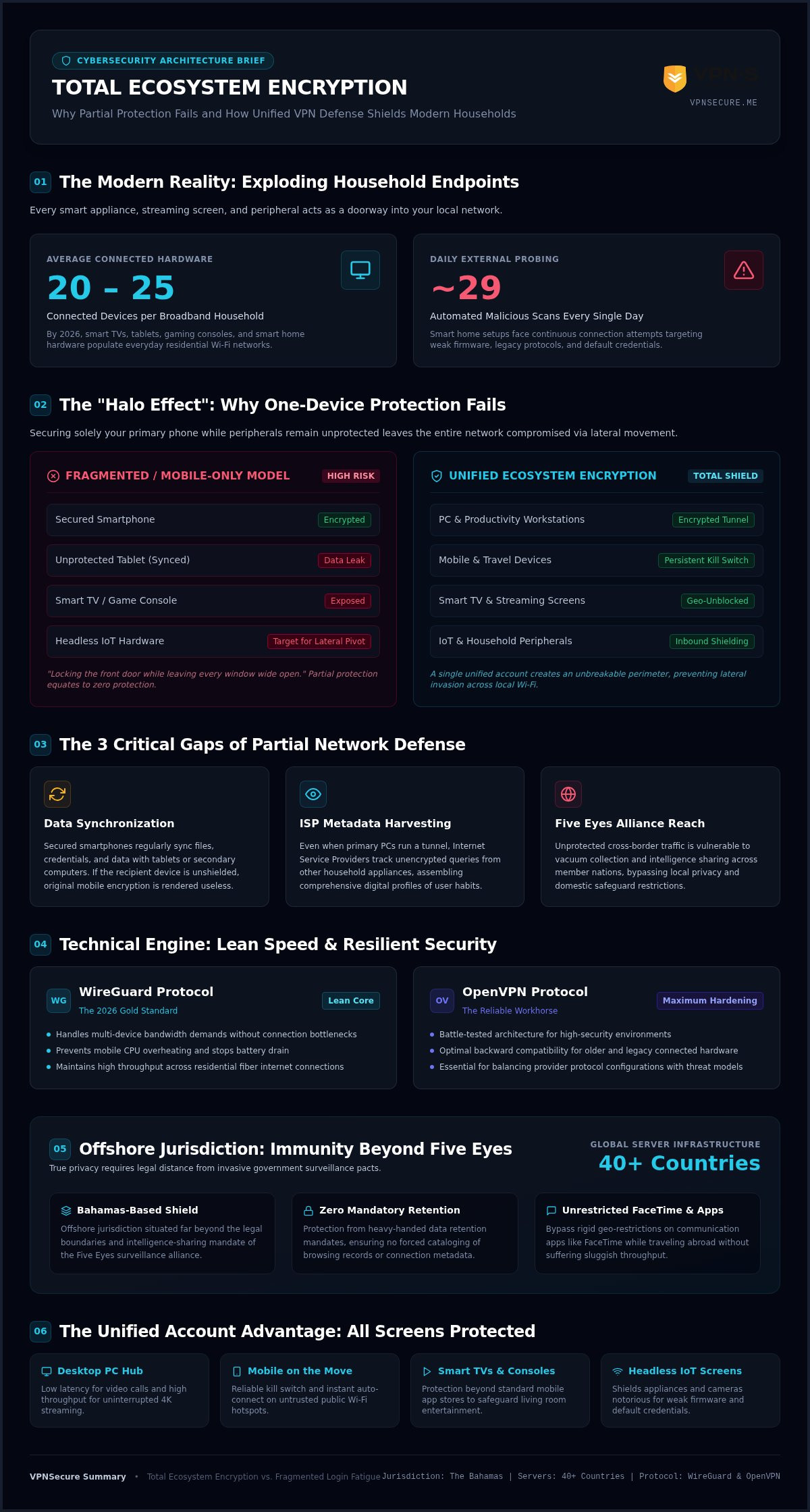
Your home is a digital target. It’s no longer just about your laptop or your primary smartphone. By 2026, the average broadband household juggles 20 to 25 connected devices. Protecting your phone while leaving your tablet or smart TV exposed is like locking the front door but leaving every window wide open. This “halo effect” of security is a dangerous illusion; partial protection is actually no protection at all. If one device is vulnerable, your entire ecosystem is at risk.
The shift from mobile-only security to total ecosystem encryption is now a necessity. You can’t afford to leave gaps in your defense. A single unprotected endpoint provides a gateway for lateral movement across your local network, making it easy for external actors to intercept data you thought was private. Reclaiming your digital autonomy requires a VPN for all devices that treats every screen with the same level of urgency.
The Risks of Unprotected Endpoints
Hackers don’t always go for the encrypted vault. They go for the “dumb” peripherals. Smart TVs, security cameras, and even connected appliances are notorious for weak firmware and default credentials. Research indicates that smart home networks now face roughly 29 automated malicious scans or connection attempts every single day. These devices act as perfect entry points for intruders looking to pivot toward your more sensitive hardware.
- Data Synchronization: Your secured phone often syncs sensitive files with an unsecured tablet. If the tablet is compromised, the encryption on your phone becomes irrelevant.
- ISP Visibility: Even if you secure your laptop, your ISP still harvests metadata and browsing habits from every other device on your Wi-Fi.
- Surveillance Reach: Unprotected traffic is easily vacuumed up by the Five Eyes intelligence alliance, where data is shared across borders regardless of your local privacy laws.
Defining a Unified Security Strategy
You need to move beyond the outdated “one app” mindset. A robust security strategy requires a VPN for all devices that enforces a consistent encryption standard across all your hardware. Whether it’s a desktop PC, a gaming console, or a smart fridge, the tunnel must remain unbreakable. This consistency prevents the accidental leaks that occur when you switch between protected and unprotected screens.
This need for unity extends to your life on the move. A secure vpn for travel must be able to shield your mobile, laptop, and tablet simultaneously. In 2026, fragmented security is a liability you can’t afford. Total ecosystem encryption is the only way to ensure that your private life stays exactly that: private.
Cross-Platform Compatibility: Defining a True VPN for All Devices
Your hardware shouldn’t be a cage. A true VPN for all devices isn’t just a marketing slogan; it’s a technical promise that your privacy isn’t limited by your operating system. Many providers claim to offer “unlimited” connections, yet their infrastructure crumbles the moment you connect a fifth screen. You need a solution that balances native app ease with the flexibility of manual protocols. If you’re tired of juggling multiple logins across your home, it’s time to simplify your security setup with a unified account.
Speed is a technical choice, not just a promise. By 2026, WireGuard has become the gold standard because it’s exceptionally lean. It handles multi-device loads without overheating your mobile CPU or dragging down your fiber connection. For older hardware or high-security needs, OpenVPN remains the reliable workhorse. The Electronic Frontier Foundation’s guide to choosing a VPN suggests that assessing how a provider handles these different protocols is vital for building a realistic threat model for your household.
Desktop and Mobile: The Core Essentials
Your PC is your productivity hub, and it demands zero compromises. Optimizing a secure vpn for pc means prioritizing low latency for video calls and high throughput for 4K streaming. On the mobile side, the requirements shift toward efficiency. You need a kill switch that actually works and an auto-connect feature that kicks in the second you hit a public Wi-Fi hotspot. We’ve designed our apps to be “set and forget,” providing persistent protection without draining your battery or slowing your scroll.
Beyond the App: Smart TVs and Gaming Consoles
Not every device in your ecosystem lets you install an app with a single click. Gaming consoles and older smart TVs often lack native support, which is where Smart DNS and manual router configurations become essential. While Apple TV now supports native VPN apps on tvOS 17 and later, many other “big screen” devices still require a provider that doesn’t leave you hanging. You can bypass geo restrictions with a VPN to unblock international streaming libraries or lower your gaming ping by bypassing ISP throttling. A real VPN for all devices ensures that no screen is left behind, regardless of whether it runs on Windows, iOS, or a proprietary smart home OS.
The Jurisdiction Factor: Protecting Your Network Outside the Five Eyes
A multi-device shield is only as strong as the law that governs it. You can install a VPN for all devices across every gadget you own, but if your provider operates out of a country like the US or UK, your traffic isn’t truly yours. These nations belong to the Five Eyes intelligence-sharing alliance, a network designed to harvest and share data without your consent. This surveillance net extends to the Nine Eyes and Fourteen Eyes groups, encompassing most of Europe and North America. If a provider in these regions is subpoenaed, they can be legally forced to log your activity in total secrecy.
This risk isn’t just theoretical. While the FTC public network security guidance highlights the dangers of hackers on open Wi-Fi, it doesn’t mention that your VPN provider could be the biggest threat if they’re under government pressure. For multi-device users, this means every single one of your digital footprints, from your morning scroll to your late-night streaming, could be archived and analyzed by state actors. When your data is spread across VPN servers in 40 countries, the legal home of your VPN becomes your ultimate kill-switch for privacy.
The Legal Reach of Surveillance Alliances
In jurisdictions like the US, National Security Letters can compel a VPN to start logging specific users without a warrant. Because these orders often come with gag orders, the company can’t even tell you they’ve been compromised. They’re forced to act as a silent arm of the state while you continue to pay for “privacy.” This is why a no log vpn audit is the only way to verify that a provider isn’t just blowing smoke. Without independent proof, a “zero-logs” claim is just a pinky promise in a courtroom. Metadata harvesting is the new gold rush, and if your provider is within reach of the Five Eyes, your history is the product.
Bahamas: The Privacy Gold Standard
We chose the Bahamas for a reason. Unlike the US or the EU, Bahamian law doesn’t impose mandatory data retention on VPN providers. This creates a legal fortress around your data. When we say we don’t log your activity, we aren’t just being nice; we’re leveraging a jurisdiction that respects your autonomy. There is no legal mechanism here to force us to spy on our users for foreign governments.
Privacy-conscious users are fleeing mainland providers who are shackled by intrusive surveillance laws. They’re looking for a VPN for all devices that offers a genuine offshore shield. By operating outside the reach of the Five Eyes, we ensure that your digital ecosystem remains a private sanctuary. In 2026, your digital freedom depends entirely on where your provider calls home. Don’t settle for a provider that answers to a three-letter agency.
Setup and Sync: How to Secure Every Screen in Minutes
Securing your digital life shouldn’t take a weekend. You can deploy a VPN for all devices across your entire home in under ten minutes if you follow a methodical plan. Stop thinking about security as a chore; it’s a one-time configuration that builds a permanent wall around your data. Whether you’re at home or in a hotel room, your protection should be instantaneous and invisible. Efficiency is the key to maintaining a secure ecosystem without the technical headache.
Follow these steps to lock down your hardware:
- Step 1: Select an affordable VPN monthly plan. Avoid the long-term contract trap and choose a plan that offers immediate flexibility.
- Step 2: Download and install native apps on your primary smartphone and desktop. These apps handle the heavy lifting of auto-connecting and kill-switch management.
- Step 3: Configure your home router. This is the ultimate efficiency play for devices that don’t support native apps, such as smart appliances or older consoles.
- Step 4: Deploy a VPN with static IP for remote access on your work hardware. This ensures you can access corporate databases without getting flagged for “suspicious” IP changes.
- Step 5: Run a leak test. Visit a verification site on each device to ensure your real IP is hidden and your DNS requests aren’t leaking back to your ISP.
The Router Shortcut
If you have 20+ devices, installing apps individually is a nightmare. The solution? Secure the source. When you configure your VPN at the router level, every piece of hardware connected to your Wi-Fi is shielded automatically. This “router hack” is the smartest way to manage a VPN for all devices because the router only counts as one single connection against your plan limit. Your smart fridge, guest phones, and old gaming consoles get professional-grade encryption without you lifting a finger. It’s time to take control of your home network and stop leaving your IoT devices exposed.
Bypassing Local Restrictions
Living in or traveling to regions like the UAE creates unique challenges for digital communication. Local ISPs often throttle or block VOIP services like WhatsApp and FaceTime. To break through, you need obfuscated servers that disguise your VPN traffic as regular HTTPS browsing. This prevents deep packet inspection from identifying and dropping your connection. By using stealth protocols, you maintain crystal-clear VOIP quality across multiple devices simultaneously, ensuring your calls stay private and uninterrupted regardless of local censorship laws.
The VPN Secure Edge: Unified Protection Without Compromise
Longevity is the ultimate proof of trust. We didn’t launch yesterday to chase a trend; we’ve been fighting for digital freedom since 2012. Over the last decade, we’ve refined our infrastructure to handle the complexities of the modern home. A VPN for all devices isn’t just about providing an app; it’s about maintaining a globally distributed network of high-speed servers across 40 countries that can handle your heavy 4K streams and low-latency gaming without breaking a sweat.
Security shouldn’t be a luxury reserved for the tech elite. We’ve stripped away the corporate overhead to offer premium, offshore protection starting at just $2.99 per month. This isn’t a watered-down service. You get the same raw, high-grade encryption on every single screen in your ecosystem. If you run into a snag while configuring your router or syncing your tablet, our expert support team is available 24/7 to walk you through the process. We don’t use bot scripts; we provide real assistance for real privacy needs.
Why We Stand Apart
Most “big name” providers answer to shareholders or government agencies. We answer to you. By operating outside the reach of the Five Eyes intelligence alliance since our founding, we’ve built a sanctuary for users who value their autonomy. There’s no corporate fluff here. We don’t sell antivirus bloatware or unnecessary extras. We focus on one thing: unbreakable encryption for every device you own. If you’re looking for a long-term commitment to your privacy, check out our best annual VPN deal to secure your digital future without the long-term trap of predatory pricing.
Ready to Secure Your Ecosystem?
Your digital life is fragmented, but your security shouldn’t be. Our interface is designed to be punchy and immediate, giving you total control over your privacy with a few clicks. We’re so confident in our offshore shield that we offer a 30-day money-back guarantee. Test it on your PC, your phone, your smart TV, and your gaming console. If you don’t feel the difference in speed and security, you get your money back. There’s zero risk to you and zero excuses left for the snoops. It’s time to reclaim your network. Get VPN Secure for all your devices now and stop leaving your data to chance.
Take Back Your Digital Autonomy Today
Fragmented security is a liability you can’t afford in 2026. Whether it’s your smart home hub or your primary workstation, every endpoint needs a shield that doesn’t answer to the Five Eyes. You now have the roadmap to secure your entire ecosystem without the technical headache or the corporate bloat typical of mainstream providers. Protecting your household is no longer a complex chore; it’s a strategic necessity.
Choosing a VPN for all devices shouldn’t be a gamble with your data. You need a provider that has been in the trenches since 2012. Our Bahamas-based jurisdiction ensures that your private life stays private, protected by a strict no-log policy that prioritizes your autonomy over government subpoenas. We’ve built the infrastructure; you just need to flip the switch to lock down your network.
Stop leaving windows open in your digital home. It is time to deploy a unified defense that respects your right to privacy and your need for speed. Secure all your devices with VPN Secure today and experience risk-free privacy with our 30-day money-back guarantee. Your network belongs to you again.
Frequently Asked Questions
How many devices can I connect to VPN Secure at once?
You can connect all your personal hardware under a single account without the headache of managing multiple subscriptions. We prioritize a seamless experience across your entire digital ecosystem, allowing you to shield your phones, tablets, and laptops simultaneously. This eliminates the need for constant logging in and out. By securing every screen, you ensure that no device becomes a weak link in your home network’s defense against automated malicious scans.
Will a VPN for all devices slow down my internet speed?
Speed loss is minimal when using a high-performance VPN for all devices powered by the WireGuard protocol. While encryption always adds some overhead, our servers in 40+ countries are optimized for zero-latency browsing and 4K streaming. You won’t notice a lag during your daily tasks. We provide unlimited bandwidth to ensure that multiple simultaneous connections don’t throttle your household’s overall internet performance or interrupt your important video calls.
Can I use one VPN subscription for both my iPhone and Windows PC?
Yes, a single subscription covers all major operating systems under one login. You can run our native apps on your iPhone and Windows PC at the same time without any conflict. We’ve designed our software to be cross-platform, so your security settings and privacy protections remain consistent whether you’re working at your desk or scrolling on the move. One account is all you need for total ecosystem encryption.
Do I need a separate VPN for my Smart TV or gaming console?
You don’t need a separate subscription for these devices. While some gaming consoles and older TVs don’t support native apps, you can protect them by configuring your router or using our Smart DNS feature. This allows you to unblock international streaming libraries and reduce gaming ping under your existing plan. Every device in your home can be shielded by the same professional grade encryption with no extra fees.
Is it legal to use a VPN on all my devices in the UAE or Saudi Arabia?
Using a VPN is legal in the UAE and Saudi Arabia for privacy and security purposes. These regions often restrict VOIP services like FaceTime and WhatsApp, and our service is specifically optimized to bypass these blocks. As long as you aren’t using the connection for illegal activities, you can safely use our offshore shield to maintain your digital freedom and communicate with your family without interference or throttling.
What happens if I forget to turn on the VPN on one of my devices?
If you forget to enable your protection, your traffic is exposed to your ISP and potential snoops. To prevent this, our apps include an auto-connect feature and a kill switch. The kill switch instantly blocks your internet access if the VPN connection drops, ensuring that no unencrypted data ever leaves your device. We recommend setting the app to launch on startup for 24/7 peace of mind across your network.
How do I set up a VPN on a device that doesn’t have a native app?
For devices like older smart TVs or IoT hardware, the most efficient method is a router-level configuration. By setting up the VPN for all devices at your router, every piece of hardware on your Wi-Fi is automatically encrypted. Alternatively, you can use manual protocols like OpenVPN or WireGuard for specific hardware. This ensures that even “headless” devices without a screen stay protected from external threats and metadata harvesting.
Why is jurisdiction important when choosing a multi-device VPN?
Jurisdiction is your ultimate safety net. If a provider is based in a Five Eyes country, they can be legally compelled to log your data in secret. Because we are based in the Bahamas, we operate outside these intrusive surveillance alliances. Bahamian law doesn’t require mandatory data retention, meaning our no-log policy is backed by a legal fortress that protects your autonomy from the reach of foreign government intelligence agencies.