




What if the VPN you trust is less exposed to government pressure than you think, but its ownership still leaves you asking who’s in control? If you’re searching for an ExpressVPN alternative outside five eyes, start with the facts: ExpressVPN is based in the British Virgin Islands, outside the Five, Nine, and Fourteen Eyes alliances. But jurisdiction is only one part of a privacy assessment. Corporate ownership, data-handling practices, and evidence behind a no-log policy matter too.
Your concern is reasonable. A VPN can encrypt your connection, but it can’t settle questions about the company behind the service or the laws where it operates. VPN Secure is based in the Bahamas, also outside those intelligence-sharing groupings, and says its no-log policy is verified by its architecture.
This guide compares the factors to check when choosing an alternative: jurisdiction, ownership, no-log evidence, connection performance, and access to global content. You’ll also get a clearer picture of how Five Eyes differs from Nine and Fourteen Eyes, so you can make a privacy decision based on more than a marketing claim.
Key Takeaways
- Assess a VPN’s jurisdiction and corporate ownership separately. A location outside intelligence-sharing alliances doesn’t answer every question about who controls the company.
- Understand what Five, Nine, and Fourteen Eyes mean, and why jurisdiction alone can’t guarantee privacy or prevent every data request.
- Look beyond a no-logs promise. Check what data the provider collects and how it supports its policy, including whether its architecture helps explain how records are handled.
- Consider the Bahamas’ offshore jurisdiction alongside the limits of its privacy-law enforcement.
- Use this comparison to decide whether an ExpressVPN alternative outside five eyes fits your needs, including server locations and access to services while traveling.
Why Users Seek an ExpressVPN Alternative Outside Five Eyes in 2026
A VPN can provide fast connections and still leave questions about who owns the service and what information it retains. That’s why some privacy-conscious users look beyond ExpressVPN’s “gold standard” reputation. But there’s an important distinction: ExpressVPN is based in the British Virgin Islands, outside the Five Eyes alliance. For people considering an ExpressVPN alternative outside five eyes, the comparison is also about corporate control and evidence behind privacy promises, not just a map.
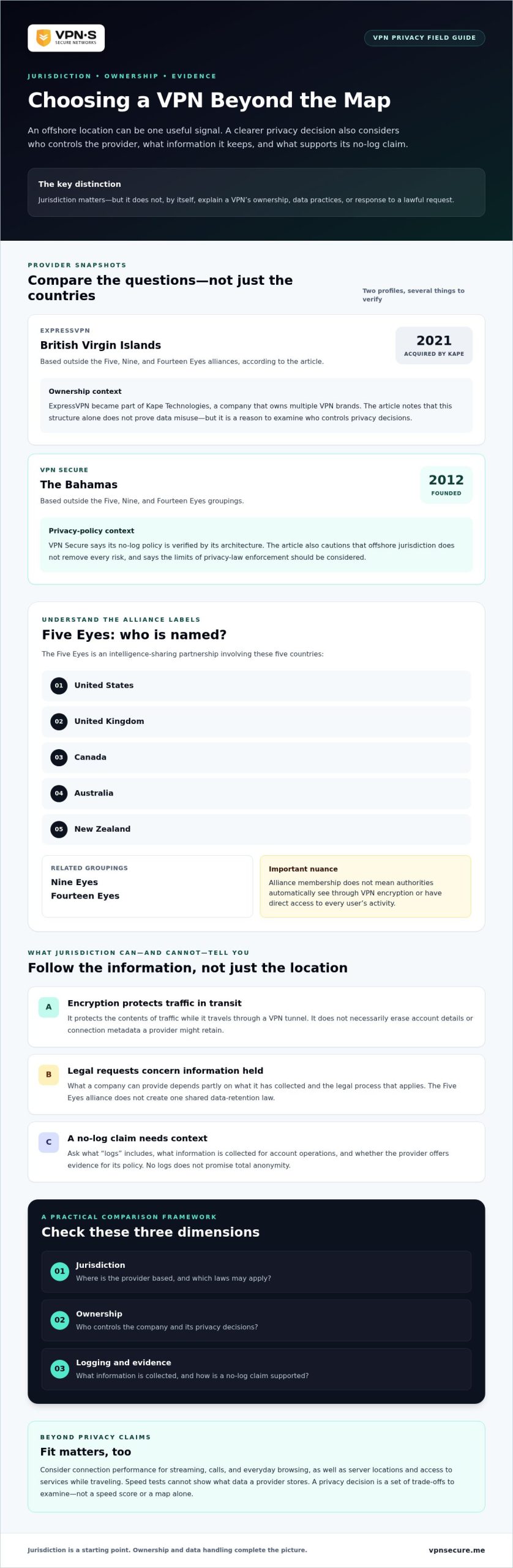
Five Eyes refers to intelligence cooperation between the United States, United Kingdom, Canada, Australia, and New Zealand. The Five Eyes intelligence alliance has a long history, but membership doesn’t mean authorities automatically see through VPN encryption or have direct access to every user’s activity. The practical concern is more specific: a provider may be subject to legal demands for information it holds, and laws can limit what a company is allowed to disclose. If a provider keeps no activity records, there may be less stored information to hand over, though that isn’t a promise of total anonymity.
Corporate Ownership and Control
Ownership is one part of the trust equation. ExpressVPN was acquired by Kape Technologies in 2021, placing it within a company that owns multiple VPN brands. Consolidation can bring shared corporate oversight and resources, but it also means a provider’s decisions sit within a larger organization. That structure alone doesn’t prove misuse of data. It does give privacy-minded customers a reason to check who controls the company, how its logging policy works, and what evidence supports it.
VPN Secure offers a different profile: a Bahamas-based provider founded in 2012, with a no-log policy it says is verified by its architecture. Offshore jurisdiction doesn’t remove every risk, but it gives you concrete questions to investigate rather than asking you to rely on brand recognition alone.
Balancing Performance and Privacy
Speed matters for streaming, calls, and everyday browsing. But a speed test can’t tell you what data a provider stores or how it might respond to a lawful request. A company’s location doesn’t settle those questions either. Review its corporate structure, privacy policy, and available evidence about logging.
That’s the shift behind a “privacy first” approach. Look past polished apps and familiar names, and compare providers on the details that affect your needs:
- Jurisdiction: Where is the provider based, and which laws may apply?
- Ownership: Who controls the company and its privacy decisions?
- Logging: What information is collected, and how does the provider support a no-log claim?
Use those checks to decide whether another provider better matches your priorities. Privacy isn’t a speed score. It’s a set of choices you can examine.
Decoding the Five Eyes Threat: Why Jurisdiction Matters
The Five Eyes alliance is an intelligence-sharing partnership between the United States, United Kingdom, Canada, Australia, and New Zealand. It creates no single shared data-retention law, but member-state laws and cooperation can affect how stored information is requested and shared. That distinction matters. An alliance doesn’t automatically give authorities access to every VPN connection, and a provider’s location alone can’t tell you what data it keeps or how it responds to legal demands.
Encryption protects the contents of traffic while it travels through a VPN tunnel. It doesn’t necessarily erase account details or connection metadata a provider might retain. If authorities seek information, what the company can provide depends partly on what it has collected and the legal process that applies.
How Intelligence-Sharing Can Affect Legal Requests
Cross-border intelligence cooperation can make jurisdiction relevant even when a request begins elsewhere. But claims that local privacy protections are simply “bypassed” oversimplify a complex legal process. In the United States, for example, National Security Letters can be used to request certain records from businesses and may come with limits on disclosure. Such letters are not a universal Five Eyes power, nor does every request automatically involve a VPN provider.
A no-log policy is meaningful only in context. Ask what “logs” covers, what information is collected for account operations, and whether the provider offers evidence for its claims. Laws and procedures differ by country, so don’t assume every court treats a no-log claim in the same way.
What Nine Eyes and Fourteen Eyes Mean
Nine Eyes and Fourteen Eyes are commonly used labels for broader intelligence-sharing arrangements involving additional partners, including European countries. These groupings don’t create one uniform surveillance law or prove that every member collects the same data. They’re useful prompts to check a provider’s home jurisdiction, corporate ownership, and the records its systems are designed to retain. For a fuller overview, read this guide to VPN jurisdiction outside Five Eyes.
Choosing an ExpressVPN alternative outside five eyes can reduce exposure to the laws of alliance member states, but offshore status isn’t a magic shield. VPN Secure is based in the Bahamas, outside the Five, Nine, and Fourteen Eyes groupings, and says its no-log policy is verified by its architecture. The Bahamas’ privacy-law enforcement has limitations, so weigh jurisdiction alongside technical practices and evidence.
Want to examine the provider’s approach directly? Review the information about VPN Secure’s privacy-focused VPN service, then compare its claims with the questions above.
VPN Secure vs. ExpressVPN: Comparing Privacy-First Architectures
Start with a correction that matters: ExpressVPN is based in the British Virgin Islands, not a Five Eyes member country. Its jurisdiction is outside the Five, Nine, and Fourteen Eyes alliances. The comparison with VPN Secure is therefore not “alliance country versus offshore haven.” It’s a closer look at ownership, logging evidence, and the features each service emphasizes.
ExpressVPN was acquired by Kape Technologies in 2021, and Kape owns multiple VPN brands. That corporate connection may influence how some customers assess independence, but it doesn’t prove that the brands share servers or user data. VPN Secure is based in the Bahamas and presents a different ownership profile. It says its no-log policy is verified by its architecture, a more specific assurance than a policy statement alone. When evaluating either provider, look for clear explanations of what data is collected and how the no-log claim is supported.
For someone choosing an ExpressVPN alternative outside five eyes, features matter too. VPN Secure offers dedicated IPs and says its service can unblock VOIP apps, while ExpressVPN is known as a broad, mass-market VPN option that includes streaming use cases. Those are different priorities, not a guarantee that either provider will work with every app, service, or network.
Server Coverage and Dedicated IPs
VPN Secure reports servers in more than 40 countries. A network’s value isn’t measured by country count alone. Consider whether locations suit your needs, how the service performs from your own connection, and whether the apps you use work as expected. Its guide to VPN servers in 40 countries explores how to think about coverage. A dedicated IP can provide a consistent address for services that expect a familiar connection, creating a more predictable “private lane.” It doesn’t make your activity anonymous, so weigh the privacy and access trade-offs.
Accessing Geo-Restricted Services and VOIP
A VPN can help you reach content that varies by location, though access depends on the destination service and its policies. Learn more about using a VPN to bypass geo restrictions. VPN Secure also says its service can unblock VOIP apps, which may be useful to travelers or residents facing limits on calling apps, including in places such as the UAE. Availability can change, so check the specific app and local rules rather than assuming access.
Deep packet inspection can identify patterns in network traffic, but no supplied evidence establishes that either provider is “undetectable” or reliably evades it. Treat claims like that with skepticism. If offshore jurisdiction, architecture-backed no-logs, dedicated IPs, or VOIP access match your priorities, review VPN Secure’s VPN service details and compare them against your own use case.
The Bahamas Advantage: Offshore Jurisdiction and Privacy
Offshore jurisdiction isn’t a magic cloak. It’s one part of a provider’s privacy profile, alongside ownership, data practices, and responses to legal demands. The Bahamas is outside the Five, Nine, and Fourteen Eyes groupings, which may appeal if you want your VPN provider based beyond those intelligence-sharing networks. But being outside an alliance doesn’t mean a company is beyond local law or immune to foreign requests.
For readers weighing an ExpressVPN alternative outside five eyes, jurisdiction is a useful starting point, not a verdict. ExpressVPN is based in the British Virgin Islands, also outside those alliances. The meaningful comparison is how each provider’s location, corporate structure, and technical design fit together.
Understanding the Bahamian Privacy-Law Framework
The Bahamas’ operative data protection framework is the Data Protection (Privacy of Personal Information) Act, 2003. A newer Data Protection Act was passed in December 2025, but the research available for this article says it was not yet in force in early 2026. The existing law and regulator provide a legal framework, though enforcement is considered weak. Treat “privacy haven” as a jurisdictional factor to assess, not a guarantee of protection.
Nor should “offshore” be reduced to tax arrangements. For VPN users, the relevant questions are where a company is legally based and what information its systems retain. Bahamian and BVI jurisdiction both sit outside the intelligence alliances discussed earlier, so neither location alone proves one provider is safer. Review the laws, ownership, and logging evidence together.
Assessing a No-Log Claim
A lack of mandatory data-retention rules for VPN providers can give a company more room to design systems that avoid keeping activity records. It doesn’t prevent subpoenas or mean requests cannot be made. The practical question is what information exists to disclose. VPN Secure says its no-log policy is verified by its architecture, a claim readers can weigh alongside its published privacy practices.
Founded in 2012, VPN Secure has an operating history, but longevity alone can’t verify privacy. Look for consistency: does the provider’s stated policy match how its systems are designed, and is its jurisdiction clearly disclosed? Those checks offer firmer ground than a broad promise of secrecy.
For a closer look at a Bahamas-based VPN provider, review VPN Secure’s service and privacy details. Consider the jurisdiction alongside the provider’s logging approach, ownership, and the protections your own situation requires.
Switching to VPN Secure: What to Check Before You Start
Switching VPNs works best when you check your needs before changing providers. Review your current service’s jurisdiction, ownership, logging policy, and the evidence behind its privacy claims. Then list the devices and apps you want protected. If you’re considering an ExpressVPN alternative outside five eyes, verify that the provider’s location and stated data practices fit your priorities rather than relying on a “private” label alone.
VPN Secure is based in the Bahamas and says its no-log policy is verified by its architecture. No VPN makes you invisible, and an app can’t protect traffic that doesn’t pass through it. Treat setup as one part of a broader privacy routine, not a substitute for careful account security or safe browsing habits.
Covering the Devices You Use
Install and sign in to the VPN app on each device you use, such as a PC, Mac, and phone. VPN Secure’s guide to VPN protection across devices can help you plan coverage. Check the app’s connection status before using sensitive services, and review account terms to understand how multiple devices and connections are handled.
Protecting each device matters because a laptop connection won’t automatically cover your phone on café Wi-Fi. A VPN also won’t protect every device on your home network unless that traffic is routed through a supported setup. Don’t assume network-wide coverage. Confirm which devices and apps are actually connected.
Building a Practical Long-Term Routine
Incognito mode mainly limits what your browser saves locally. It doesn’t encrypt your connection or replace a VPN. Consider whether a monthly or annual subscription fits your plans, and compare the terms before choosing. This guide to annual VPN subscriptions can help you think through the commitment without treating a longer plan as automatically right for everyone.
For speed, start with a nearby server, then test browsing, calls, or streaming under similar network conditions. If performance dips, try another suitable location and check whether the issue follows the VPN connection. Keep privacy expectations grounded: a VPN encrypts traffic between your device and the VPN server, but doesn’t hide your identity from every website or prevent all tracking.
VPN Secure offers a 30-day money-back guarantee, giving you a defined period to assess the service against your own needs. Read the terms and test the devices and activities that matter to you. Review VPN Secure’s service details and decide whether its offshore approach is the right fit.
Choose Your Next Privacy Layer With Confidence
Choosing an ExpressVPN alternative outside five eyes means looking beyond speed and familiar branding. Check where the provider is based, who owns it, and whether its no-log claims are supported by evidence. Jurisdiction matters, but it works alongside sound technical practices, not in place of them.
VPN Secure offers a different option: a Bahamas-based provider founded in 2012, with a no-log policy it says is verified by its architecture. Its offshore location places it outside the Five Eyes alliance, while the 30-day money-back guarantee gives you a defined period to assess whether the service fits your needs. No VPN can promise total invisibility, so make your choice with clear expectations.
Your privacy decisions belong to you. Review the details, test the service against your everyday needs, and decide whether an offshore provider is the right fit. Explore VPN Secure’s service and decide whether it matches your privacy priorities.
Frequently Asked Questions
Is ExpressVPN part of the Five Eyes intelligence alliance?
No. ExpressVPN is based in the British Virgin Islands, which is outside the Five Eyes alliance. The alliance’s members are the United States, United Kingdom, Canada, Australia, and New Zealand. A provider’s location is only one factor in assessing privacy. Also consider who owns the company, what information it collects, and whether its no-logs claims are supported by evidence.
Why should I care about a VPN’s jurisdiction?
Jurisdiction can affect which laws apply to a VPN company and how legal requests for information are handled. It doesn’t automatically reveal your traffic or mean a provider must retain activity records. If you’re choosing an ExpressVPN alternative outside five eyes, compare the provider’s location with its ownership, data practices, and evidence for its privacy claims. No single factor guarantees privacy.
Are the Bahamas a safe place for a VPN to be based?
The Bahamas is outside the Five, Nine, and Fourteen Eyes groupings, which may appeal to privacy-conscious users. It isn’t a legal shield: local law still applies, and foreign data requests may raise complex legal questions. The Bahamas has a data protection framework, but enforcement is considered weak. Assess a provider’s jurisdiction alongside its ownership, logging practices, and technical evidence.
Can a Five Eyes country force a VPN to start logging?
It depends on the jurisdiction, the company’s legal obligations, and the specific order or process involved. Don’t assume every Five Eyes government can compel any VPN worldwide to begin logging. A provider may also have limited information to produce if it doesn’t collect or retain activity records. Check what its no-logs policy covers and what evidence supports the claim.
Is VPN Secure as fast as ExpressVPN?
There isn’t enough comparative speed-test evidence here to say that VPN Secure is as fast as ExpressVPN. Results can vary with your internet connection, device, server location, and the service you’re using. VPN Secure has servers in more than 40 countries. To compare fairly, test nearby servers under similar conditions and check the activities that matter to you, such as calls or streaming.
What happens if a VPN is based in a Five Eyes country?
Being based in a Five Eyes country doesn’t automatically mean authorities can see encrypted VPN traffic or access every user’s activity. The provider may be subject to local legal processes, and any information it holds could be relevant to a request. The practical question is what data the company collects and retains. Review its policy, ownership, and supporting evidence rather than judging location alone.
Does VPN Secure work for unblocking Netflix and VOIP?
VPN Secure says its service can unblock streaming platforms and VOIP apps. That doesn’t guarantee access to Netflix or any particular app in every location. Streaming platforms can change how they detect VPN connections, while access to calling apps may vary by network and region. Check the service’s current information and applicable local rules before relying on access.
How do I know if my VPN is truly no-logs?
Start by reading the policy to see exactly what “no logs” means. Distinguish browsing activity from account, payment, or diagnostic information, and look for independent evidence or a clear technical explanation of how the service avoids storing activity records. VPN Secure says its no-log policy is verified by its architecture. Treat any claim as something to evaluate, not proof of total anonymity.