


In short
VPNs with free trials can help you test speed, apps, and access before committing, but not every offer described as a “trial” is actually free. Check the payment requirement, renewal price, cancellation route, feature limits, refund terms, and privacy documentation before entering any billing details.
Key takeaways
- A VPN trial may be genuinely free, app-store based, discounted for the first month, or refundable after an upfront payment, and those offers work differently.
- The U.S. Federal Trade Commission advises consumers to check a trial’s length, cancellation terms, and automatic-renewal details before signing up.
- A payment card requirement does not automatically make an offer unsafe, but it makes the cancellation deadline and renewal price essential checks.
- Test the VPN on the devices, networks, and services that matter to you before the trial ends, not only on a home connection.
- A no-logging statement is a provider claim that should be read alongside the privacy policy, not treated as proof that a VPN makes every activity anonymous.
Table of contents
- How do VPN free trials actually work?
- What should you check before starting a trial?
- Does a short trial prove a VPN is private and useful?
- What is the difference between a free VPN, a free trial, and a money-back guarantee?
- How should you test a VPN before the trial ends?
- Frequently asked questions
- What should you do next?
A free VPN trial is only valuable if it lets you answer a real question: does this service work reliably for your devices, connection, and privacy expectations? The best approach is to treat the offer as a short evaluation period, not as a reason to rush through checkout.
How do VPN free trials actually work?
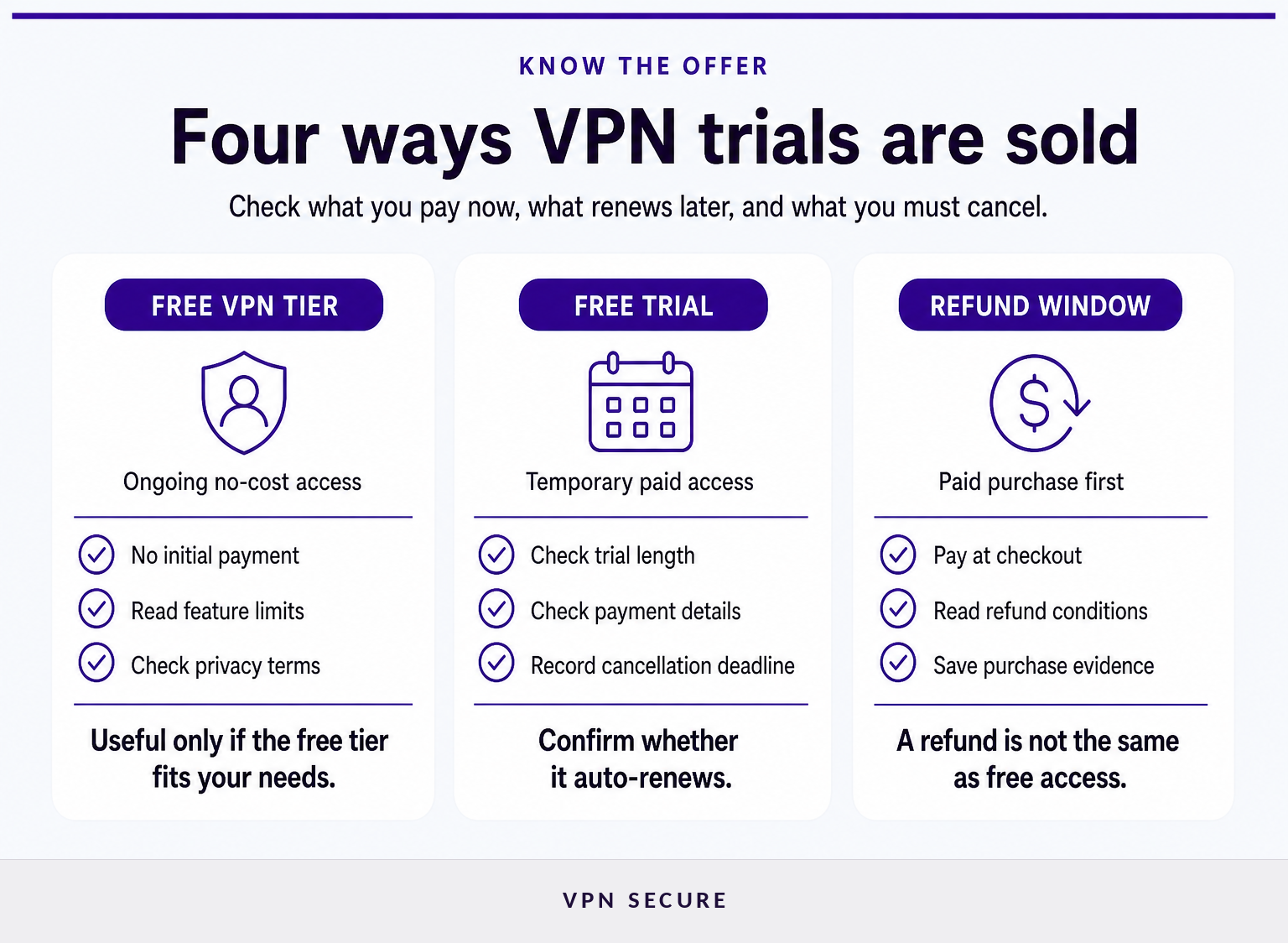
VPN free trials usually fall into four groups: a no-charge trial, an app-store trial that renews unless canceled, an introductory-price subscription, or a paid plan with a refund window. The important question is not the label but what happens to your payment method and access when the evaluation period ends.
A provider may call an offer a free trial even though you must provide payment details and cancel before renewal. That can still be a reasonable arrangement, but it is different from an offer that requires no payment method at all. The Federal Trade Commission recommends checking the trial length, the cancellation method, and when automatic billing begins before you sign up for any subscription trial. Read the FTC’s free-trial guidance.
Another common offer is a low-cost introductory month. That is a paid promotional period, not a free trial. For example, as of October 17, 2026, VPN Secure’s monthly plan advertises a 30-day trial for $1, followed by recurring billing at the stated monthly rate. The same VPN pricing page says its plans are covered by a 30-day money-back guarantee. Those are two separate protections: a discounted first month and a refund policy.
A free-trial label is useful only when you know whether it means no upfront cost, a promotional price, or a refundable purchase.
What should you check before starting a trial?
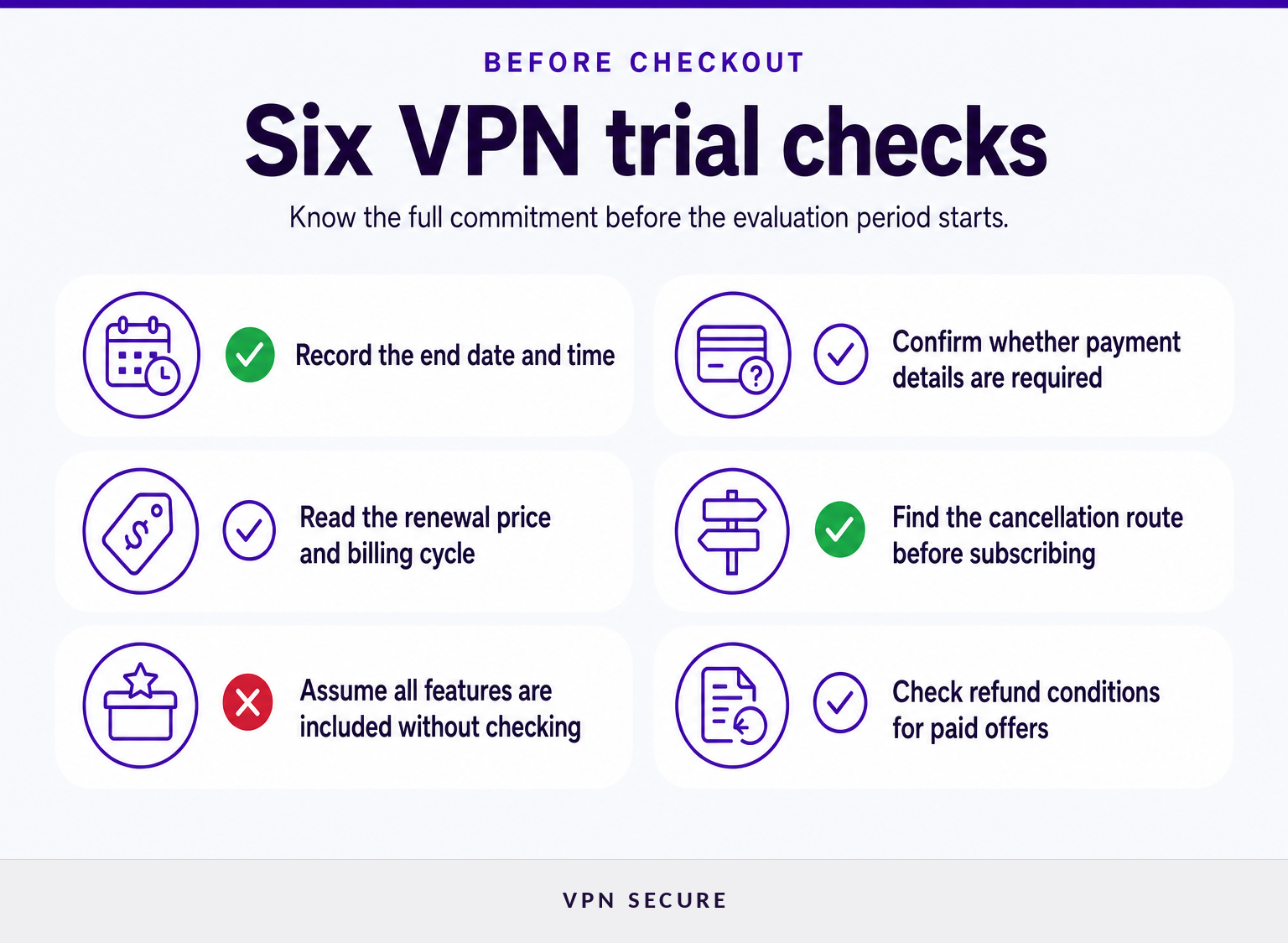
Check the full checkout terms before creating an account, especially the payment requirement, renewal price, and cancellation instructions. Then confirm that the trial includes the platforms and features you actually need to test.
Use this checklist before selecting any VPN trial:
- Trial length: Is the offer measured in hours, days, or a month? A short mobile trial may be enough to test the app, but not enough to evaluate a service across work, travel, and home networks.
- Payment requirement: Does checkout ask for a card, a payment-wallet authorization, or no payment method? If a payment method is required, note the exact renewal date before completing the purchase.
- Renewal price: Check what you will pay after the trial, how often you will be billed, and whether the first price differs from later renewals.
- Cancellation route: Identify whether cancellation happens in the provider dashboard, through an app store, through the payment provider, or by contacting support. Save the instructions before you need them.
- Feature access: Check whether trial users can use all server locations, all protocols, all device slots, and the features relevant to your needs.
- Device limits: A trial that works only on a phone does not prove that the desktop app, browser extension, router configuration, or other supported platform will suit you.
- Refund exclusions: If the offer is a money-back guarantee rather than a free trial, read the conditions that apply to refunds, including any time limit and purchase-channel restrictions.
VPN Secure states that one subscription can connect up to 10 devices and supports Windows, macOS, iOS, Android, Linux, routers, Firefox, and Chrome. Test only the platforms you plan to use, then compare the result with the service’s published VPN pricing and plan details.
The right trial is the one whose payment, renewal, and cancellation terms you can explain in one sentence before you subscribe.
Does a short trial prove a VPN is private and useful?
No. A short trial can show whether a VPN app connects reliably and meets your practical needs, but it cannot independently prove every privacy or security claim. Read the provider’s policies, test basic behavior, and remember that a VPN reduces some network exposure without making a person invisible online.
Start with the provider’s stated logging policy. VPN Secure says it does not log IP addresses, connection timestamps, disconnection timestamps, bandwidth usage, DNS requests, or browsing activity. Those statements should be read in full on its no-logging policy page, then compared with the more detailed information in its privacy policy, which says account, payment, and support-related information is collected for operating the service.
That distinction matters. A service can state that it does not log browsing activity while still needing enough account and billing information to provide a subscription. Privacy policies explain what a provider says it collects, why it collects it, and how long it may retain that information.
During a trial, test whether the VPN connects on your normal home network and on an untrusted public Wi-Fi network. Check that websites load, video calls remain stable if you rely on them, and the app reconnects predictably after sleep mode or a network change. If a feature such as browser-only proxy access matters, test that specific feature rather than assuming it behaves like a full-device VPN tunnel.
A trial can validate day-to-day usability; privacy claims need to be read as documented provider commitments with clear limits.
What is the difference between a free VPN, a free trial, and a money-back guarantee?
A free VPN is a service tier that can be used without paying, while a free trial is temporary access to a paid service. A money-back guarantee is a paid purchase that may be refundable if you meet the provider’s stated conditions.
These terms are easy to confuse because all three let a person try a VPN with limited financial risk. They do not give you the same rights or access.
| Offer type | What you pay at the start | What to verify | What happens next |
|---|---|---|---|
| Free VPN tier | Usually nothing | Data, speeds, server choices, device limits, and privacy terms | The free tier continues under its rules |
| Genuine free trial | Nothing, or payment details held for later renewal | Trial duration, cancellation deadline, and whether the card is charged automatically | Access ends or converts to a paid plan |
| Introductory-price trial | A reduced amount | The promotional price, later price, renewal schedule, and refund terms | The service renews at the disclosed price unless canceled |
| Money-back guarantee | The full purchase amount | Refund deadline, eligibility, and any exclusions | The purchase remains active unless canceled or refunded |
A permanent free tier may suit light or occasional use, but it is not evidence that the paid service will meet your needs. A trial or refund period is more useful when it gives access to the precise apps, locations, protocols, device count, and support experience you expect to use after subscribing.
The safest comparison is not “free versus paid,” but “what can I test, what can I be charged, and what must I do before the deadline?”
How should you test a VPN before the trial ends?
Test the VPN against a short list of tasks that reflect your routine, then cancel or continue before the deadline you recorded at signup. Do not leave the decision until the last hour, particularly if cancellation requires an app store, payment service, or support request.
A practical test plan looks like this:
- Install the apps you will actually use. Test your primary computer and phone first. If you use a browser extension or a router, make time to test that setup too.
- Connect from more than one network. Try your home connection, mobile data, and a public or guest network where it is safe to do so. A VPN that works in one place may behave differently elsewhere.
- Use your normal services. Browse, attend a call, download a legitimate file, or perform another routine activity that matters to you. Do not judge the service only by whether the connection button changes color.
- Check the privacy settings and account area. Read the logging policy, confirm the account email and payment method, and identify the renewal and cancellation controls.
- Document the result. Save the confirmation email, note the renewal date, and keep any cancellation confirmation. If you need help, review the provider’s published cancellation and support information before the trial closes.
A successful VPN trial ends with a conscious choice to continue or cancel, not an unexpected renewal.
Frequently asked questions
Which paid VPNs offer free trials?
Paid VPN providers may offer a short free trial, an app-store trial, a low-cost introductory period, or a money-back guarantee. Terms change frequently, so check each provider’s official pricing and checkout pages for the current duration, payment requirement, feature access, renewal price, and cancellation route before treating an offer as free.
Can the FBI track a VPN?
A VPN can encrypt traffic between a device and the VPN service and can mask a user’s public IP address from websites, but it does not make a person untraceable. Account records, device evidence, websites, payment trails, and lawful investigative requests may still provide evidence. The U.S. Department of Justice explains lawful access processes.
Are there such things as free VPNs?
Yes, some providers offer permanent free VPN tiers, while others offer limited-time trials of paid plans. Before using either, check the provider’s privacy policy, server and device limits, data or speed restrictions, renewal terms, and whether the service includes the features you need. “Free” describes price, not necessarily capability or privacy.
What are some good free VPN trials available on Reddit?
Discussion threads can reveal the questions shoppers ask, such as whether a trial needs a card or auto-renews, but they are not a reliable source of current terms. Use them to identify concerns, then verify every trial detail on the VPN provider’s official pricing, refund, privacy, and cancellation pages before signing up.
What should you do next?
Pick one or two VPN offers, write down the renewal deadline before checkout, and test them against your actual devices and networks. If a provider cannot clearly show its trial terms, privacy documentation, and cancellation route, choose a different option.
For a transparent paid evaluation option, review VPN Secure’s current plans and 30-day trial terms before subscribing.