


In short
A VPN for India should match the job you actually need it to do: protect traffic on an unfamiliar network, connect through an Indian IP address, or use a reliable nearby location. Check the provider’s privacy terms, current server list, supported devices, connection protocols, and the legal limits that still apply to your activity.
Key takeaways
- India’s 2022 CERT-In Directions require covered consumer VPN providers to retain specified subscriber information for five years after service cancellation or withdrawal.
- An Indian VPN server can change the IP address a website sees, but it cannot guarantee access to a specific website, app, streaming catalog, or account.
- A nearby server may be the better choice when privacy and connection stability matter more than appearing to connect from India.
- A trustworthy VPN should publish its privacy terms, current locations, supported devices, and practical support options before asking for payment.
- Free VPN apps deserve extra scrutiny because their limits, data practices, and app-source safety can vary widely.
Table of contents
- Which VPN is still working in India?
- Are VPNs legal to use in India?
- Do you need an Indian server or a nearby server?
- What should you check before paying for a VPN?
- How do you connect to a VPN in India?
- How do free VPNs compare with paid VPNs?
- Frequently asked questions
- What is the sensible next step?
Which VPN is still working in India?
A VPN that works in India is one that can establish a stable connection on your devices, offers locations relevant to your task, and is clear about how it handles account and activity data. No provider can honestly promise that every website, calling service, game, or streaming platform will accept every VPN connection indefinitely.
Start with the purpose. If the goal is safer browsing on hotel, airport, café, or shared Wi-Fi, the useful feature is a full-device encrypted connection. If the goal is to appear online from India while traveling, check the live location list for an Indian endpoint. If the goal is reliable general browsing, compare nearby locations as well, then test the service you need after connecting.
| Check before subscribing | What to look for | Why it matters |
|---|---|---|
| Privacy policy | Clear wording about activity logs and account data | A VPN changes who carries your traffic, so the provider’s terms matter. |
| Current locations | An Indian endpoint and practical nearby alternatives | Server lists change, and the closest useful route depends on your task. |
| Device support | Apps or setup options for every device you use | A phone-only plan is a poor fit if work also happens on a laptop. |
| Protocols | Modern options such as WireGuard or OpenVPN | Protocol choice can affect compatibility and troubleshooting options. |
| Support | Setup documentation and a real route to help | Connection issues are normal on changing networks. |
| Service limits | No guarantees of access to third-party sites | A new IP address cannot override a platform’s rules or detection systems. |
A VPN encrypts the connection between your device and the VPN server, but it does not make every online activity anonymous, lawful, or accepted by third-party services. For the basic mechanics, see how a VPN protects traffic.
The best VPN choice starts with the job, not a generic claim that one service works everywhere.
Are VPNs legal to use in India?
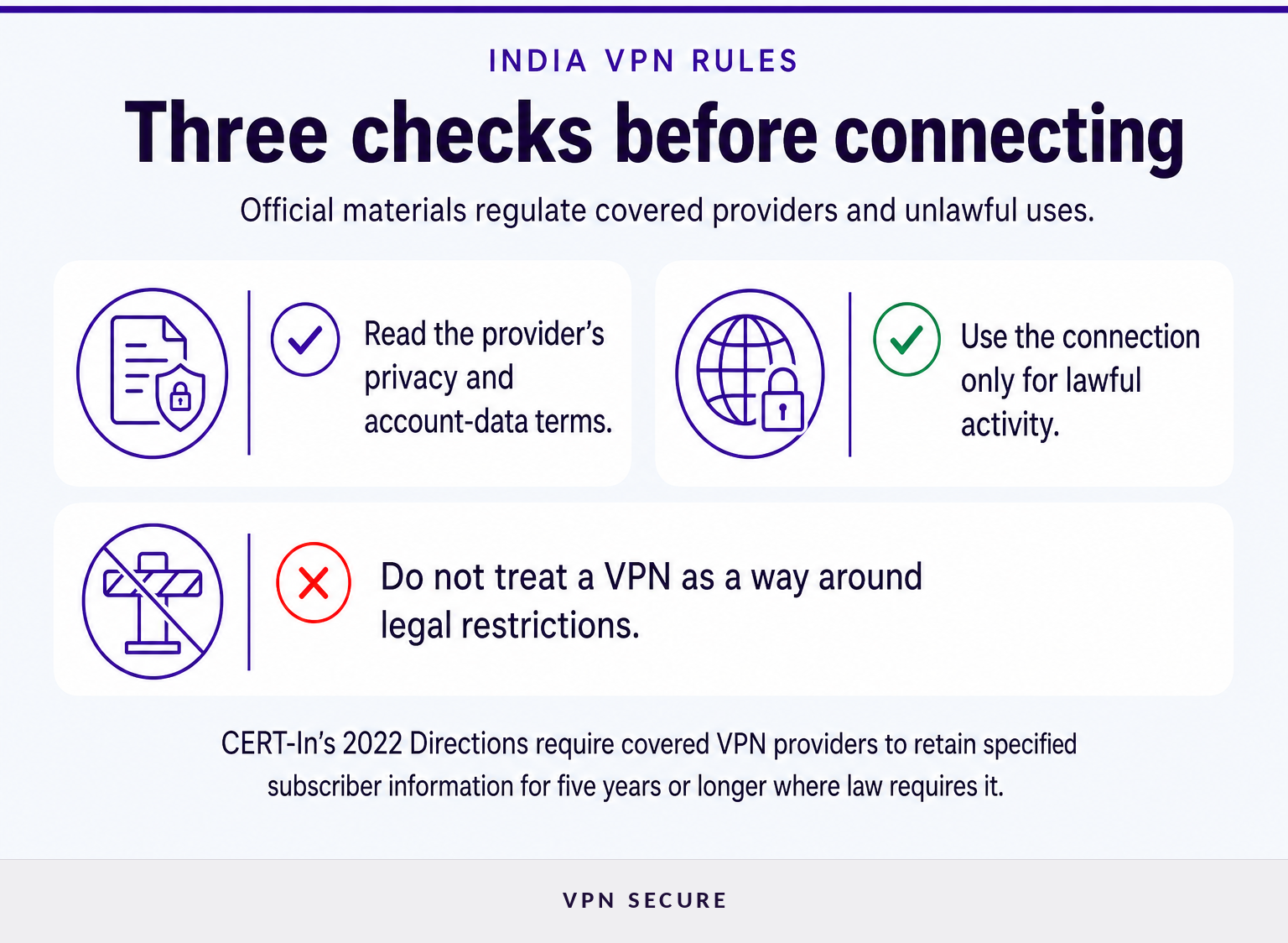
India’s official materials regulate covered VPN providers and unlawful online activity rather than announcing a blanket ban on ordinary VPN technology. A VPN does not exempt a person from Indian law, website rules, workplace policy, or a school or network administrator’s rules.
CERT-In’s Directions of April 28, 2022 say covered VPN service providers must register and retain specified subscriber information for five years or longer after cancellation or withdrawal where required by law. CERT-In’s FAQ clarifies that this category concerns internet-proxy-like VPN services offered to general internet users, rather than a company’s internal corporate VPN. Read the CERT-In Directions and the official FAQ. (cert-in.org.in)
The policy environment also changed in April 2026. MeitY issued an advisory telling VPN providers and intermediaries to make reasonable efforts not to permit access to unlawful betting and prediction-market platforms that have been blocked in India. The advisory is specifically about illegal and blocked services, not a general statement that all personal VPN use is prohibited. Read the MeitY advisory. (meity.gov.in)
For an everyday user, the practical rule is simple: use a VPN for lawful privacy and connectivity purposes, and do not treat it as a tool for bypassing laws, court orders, workplace controls, payment restrictions, or platform terms. Anyone handling regulated work, sensitive investigations, financial transactions, or a specific legal dispute should seek advice from a qualified lawyer in the relevant jurisdiction.
A VPN can improve connection privacy, but it does not remove responsibility for how the connection is used.
Do you need an Indian server or a nearby server?
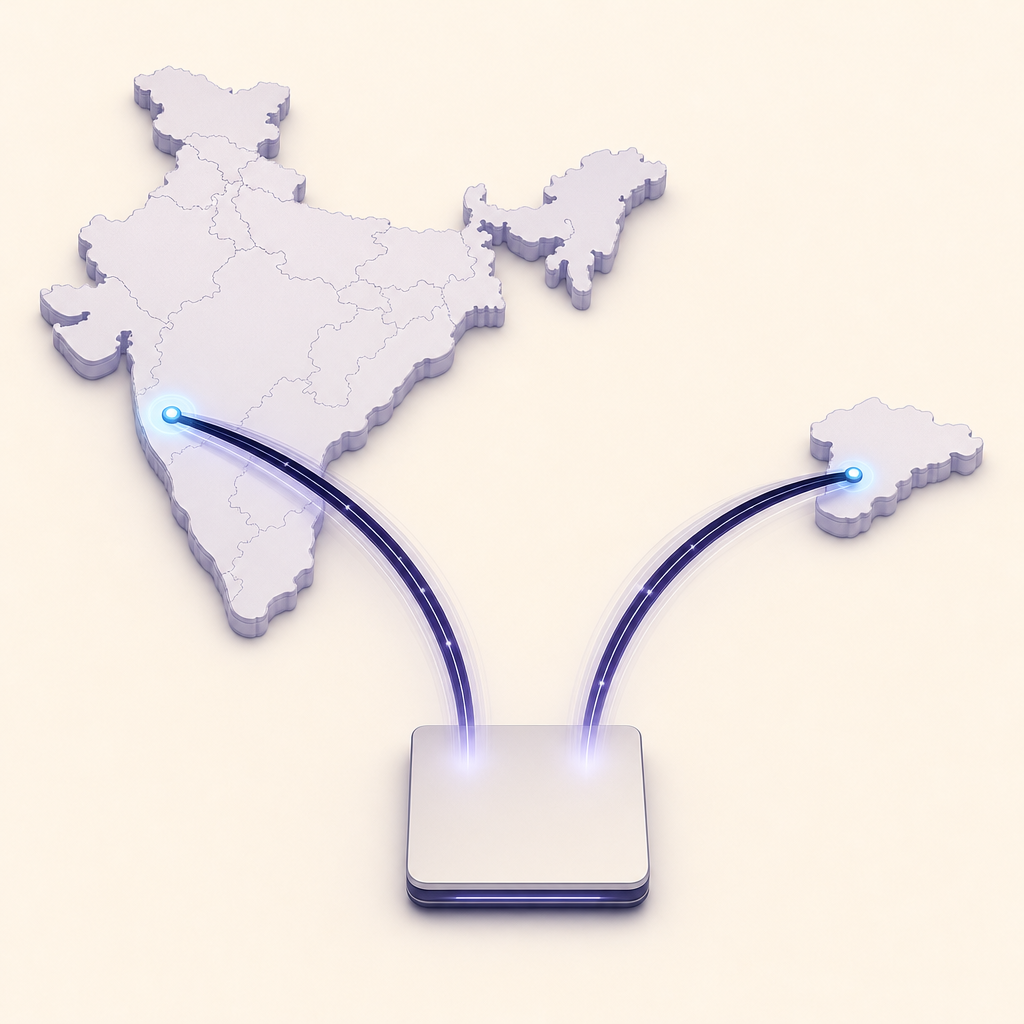
Choose an Indian server when a legitimate service specifically needs to see an Indian IP address. Choose a nearby server when the main aim is private browsing, a stable connection, or lower latency, and no service requires an India-based IP.
These are different needs. An Indian endpoint can be useful for a region-specific website, account workflow, or local content experience while you are outside India. It may not be useful for ordinary browsing, and it cannot promise access to any particular catalog or app because services can apply their own location, payment, account-history, and VPN-detection checks.
A nearby location can sometimes be more practical for general traffic because the route may be shorter. It is still worth testing rather than assuming. Distance is only one variable: local congestion, peering, protocol choice, the local network, and the website itself can all affect results.
As of October 2026, VPN Secure’s live locations page lists a Mumbai endpoint with WireGuard and OpenVPN support. The same page should be checked immediately before subscribing or connecting because live server availability and features can change. Review the current VPN server locations. (vpnsecure.me)
Before paying, confirm that the provider supports the location you need today and keep a nearby alternative ready for ordinary browsing.
What should you check before paying for a VPN?
Check the provider’s written privacy policy, device support, current locations, connection options, and support resources before choosing a plan. Treat any claim that a VPN guarantees anonymous browsing or permanent access to a third-party service as a warning sign.
Read the privacy terms, not just the headline
A privacy claim is most useful when the provider explains what it does and does not store. Read the terms and privacy policy for account details, payment information, technical diagnostics, legal disclosures, and the distinction between activity logs and account data.
VPN Secure’s published terms state that it does not store user activity logs or data on its servers. The same terms say that it does not guarantee availability in specific locations and does not control whether a particular outside site works through the service. Review the VPN Secure terms. (vpnsecure.me)
Make sure the VPN covers your actual devices
A subscription is only useful if it covers the devices and operating systems used every day. Check phones, tablets, laptops, desktops, and any router or browser requirements before purchase. A browser proxy is narrower than a full-device VPN because it normally affects browser traffic only, not every application on the device.
Check protocols and recovery options
Look for supported protocols, then consider how easy it will be to change them if a network blocks or disrupts one connection method. A provider should also offer setup instructions and a support path when a login, local Wi-Fi network, or protocol setting causes trouble.
Use the VPN Secure support resources before travel or an important work session, not only after a connection fails.
Look at the refund terms and pricing structure
Read renewal pricing, billing periods, refund conditions, and any separate add-ons. A short plan can be useful for a trip or compatibility test, while a longer plan only makes sense once the service works on the devices and networks that matter to you. Compare the available VPN plans.
The right paid VPN is the one whose written terms, current locations, devices, and support match your real use case.
How do you connect to a VPN in India?
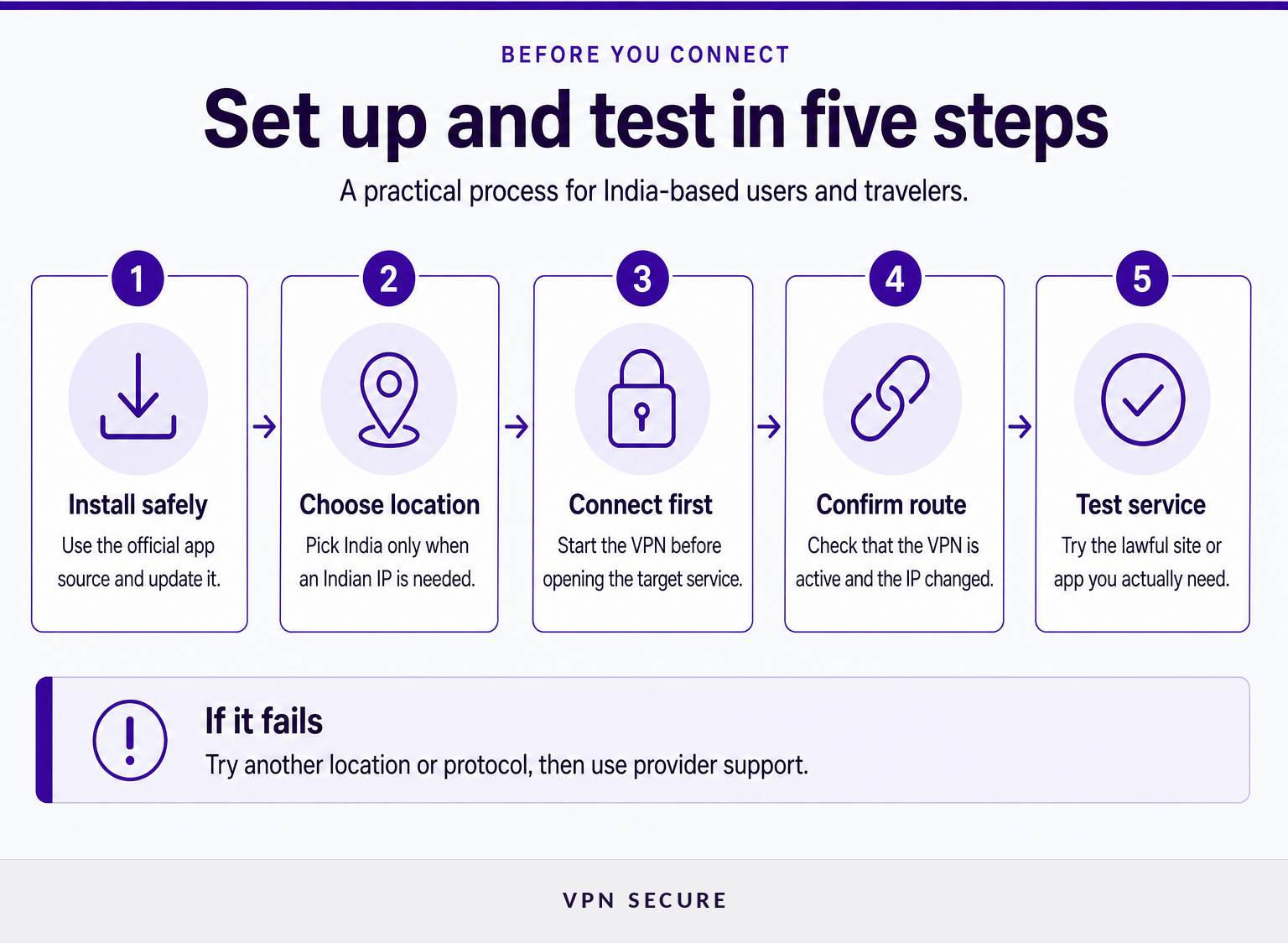
Install the provider’s official app, sign in, select the location that fits the task, and connect before opening the service you need. Then verify that the VPN is active and test the specific site or app because results can vary by account, network, and platform policy.
Use this simple process:
- Install from an official source. Use the provider’s official download page or a recognized app store, and keep the operating system and app updated.
- Sign in and choose the right location. Select India only when you genuinely need an Indian IP address. Otherwise, choose a nearby location that performs well for your network.
- Connect before opening sensitive services. This avoids creating a session with your normal IP address before the tunnel is active.
- Confirm the connection. Check the app status and, where useful, confirm that the public IP location changed as expected.
- Test one real task. Open the website, work system, or app that matters. If it fails, switch protocol or location, then consult support instead of repeatedly reconnecting.
Public Wi-Fi is not automatically unsafe, because HTTPS now protects many website connections. Still, the U.S. Federal Trade Commission recommends checking for secure connections and using sensible account-security habits on public networks; a VPN can add a protected route between your device and the VPN server, but it is not a substitute for updates, strong passwords, and multi-factor authentication. Read the FTC’s public Wi-Fi guidance. (consumer.ftc.gov)
A successful VPN setup is not complete until the connection works for the specific lawful service you need.
How do free VPNs compare with paid VPNs?
Free VPNs can be useful for limited testing, but they often require more checking because limits and data practices vary from one service to another. A paid plan may be more suitable when you need consistent device support, a particular location, or help resolving connection problems.
Do not assume every free VPN is unsafe, and do not assume every paid VPN is private. Review the same basics either way: the provider identity, privacy terms, app permissions, supported locations, bandwidth or data restrictions, and the source of the app download.
The FBI warned in 2026 that some free VPN services with hidden terms may enroll devices in residential proxy networks, and it advised users to be cautious about untrusted VPN apps and pop-up downloads. This is a reason to install only from official sources and to read the terms before granting permissions. Read the FBI notice on risky VPN applications. (fbi.gov)
Free access can be appropriate for a short, low-risk test, but the provider’s terms and app source matter more than the word “free.”
Frequently asked questions
Which VPN is still working in India?
A VPN is still working in India when it can establish a stable connection on your device and network, offers a usable location, and works with the specific lawful service you need. Test the location and protocol yourself because websites and apps can reject VPN connections, and server availability can change without notice.
Can the FBI track a VPN?
A VPN does not make someone impossible to investigate. Law enforcement investigations can involve account records, devices, websites, payment trails, service-provider data, and lawful cooperation across jurisdictions. The FBI has documented investigations involving VPN infrastructure, which shows that a VPN is a privacy tool, not a guarantee of immunity from lawful investigation. (fbi.gov)
What is the best VPN for Asia?
The best VPN for Asia depends on the country, the network, the devices, and the task. Check current locations near the country you need, protocol support, privacy terms, and support options. If a service needs a particular country IP address, verify that location first instead of choosing based on a broad regional label.
How to connect to India VPN for free?
To connect to an India VPN for free, install a legitimate provider’s official app, create an account if required, select an available India location, and connect. Before relying on it, check data limits, privacy terms, app permissions, and whether the app actually offers an Indian endpoint on its free tier.
The safest answer is specific: choose the location for the task, then verify the provider and the connection before relying on it.
What is the sensible next step?
List the devices you use and decide whether you need an Indian IP address or simply a private, stable connection. Then review VPN Secure’s current server locations, read the terms, and test the service on the one network and app that matter most before committing to a longer plan.
Choose a VPN based on what you can verify today, not on a promise that every service will work tomorrow.