



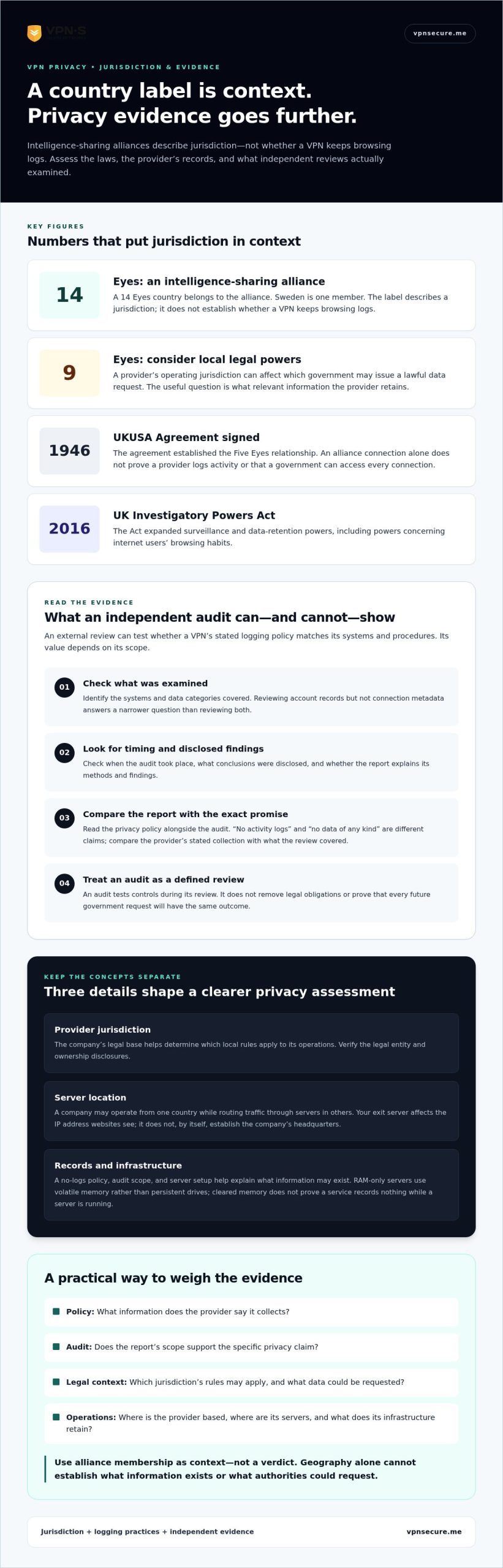
A VPN’s country matters, but it isn’t the whole privacy story. A 14 Eyes country belongs to an intelligence-sharing alliance: Sweden, for example, is a member. Choosing a no-log VPN outside the Five Eyes can reduce one jurisdictional concern, but location alone doesn’t prove what data a provider keeps.
It makes sense to look beyond the app and ask who could demand information, and whether there would be anything useful to hand over. But alliance labels are only one part of a privacy assessment. A provider’s logging practices, independent audits and operating jurisdiction all matter.
This guide explains what the 14 Eyes label means, when 9 Eyes jurisdiction may matter, and why an audit can offer evidence about a no-logs claim. You’ll also learn how to assess a VPN’s operating location without treating geography as a guarantee, so you can make a clearer, more informed choice.
Key Takeaways
- Assess an independent no-logs audit by looking at what it examined and whether its findings support the provider’s specific privacy claims.
- Understand what a 14 Eyes connection says about intelligence-sharing, then weigh jurisdiction alongside the provider’s logging practices and server setup.
- Consider how local laws and lawful government requests may affect a VPN provider, including when its jurisdiction appears on the 9 Eyes list.
- Compare a provider’s operating country with its actual privacy practices; being outside the Fourteen Eyes alliance does not remove its duty to follow local law.
Has the no-logs policy been independently audited?
An independent audit can assess whether a VPN’s stated logging policy matches its systems and procedures. It provides evidence beyond a provider’s own claims, but its value depends on what the review covers.
Independent Verification of No-Logs Claims
An independent audit is an external review of a VPN provider’s logging practices, controls and relevant infrastructure. Compare the report’s scope with the provider’s precise no-logs promise to see what the audit actually supports.
Look for which systems were examined, when the audit took place and what conclusions were disclosed. A review of account records but not connection metadata answers a narrower question than one covering both. Check whether the report explains its methods and findings instead of relying on a badge or brief marketing claim.
Read the privacy policy alongside the audit. Identify what the provider says it collects, such as diagnostic or account information, and compare those categories with the report’s scope. “No activity logs” and “no data of any kind” are different claims. Precision matters when assessing what information could be linked to your activity.
Audits and Real-World Legal Pressure
An audit tests controls during a defined review, while a legal request can show how a provider responds when authorities seek information. Both can offer useful evidence, but they answer different questions about a VPN’s no-logs claim.
For a real-world example, examine a public court filing or transparency report describing a data request and the information available to disclose. Check the dates, the type of data sought and whether the record supports the provider’s stated policy. An audit cannot prove that every future request will have the same outcome.
Jurisdiction still matters. A provider may face a lawful order under the rules where it operates, and an audit does not remove that obligation. The practical question is whether the provider retains relevant records and what those records contain.
The European Union says the GDPR can apply to VPN providers outside the EU when they process data belonging to EU residents. Data practices therefore matter alongside location. Compare the provider’s policy, audit scope and applicable legal obligations. An alliance label alone cannot establish what information exists or what authorities could request.
What does 14 Eyes country mean?
A 14 Eyes country belongs to an intelligence-sharing alliance; Sweden is one member. For VPN privacy, the label describes a jurisdiction, not whether a provider keeps browsing logs.
Server location and provider jurisdiction are separate details. A VPN company may operate from one country while routing traffic through servers in others. Your exit server affects the IP address websites see, while the company’s legal base shapes which local rules apply to its operations. Check both rather than treating a map pin as a complete privacy assessment.
RAM-only, or diskless, infrastructure stores server data in volatile memory rather than on persistent drives. When a server shuts down or restarts, its memory is cleared. This can limit what remains on the machine, but it does not prove that a VPN service records nothing while the server is running. Look for a clear explanation of what the infrastructure does and does not retain, and whether those claims have been independently audited.
Country coverage also affects practical use. A nearby server can provide a shorter route for everyday browsing, while a server in another country may give you an IP address associated with that location. Encryption protects traffic between your device and the VPN server, but it does not determine server speed or guarantee access to a streaming platform.
An alliance label alone cannot provide a reliable comparison of outside-Five-Eyes VPNs on speed, locations and streaming. Compare available countries, server infrastructure and privacy evidence, then consider how distance and network conditions affect your connection.
Use the 14 Eyes label as context, not a verdict. An independent audit, a clearly explained logs policy and details about server infrastructure give you more useful evidence than country coverage alone.
Should you worry if your VPN jurisdiction is on the 9 Eyes list?
Before subscribing, verify the provider’s legal entity, ownership disclosures, audit reports and logging policy. Then compare its operating jurisdiction with the laws that may affect your situation.
Jurisdiction and Government Data Requests
Jurisdiction affects which government may issue a lawful data request to a VPN provider. Providers generally face few data-retention requirements, but they must comply with applicable lawful government orders. The practical issue is what information exists when a request arrives. A provider that keeps no relevant activity logs has less stored browsing data to disclose than one that retains those records.
VPN Headquarters and Alliance Jurisdictions
The Five, Nine and Fourteen Eyes are intelligence-sharing alliances, and the UKUSA Agreement establishing the Five Eyes relationship was signed in 1946. A VPN headquartered in a member country may face that country’s laws; the alliance label alone doesn’t prove a provider logs activity or that a government can access every connection. The United Kingdom’s Investigatory Powers Act 2016 expanded surveillance and data-retention powers, including powers concerning internet users’ browsing habits.
Ownership and Operational Jurisdiction
Ownership identifies who controls a VPN business, while operational jurisdiction concerns where it operates and which local laws apply. Review the provider’s named legal entity, ownership disclosures and policy together. A Netherlands server location, for example, does not by itself establish the company’s headquarters. Panama has no mandatory data-retention laws specifically requiring VPN providers to collect and store user activity logs, and it is not part of the Five Eyes or Fourteen Eyes alliances.
Jurisdiction, Privacy Laws, and Sensitive Communications
For sensitive communications, weigh the provider’s logging policy, legal base and data-handling practices together. Panama has no mandatory data-retention laws, but providers still operate under applicable local laws. Compare that with the United Kingdom’s 2016 surveillance and retention powers, then consider your own risk and the records a service keeps. There are over 200 nations to consider, so alliance membership is one factor, not a complete privacy verdict. Choose based on the law, the provider’s actual practices and the information your activity could expose.
VPN providers based outside the Fourteen Eyes alliance
A no-log VPN outside the Five Eyes may address one jurisdictional concern, but location alone does not establish logging practices. Assess the provider’s disclosed legal base alongside independent audit evidence and its stated approach to lawful requests.
Providers Headquartered Outside the Alliance
A provider headquartered outside the alliance operates under the laws of its own jurisdiction, not simply those of its server locations. Knowing the legal identity and operating base helps you understand which government may have authority over the business, rather than guessing from a country shown in an app.
Assess a provider’s headquarters and audit history separately. Establish the legal entity and location, then look for a published independent assessment of its no-logs claims. A country label alone does not tell you what information the provider collects.
Independently Audited No-Logs Policies
An independent no-logs audit examines whether a provider’s systems and procedures support its logging claims. It matters because the report can show what was tested, which infrastructure was in scope and what conclusions the reviewer reached.
Read the report, not just a claim that the service is “audited.” Compare its scope with the logging policy, since a review of one system may not cover every product or process. Check when the review took place and whether the provider has disclosed subsequent changes.
Location does not cancel legal obligations. VPN providers based outside the Fourteen Eyes alliance must still comply with the laws of the country where they operate. If a lawful request arrives, the information available depends partly on what the provider retains and on the request’s legal basis and scope.
For a no-log VPN outside the Five Eyes, compare its disclosed headquarters, ownership information, audit scope and logging policy. Then consider your threat model. Protecting everyday internet traffic may call for different scrutiny than handling sensitive communications. The alliance label is context, not a privacy test.
Use those checks to explore privacy-focused VPN options with jurisdiction and evidence in mind.
VPN Secure: Monthly VPN Subscription
VPN Secure’s Monthly VPN Subscription provides an encrypted VPN connection for everyday browsing, travel and public Wi-Fi. Its private, no-log service helps protect your internet traffic and access geo-restricted content, including streaming platforms and VOIP apps.
Choose a monthly subscription if you want VPN access without committing to an annual plan. The same privacy checks apply: review the logging policy and available audit evidence, and consider the provider’s jurisdiction alongside the service’s practical fit. A VPN can protect traffic between your device and the VPN server, but it does not replace careful account security or make every online activity anonymous.
Explore VPN Secure’s Monthly VPN Subscription at VPN Secure.
Make your next privacy choice with purpose
Turn your research into a decision that fits how you use the internet. If you’re considering a no-log VPN outside the Five Eyes, focus on the evidence behind its privacy claims and the laws that apply to its operations. Then weigh those details against your needs, whether you want everyday protection on public Wi-Fi or a more private connection while traveling.
VPN Secure offers Monthly and Annual VPN Subscriptions, plus a Dedicated IP. Choose the option that fits your intended use, while keeping expectations grounded: a VPN can protect your connection, but it cannot control every part of your online privacy. Start with clear priorities.
Contact VPN Secure about your VPN options and take your next step with confidence.
Frequently Asked Questions
Can a VPN protect you from surveillance?
A VPN encrypts traffic between your device and the VPN server, helping shield it from observation along that connection. It does not make you invisible: websites can still identify you through logged-in accounts, and software on your device can expose activity. For example, a VPN can protect traffic on public Wi-Fi, but it cannot stop a platform from linking your browsing to your account.
Do the 5 Eyes nations work alone?
No. The Five Eyes, Nine Eyes and Fourteen Eyes are intelligence-sharing alliances, so member countries cooperate on intelligence matters. That does not mean every request or surveillance activity is automatically shared among all members. When choosing a VPN, distinguish alliance membership from the provider’s own legal obligations, data practices and response to lawful requests. The alliance label alone does not show what information a service retains.
Has the policy been tested under real legal pressure?
An independent audit and a documented legal case test different things. An audit examines specified systems and procedures; a public court record or transparency report can show what information a provider could produce after a request. Neither substitutes for the other. Look for a record describing the information sought and the provider’s response, rather than relying on a general privacy claim.
Is the jurisdiction also subject to GDPR?
It can be. According to the European Union, the GDPR can apply to VPN providers outside the EU when they process data belonging to EU residents. The provider’s location alone does not settle the question; the data involved and who it relates to matter. If you’re an EU resident, consider how the service handles your personal data alongside the laws of its operating jurisdiction.
Should I use a VPN based outside the 14 Eyes list?
Consider it if reducing exposure to that jurisdiction is part of your privacy priorities, but do not choose by country alone. Pair the provider’s legal location with its logging policy, independent audit scope and data-handling details. For example, a location outside the alliance does not tell you whether a VPN records connection details. Decide based on your threat model and the available evidence about the service.
What Information Do VPNs Log?
VPN logging policies may cover activity, connection details or technical diagnostics. Activity logs can describe browsing or services used; connection records may include an IP address, timestamps or data usage. VPN Secure’s “Zero Logging. Period.” policy means it does not log IP addresses, connection or disconnection timestamps, bandwidth usage or DNS requests. For details, read our full no-logging policy.