




Your VPN’s no-logs policy is a worthless pinky-promise if a government can legally force them to log your data in secret. In 2026, the reach of global surveillance is deeper than ever, making the choice of a Five Eyes vs 9 Eyes vs 14 Eyes VPN more critical than ever before. With the U.S. extending warrantless surveillance under FISA Section 702 and the UK issuing fresh Technical Capability Notices to break encryption, the walls are closing in on digital privacy. You probably feel like you’re being watched because, statistically, you are. It’s frustrating to pay for protection only to realize your provider might be a puppet for a state intelligence agency.
We’re here to cut through the marketing fluff and expose the reality of these global intelligence alliances. You deserve to know exactly which countries trade your data like a commodity and how to find a provider that truly answers to no one. This guide maps out the surveillance web, explains why offshore jurisdictions like the Bahamas are your best defense, and reveals how to pick a VPN that stays out of the reach of secret subpoenas. We’ll show you how to take back your autonomy and secure your digital life with a 30-day money-back guarantee of real, verifiable privacy.
Key Takeaways
- Expose the “Signals Intelligence” loophole where ally nations trade your data to bypass domestic privacy laws and legal restrictions.
- Navigate the hierarchy of risk when comparing a Five Eyes vs 9 Eyes vs 14 Eyes VPN to keep your data out of the reach of the NSA and GCHQ.
- Learn why “having nothing to hide” won’t stop mass metadata collection or the invasive reach of global surveillance initiatives.
- Discover why a no-log policy is a hollow promise without an offshore jurisdiction like the Bahamas to shield you from secret gag orders.
- Secure your digital life with a provider that acts as your vigilant ally, staying entirely independent of global surveillance alliances.
The Global Surveillance Trap: What Are the 5, 9, and 14 Eyes?
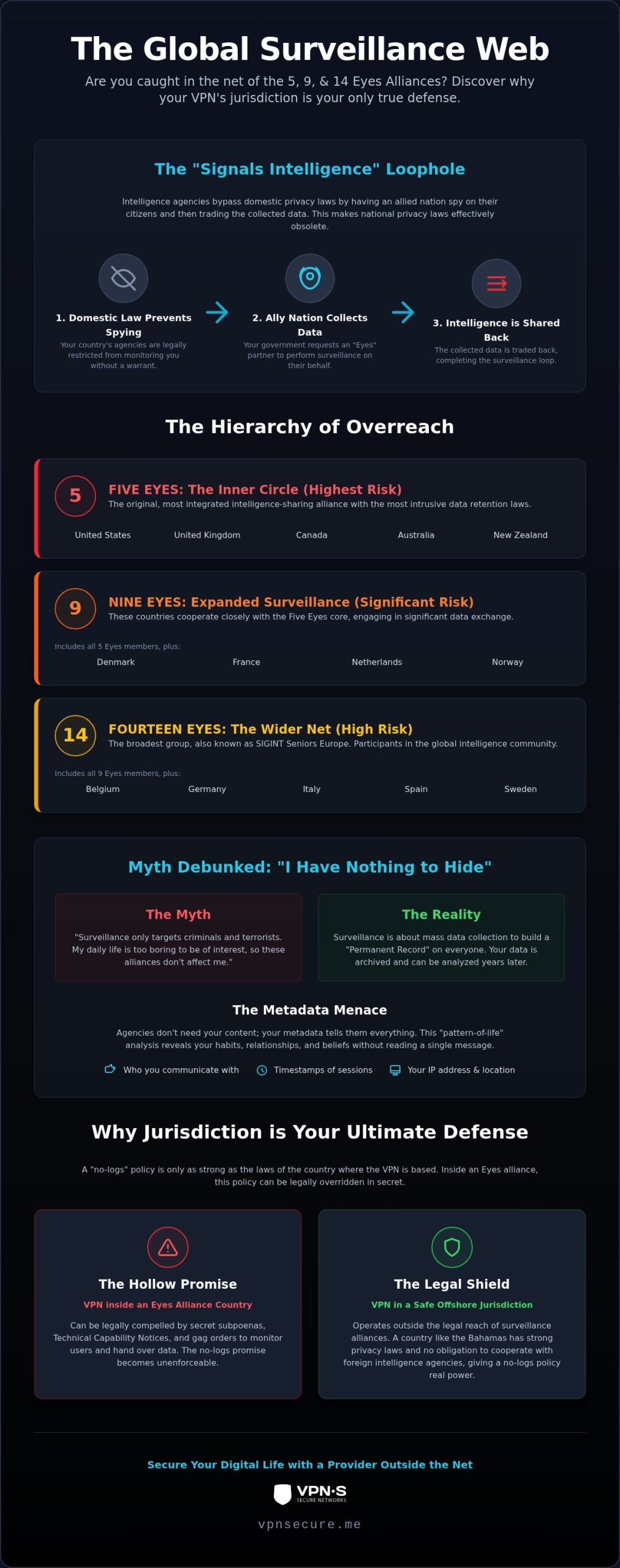
The internet isn’t the wild west anymore; it’s a monitored grid. At the heart of this grid lies a series of intelligence-sharing agreements known as the 5, 9, and 14 Eyes. These aren’t just casual handshakes between diplomats. They are sophisticated networks designed for sharing Signals Intelligence (SIGINT), which includes everything from your private emails to your browsing history. The 14 Eyes functions as an extension of the original Cold War pact, now optimized for modern data harvesting and seamless intelligence sharing.
The trap is simpler than you think. Most countries have laws that stop their own agencies from spying on their citizens without a warrant. To get around this, they use a loophole: they ask an ally to do the spying for them. If the NSA can’t legally watch you, the GCHQ might, and then they’ll trade that data over a secure channel. By 2026, the UKUSA Agreement has evolved into a real-time data exchange that makes domestic privacy laws feel like a suggestion rather than a rule. Understanding the difference between a Five Eyes vs 9 Eyes vs 14 Eyes VPN is your first step toward opting out of this dragnet.
The Core: Who Are the Five Eyes?
The Five Eyes alliance is the inner circle. It consists of the United States, United Kingdom, Canada, Australia, and New Zealand. These five nations are the original heavy hitters of global surveillance. They share the most intimate level of intelligence and have the most intrusive data-retention laws on the planet. This partnership traces back to the 1946 UKUSA Agreement, a document that still dictates how your digital life is monitored in 2026. If your VPN is based in one of these countries, they aren’t just subject to local laws; they are part of the most powerful surveillance machine in history.
The Expansion: 9 Eyes and 14 Eyes Members
The surveillance web doesn’t stop at the English-speaking world. The 9 Eyes adds Denmark, France, the Netherlands, and Norway to the mix. While their cooperation isn’t as deep as the core five, they still participate in significant data exchange. The 14 Eyes, officially known as SIGINT Seniors Europe, expands even further to include:
- Belgium
- Germany
- Italy
- Spain
- Sweden
Even in these third-tier nations, the risk remains high. These countries are still active participants in the global intelligence community. If a VPN provider operates within these borders, they can be pressured to hand over user data through secret subpoenas or gag orders that prevent them from ever telling you what happened. Choosing a Five Eyes vs 9 Eyes vs 14 Eyes VPN means deciding which level of government overreach you’re willing to tolerate, or ideally, how to avoid it entirely.
Myth: ‘I Have Nothing to Hide, So These Alliances Don’t Affect Me’
“I have nothing to hide” is the most dangerous phrase in the digital age. It assumes that surveillance is only for “bad actors” and that your daily life is too boring for a state agency to notice. This is a fundamental misunderstanding of how global intelligence works. Surveillance isn’t about finding a smoking gun; it’s about building a “Permanent Record.” Data collected from you today is archived and stored. Even if it stays encrypted for now, it can be decrypted and analyzed in a decade when political climates shift or decryption technology advances. Privacy is a fundamental human right, not a cloak you use only when you’re doing something wrong.
When you choose a Five Eyes vs 9 Eyes vs 14 Eyes VPN, you aren’t just picking a service; you’re deciding who gets access to your digital history. In 2026, with the EU AI Act fully active and mass surveillance under FISA Section 702 continuing in the U.S., the dragnet is wider than ever. These alliances don’t care if you’re a law-abiding citizen. They care about the aggregate. Your data is a grain of sand in a mountain of information used to predict behavior and control narratives. Opting out is an act of autonomy.
The Metadata Menace
You might think your encrypted messages are safe, but your metadata tells the real story. Signals Intelligence (SIGINT) focuses heavily on connection timestamps, IP logs, and the duration of your sessions. This allows agencies to perform “pattern of life” analysis. They don’t need to read your emails to know your religion, your health struggles, or your political affiliations; they just need to see who you talk to and when. In alliance countries, ISPs act as the primary data feeders, funneling this metadata directly into centralized hubs. It’s a goldmine for intelligence agencies that requires zero warrants to process.
The Inevitability of Data Breaches
Centralized surveillance hubs are the ultimate honeypots for hackers. No government database is unhackable, and when 14 different nations share your data, the attack surface expands exponentially. If one member of the alliance has a security lapse, your “private” data is exposed across the entire network. Keeping your data off the grid is the only way to ensure it isn’t leaked, sold, or used against you later. It’s time to choose a provider that values your autonomy and keeps your digital footprint outside these high-risk zones.
The Hierarchy of Overreach: Comparing the 5, 9, and 14 Eyes
Privacy isn’t a sliding scale; it’s a binary state. You either have it, or you don’t. When you analyze a Five Eyes vs 9 Eyes vs 14 Eyes VPN, you’re looking at a hierarchy of risk that determines how easily a government can seize your data. The Five Eyes represent a “Critical” risk level. The Nine Eyes are “High,” and the 14 Eyes are “Moderate” but still dangerous. If your VPN is based in a Five Eyes country, it’s legally compromised from the moment it boots up its first server. No matter what the marketing says, the state’s power to demand data overrides any user agreement.
The core issue is that these alliances create a unified surveillance front. A provider in the US or UK is subject to laws that can force them to log data in secret. This is why we insist that a no-log vpn audit is the only way to verify a provider’s claims. Without external verification and a safe jurisdiction, “zero logs” is just a phrase used to sell subscriptions. In these alliance nations, the law is designed to help the state, not the individual.
Five Eyes: The Gold Standard of Intrusion
The US and UK are the architects of modern surveillance. In the United States, the FBI uses National Security Letters (NSLs) to demand user information without a warrant. These letters come with permanent gag orders. A VPN provider could be logging your every move right now and they’d be legally barred from telling you. In the UK, the Investigatory Powers Act serves as the most extreme surveillance framework in the democratic world. It gives the GCHQ the power to interfere with hardware and demand “technical capability” changes to bypass encryption. Australia and Canada follow suit, with both nations becoming increasingly hostile to encrypted services through aggressive “assistance and access” legislation.
9 And 14 Eyes: The “Third Party” Partners
The Nine and 14 Eyes alliances expand the dragnet across Europe. Countries like Germany, France, and Sweden often try to market themselves as privacy-friendly, but their alliance duties tell a different story. These nations participate in “voluntary” data sharing with the NSA and GCHQ. If a core Five Eyes member wants your data, these “third party” partners usually hand it over to maintain their intelligence-sharing privileges. The 14 Eyes is the threshold for a truly risky VPN jurisdiction. Even if a country has strong domestic privacy laws, its membership in this pact means your data is always one “request for information” away from being shared across the globe. When choosing a Five Eyes vs 9 Eyes vs 14 Eyes VPN, the only winning move is to stay outside the alliance entirely.
Why a ‘No-Logs’ Policy Fails Without the Right Jurisdiction
“Zero Logs” is a catchy slogan, but it isn’t a legal defense. When you’re weighing the pros and cons of a Five Eyes vs 9 Eyes vs 14 Eyes VPN, you have to look past the website copy. A provider based in the United States or United Kingdom can be served with a secret subpoena and a gag order simultaneously. This means they are legally required to start logging your activity and legally forbidden from telling you about it. A no-log policy is only as strong as the government’s inability to subvert it with a secret court order. Understanding VPN data privacy laws and how they differ by jurisdiction is the only way to know if your provider’s promises will hold up when it matters most.
In 5 Eyes jurisdictions, the law is the ultimate back door. If a VPN operates in a country that is part of these alliances, they have a boss, and it isn’t you. Contrast this with an offshore provider based in the Bahamas. Without the legal framework of the UKUSA agreement, there is no mechanism for a foreign agency to force a “silent tap” on your connection. Jurisdiction is a legal reality; “Zero Logs” is just marketing until the subpoenas start flying. You need a provider that is legally empowered to say no. Use our no log vpn jurisdiction checklist to verify exactly where your provider stands before trusting them with your data.
The Secret Subpoena: How VPNs Are Flipped
Many users rely on “warrant canaries” as an early warning system. These are statements on a website claiming the company has never received a secret government request. If the statement disappears, you’re supposed to know they’ve been compromised. In reality, these are fragile. Courts can compel a company to keep a canary active even after a warrant is served, turning your warning system into a state-sponsored lie. History shows that “no-log” providers often find logs once the FBI or GCHQ knocks. Jurisdiction determines whether a VPN has the standing to fight these orders in court or if they must simply roll over and comply.
RAM-Only Servers vs. Legal Compliance
RAM-only servers are a great technical hurdle because they wipe data upon every reboot. However, they aren’t a magic wand. If a court orders a VPN to monitor a specific user in real-time, RAM-only hardware won’t stop the software from sniffing traffic as it passes through the server. There is a massive difference between “not having data” and “being forced to collect data” moving forward. Technical features are useless if the legal foundation is rotten.
Don’t get stuck in a long-term contract with a provider that might be forced to betray you. If you’re looking for a way out, check our guide on affordable VPN monthly plans to see how you can get top-tier protection without the multi-year trap. It’s time to switch to a provider that puts jurisdiction ahead of marketing hype and keeps your digital life truly private.
Escaping the Net: Why Bahamas Jurisdiction Is Your Ultimate Privacy Play
You’ve seen the map. You know the risks. Now you need a way out. Finding a provider that sits outside the reach of the UKUSA agreement isn’t just a technical preference; it’s a legal necessity. When comparing a Five Eyes vs 9 Eyes vs 14 Eyes VPN, the most important factor isn’t the server count or the encryption protocol. It’s the physical location of the company’s headquarters. If the law can’t reach the provider, the provider can’t be forced to reach for your data. Being outside the 14 Eyes is the first step toward true anonymity in a world that wants to catalog your every move.
The Bahamas serves as a strategic shield against the invasive reach of global surveillance alliances. By positioning our operations in a jurisdiction that prioritizes individual privacy over state-level data harvesting, we create a legal wall between your digital life and the agencies that want to monitor it. It’s about autonomy. You shouldn’t have to worry about whether your VPN provider will be flipped by a secret court order. In the Bahamas, that mechanism simply doesn’t exist for the benefit of foreign intelligence agencies. Learn more about how where your VPN lives determines your final line of defense against state-level surveillance and secret subpoenas.
The Bahamas Advantage
The Bahamas is more than just a tropical destination; for digital privacy, it’s a fortress. There are no mandatory data retention laws for VPN providers here. This independence from the UKUSA intelligence-sharing pact is why VPN Secure was founded here in 2012 by Infinite Quant Ltd. We leverage this jurisdiction to ensure that our no-log policy isn’t just a promise; it’s a legal reality. We don’t answer to the NSA or GCHQ. We answer to Bahamian law, which doesn’t require us to keep tabs on your “pattern of life” or connection metadata.
Taking Action: Your Privacy Checklist
Don’t let marketing fluff dictate your security. Use this checklist to verify if your current provider is actually protecting you:
- Check the “About Us” page: Where is the company actually registered? If it’s a 14 Eyes nation, you’re already in the net.
- Verify the jurisdiction: Does the country have mandatory data retention laws? If so, “no-logs” is a myth.
- Prioritize autonomy: Choose an independent ally that values your freedom over corporate growth or government contracts.
Securing your digital life shouldn’t be a luxury. You can gain high-level protection for as little as $2.99 per month. We believe privacy is a right, not a subscription tier. To make the switch even easier, we offer a 30-day money-back guarantee. You can test our offshore defense and see what real digital liberation feels like with zero risk. Stop being a data point in a global surveillance grid and start browsing on your own terms today.
Take Back Your Digital Sovereignty
The global surveillance net is designed to be invisible, but its impact on your autonomy is very real. You now understand that the choice of a Five Eyes vs 9 Eyes vs 14 Eyes VPN isn’t just about technical specs; it’s about whether your provider is legally forced to betray you. Jurisdiction is the only foundation for true privacy. Without a safe legal home, every security claim is just a marketing gamble you can’t afford to lose.
By moving your digital footprint to the Bahamas, you place your data beyond the reach of the UKUSA pact and secret gag orders. It’s time to stop being a passive target in a global data harvest. You can secure your connection with a verified no-log policy that actually has the legal teeth to protect you. Shield your data with VPN Secure—Starting at $2.99/mo and enjoy the absolute protection of a service based outside the 14 Eyes. We back our promise with a 30-day money-back guarantee, so you can reclaim your freedom with zero risk. Your internet, your rules.
Frequently Asked Questions
Is a VPN safe if it’s based in a Five Eyes country?
No, a VPN based in a Five Eyes country is legally vulnerable from day one. These nations, including the US and UK, have the power to serve providers with secret subpoenas and permanent gag orders. This means a company could be forced to log your data while being legally barred from telling you. Even if they claim to have a no-log policy, the state’s legal authority overrides any marketing promise.
Which countries are in the 14 Eyes alliance in 2026?
As of 2026, the 14 Eyes alliance includes the original Five Eyes (US, UK, Canada, Australia, and New Zealand) plus nine additional partners. These are Denmark, France, the Netherlands, Norway, Belgium, Germany, Italy, Spain, and Sweden. These nations share signals intelligence and work together to bypass domestic privacy restrictions. If your provider is registered in any of these fourteen countries, your data is within their shared reach.
Can the government force a no-log VPN to provide data?
Yes, governments in alliance jurisdictions can legally compel a provider to start logging a specific user in real-time. While a company can’t provide data they haven’t saved, a court order can force them to change their software to capture future traffic. This is why the debate over a Five Eyes vs 9 Eyes vs 14 Eyes VPN is so critical; jurisdiction determines whether a company has the legal standing to refuse these invasive demands.
Why is the Bahamas considered a good jurisdiction for a VPN?
The Bahamas is a premier privacy haven because it operates entirely outside the Five Eyes, Nine Eyes, and 14 Eyes alliances. There are no mandatory data retention laws for VPN providers in this jurisdiction. This independence allows services like VPN Secure to maintain a verified no-log policy without the threat of secret government interference. It provides a legal fortress that protects your digital autonomy from state-level surveillance dragnets.
Does server location matter as much as the VPN’s home jurisdiction?
No, the home jurisdiction is far more important than the physical server location. While a server in a 14 Eyes country might be subject to local hardware interference, the legal entity governing your data is where the company is registered. If the company is based in a safe offshore zone like the Bahamas, they aren’t beholden to the UKUSA agreement, making it much harder for foreign agencies to demand your connection logs.
What is the difference between Five Eyes and 14 Eyes?
The difference lies in the level of intelligence sharing and historical cooperation. The Five Eyes is the core group that shares the most sensitive signals intelligence under the 1946 UKUSA Agreement. The 14 Eyes is a broader extension that includes European partners who participate in coordinated surveillance but don’t have the same unlimited access to the core group’s primary databases. Both, however, represent a significant risk to your privacy.
How can I tell if my VPN is outside the 14 Eyes?
You can verify this by checking the “About Us” page or the legal section of the provider’s Terms of Service. Look for the specific legal entity that owns the service and where it is incorporated. If the company is based in the US, UK, or any EU member of the alliance, they are inside the net. Choosing a Five Eyes vs 9 Eyes vs 14 Eyes VPN requires verifying that the headquarters is in a non-member country.
Can Five Eyes countries see my browsing history if I use a VPN?
If you use a high-quality VPN outside their jurisdiction, they cannot see your specific browsing history. However, if your VPN is based within the alliance, agencies can subpoena the provider for your metadata or connection logs. They might not see what you’re doing in real-time, but they can identify who you are talking to and when. This is why using an offshore provider is the only way to ensure true anonymity.