




You don’t need to build every part of a VPN from scratch to build a brand people trust. But a quick launch can still fall flat if the service feels generic or leaves customers wondering who handles privacy, billing, and support. To launch branded VPN service with a solid foundation, you need more than a logo on an app. You need a clear promise and a plan for delivering on it.
If you’re deciding what to build, what to license, and what your team must operate day to day, start with your customers’ needs. White-label infrastructure can give you a technical foundation without requiring you to create the backend independently. It doesn’t replace the work of defining your audience, differentiating your offer, and communicating privacy honestly.
This practical blueprint covers the key decisions, from validating your idea and comparing white-label licensing with custom development to planning customer support, billing, updates, and launch activities. VPN Secure provides white-label VPN infrastructure and apps for businesses to rebrand and sell. The goal is to make the technology, brand promise, and day-to-day operations work together, rather than treating a licensed foundation as a finished business.
Key Takeaways
- To launch branded VPN service with purpose, define your audience, use cases, and service boundaries before shaping the offer.
- Map the customer journey from discovery to cancellation so billing, setup, support, and renewals have clear owners.
- Compare white-label licensing with custom development by weighing control, branding, technical workload, and ongoing responsibilities.
- Turn launch decisions into concrete deliverables, from a product brief and claims review to tested onboarding.
- VPN Secure’s white-label licensing gives businesses VPN infrastructure and apps to rebrand, leaving room to focus on their brand and customer relationships.
What does it take to launch a branded VPN service in 2026?
A VPN brand is more than a name, logo, and subscription page. It’s a customer-facing service built around VPN technology that you either license or develop yourself. Customers experience the whole package: the promise you make, the apps they use, how they get help, and how clearly you explain the service’s limits.
White-label licensing lets you rebrand an existing VPN technical foundation; independent development means building and operating that foundation yourself. Licensing can reduce the need to create the entire backend alone, but neither route removes the need to define your audience, assign operational responsibilities, and make claims you can stand behind. To launch branded VPN service, start with the customer’s problem, not the technology.
A VPN creates an encrypted connection between a device and a network or VPN server. The Virtual Private Network (VPN) overview offers useful background on the technology and its architecture. That’s a starting point, not a reason for your product to exist. Your offer needs to address a specific customer need.
Choose the audience and problem before shaping the offer
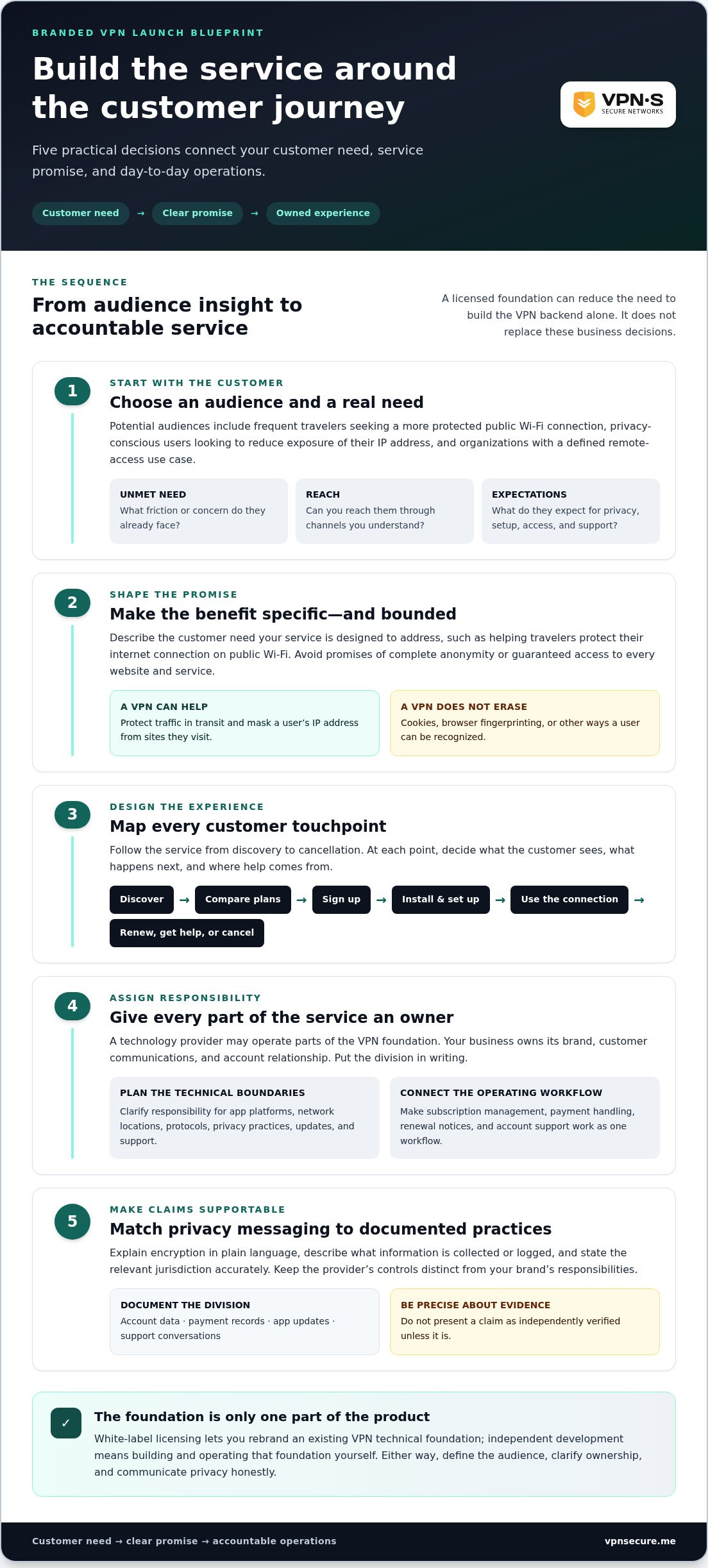
Potential audiences include frequent travelers looking for a more protected connection on public Wi-Fi, privacy-conscious users seeking to reduce exposure of their IP address, or organizations with a defined remote-access use case. Compare audiences using three practical questions:
- Unmet need: What friction or concern does this audience already face?
- Reach: Can you reach them through channels you understand, such as an existing customer base, a specialist community, or relevant content?
- Expectations: What do they expect from the service in terms of privacy, setup, access, and support?
Choose a need you can serve and turn it into a bounded promise. For example, you might describe a service designed to help travelers protect their internet connection while using public Wi-Fi. Avoid claims of complete anonymity or guaranteed access to every website and service. A VPN can help protect traffic in transit and mask a user’s IP address from sites they visit, but it doesn’t erase cookies, browser fingerprinting, or other ways a user can be recognized.
Set the boundaries of the service you intend to sell
Decide where your brand appears across the customer experience, including signup, apps, setup guidance, support, and educational content. Then distinguish that customer-facing promise from the technical capabilities behind it. Define who handles app platforms, network locations, protocols, privacy practices, updates, and support. Keep those responsibilities clear in your product plan and customer communications.
Make the promise useful and precise. If your service is designed to help people use public Wi-Fi with added connection privacy, don’t imply that it secures every part of their digital life. A VPN doesn’t replace updated devices, strong account passwords, multifactor authentication, or careful browsing. Trust grows when your brand explains what the service does, what it doesn’t do, and how customers can use it responsibly.
How should you design the VPN product, brand, and operating model?
A strong VPN product is a connected system, not a set of separate decisions. Write a product blueprint that names the intended users, supported use cases, customer journey, and service boundaries. Then assign an owner to each part of the experience. A technology provider may operate parts of the VPN foundation, while your business owns the brand, customer communications, and account relationship. Put that division in writing before launch.
Map the lifecycle from a customer’s perspective: they discover the service, compare plans, sign up, install and set up an app, use the connection, renew or seek help, and eventually cancel. At each step, decide what the customer sees, what happens next, and who resolves a problem. Subscription management, payment handling, renewal notices, and account support should work as one workflow, not as disconnected tools.
- Discovery and signup: Explain who the service is for, what each plan includes, and how billing works.
- Setup and use: Provide platform-specific instructions and a clear route for connection problems.
- Renewal and cancellation: Make account changes understandable, and align customer messages with your stated billing and data practices.
Turn a privacy promise into clear, supportable messaging
Make every privacy claim match the service’s documented practices. Explain encryption in plain language, describe what information is collected or logged, and state the relevant jurisdiction accurately. Document what the VPN provider controls and what your brand controls, including account data, payment records, app updates, and support conversations. A no-log VPN audit guide can help structure questions about evidence, but don’t present a claim as independently verified unless it is.
Technical references can sharpen your internal review. For example, the NIST Guide to IPsec VPNs discusses IPsec VPN implementation and security considerations. Use it to inform technical questions, not as proof that a particular deployment meets a standard or has been independently assessed.
Design the customer experience around the product promise
Make plan differences, supported platforms, setup steps, and account controls easy to find. Treat app branding and onboarding as part of the product: a polished logo cannot rescue confusing setup or vague help content. Create clear support routes for billing questions, connection issues, and account access, and assign an owner to each route before customers need it.
Build operational details into a simple responsibility map. For each workflow, identify the responsible party, the information they need, and the message the customer receives. For example, if a connection problem requires technical escalation, explain how the customer reports it and who provides the next update. If a customer cancels, ensure the account process and any statements about data handling align with your written policies. VPN protection also has limits: users still need secure devices, strong account credentials, and careful browsing.
Businesses building a licensed deployment can explore VPN Secure’s white-label VPN licensing, which provides VPN infrastructure and apps to rebrand alongside a customer experience designed for their audience.
White-label or custom VPN development: which launch path fits?
The choice is a trade-off between control and responsibility. White-label licensing gives you a technical foundation to rebrand, reducing the need to build a complete VPN backend independently. Custom development gives your team more direct control over how that foundation is designed, but your team also takes on more work to build, test, secure, and maintain it. Neither route decides whether your customer experience feels distinctive.
A licensed backend does not dictate a generic brand. Your audience, positioning, onboarding, support, website, and customer communications shape how the service feels. The licensing arrangement defines the technical foundation you’re using. Align your product promise with that foundation before making public claims.
Decision area
White-label licensing
Custom development
Control
Work within the licensed technical foundation and agreed scope.
Choose more of the architecture and product behavior, while owning the consequences.
Technical workload
License infrastructure and apps instead of building the full backend alone.
Build and integrate the components your service needs.
Branding flexibility
Apply your brand to the customer experience within available branding controls.
Design customer-facing and technical elements around your requirements.
Ongoing duties
Define who handles updates, support, privacy documentation, and operations.
Plan for maintenance, testing, security response, and customer support.
Launch complexity
Less backend construction, with scope alignment still essential.
More direct control, alongside more coordination and delivery work.
When white-label licensing can be a practical route
This route can suit a team that wants to focus on a defined audience, customer relationships, and brand promise rather than creating every technical layer itself—much like how managed service providers rely on ReadySECURE to deliver white-label security solutions directly to clients. Evaluate app branding, platform coverage, updates, support, privacy documentation, and operational ownership as part of the launch plan. Base product claims on the documented capabilities of the deployment, not assumptions.
When custom or hybrid development deserves consideration
Custom components may make sense when a distinct technical workflow or control requirement can’t be met within a licensed foundation. A hybrid model can pair licensed VPN infrastructure and apps with brand-owned customer experiences, such as onboarding or help content. For organizations deploying custom connectivity within broader corporate or hospitality networks, working with established technology integrators like ITSthe1 Solutions can help align IT and telecom infrastructure with day-to-day operations. Compare total responsibility, not just initial development: account for building, testing, maintenance, security response, and customer support before choosing how to launch branded VPN service.
VPN Secure provides white-label VPN licensing with infrastructure and apps for businesses entering the privacy market. Define the customer experience you want to own, then align your deployment plan and responsibilities with the technical foundation you license.
What steps should you complete before launching a branded VPN?
A launch is ready when the customer journey works, the privacy message matches the service, and someone owns each operational task. Follow this sequence and save the output from every step. These deliverables help your team identify gaps before customers encounter them.
- Validate the audience. Speak with people in your intended market and test whether the problem you’ve chosen matters to them. Output: a short audience summary covering the need, use case, and likely acquisition channels.
- Write the product brief. Define the service promise, intended use cases, customer journey, and boundaries. Output: a brief your business and technical partners can use to make consistent decisions.
- Align provider scope and responsibilities. Map required app branding, platform coverage, infrastructure, updates, support, privacy documentation, and operational ownership against the deployment. Output: a written scope and responsibility map that distinguishes documented capabilities from assumptions.
- Configure the customer experience. Prepare the brand presentation, plan details, signup flow, setup guidance, account management, and support routes. Output: a working onboarding flow and customer-facing help content.
- Review product and privacy claims. Compare every statement on your website and in your app with the service’s documented practices and capabilities. Output: an approved claims review with unsupported promises removed.
- Prepare operations. Connect subscription management, payment handling, renewal communications, cancellation, support, and incident escalation. Output: a support plan naming who handles billing questions, account access, connection issues, and service interruptions.
- Test before release. Walk through registration, payment status, app setup, connection guidance, renewal notices, support contact, and cancellation. Output: a test record showing what worked, what failed, and what was fixed before opening signups.
Validate readiness before opening signups
Run the journey as a real customer would, from the first page visit to account cancellation. Test successful and unsuccessful payment outcomes, unclear setup instructions, and a connection issue that needs escalation. Check that support guidance tells customers where to go and what information to provide. Make sure any privacy practice promised on the website aligns with the deployment’s documentation. A polished launch page can’t compensate for a broken flow or an unanswered customer problem.
Plan acquisition and learning after release
Choose channels that reach your defined audience, then explain the product’s specific value without implying perfect security or guaranteed access. Track signup completion, activation, support themes, retention, and customer feedback. Use those signals to improve onboarding and clarify messaging, not to make broader claims than the service supports. For adjacent planning around a reseller model, explore the VPN reseller business guide.
If a licensed technical foundation fits your launch plan, explore VPN Secure’s white-label VPN option as you shape your deployment and customer experience.
How can VPN Secure support your branded VPN launch?
You don’t have to build every technical layer yourself to enter the privacy market. VPN Secure provides white-label VPN licensing with infrastructure and apps that businesses can rebrand and sell. This gives your team a technical foundation to build around while you focus on who the service is for, what your brand stands for, and how customers experience it.
VPN Secure has operated since 2012. That history offers context for businesses considering a branded VPN launch, but it doesn’t replace the need to define your deployment responsibilities. A clear plan connects four things: the branding customers see, the technical capabilities included, the work each party owns, and the customer journey your business intends to deliver.
What the white-label model is designed to help businesses do
Through white-label licensing, third parties can rebrand and sell VPN infrastructure and apps without independently building the entire backend. The model can suit businesses that want to concentrate on their target audience, brand promise, and customer relationships rather than creating every technical component from scratch. Your product’s identity comes from the experience you create, including its positioning, onboarding, content, and customer communication.
Deployment details matter. App platforms, branding, protocols, infrastructure, support, and updates are practical considerations for your launch plan. Keep public product claims aligned with the deployment and its documented privacy practices.
Prepare for a focused conversation about your launch
Bring a clear outline of your intended users, launch goals, brand requirements, and customer journey. Identify what customers should see from discovery through setup and account management, then list the operational tasks your business will own. This makes it easier to define a deployment in practical terms instead of starting with a vague idea for a VPN brand.
Plan responsibility for operational details, including support, updates, privacy documentation, and customer communications. Be precise about what you need and what your team can manage. For instance, if your brand will handle customer account questions, define how technical issues move between your support team and the infrastructure provider. The goal is a usable division of work, not an impressive-sounding but unclear promise.
VPN Secure’s white-label licensing is for businesses entering the privacy market without building the complete technical backend independently. Bring your product plan and customer requirements into the planning process so the deployment supports the service you intend to offer. Explore VPN Secure’s white-label VPN licensing to take the next step. For adjacent planning around the reseller model, see the white-label VPN solutions guide.
Make your next move a focused one
A strong launch starts with decisions you can act on: who you want to serve, what you can credibly promise, and which parts of the customer experience your team will own. Put those choices into a short launch brief. Use it to align your brand promise with the technology and operating roles behind it before setting a release plan.
You don’t need to solve every technical challenge alone. VPN Secure’s white-label option gives businesses infrastructure and apps to rebrand and sell, providing a foundation for a service shaped around their audience.
Explore VPN Secure’s white-label VPN solution and take the next step toward a service customers can understand and trust. Build with purpose, communicate clearly, and give your VPN brand room to grow.
Frequently Asked Questions
How do I launch a VPN service under my own brand?
To launch branded VPN service, start with one clearly defined customer and a problem your offer can address. Write a short brief covering the intended user, why they’d choose your service, and the experience you want them to have. Next, decide whether licensing or custom development fits your capabilities, then map the costs, roles, and decisions your team must own. Treat launch readiness as a testable standard, not a date on a calendar.
What is the difference between a white-label VPN and a custom-built VPN?
A white-label VPN uses licensed technical foundations that a business can rebrand and sell; a custom-built VPN is developed to the business’s requirements. With licensing, you focus less on creating every backend component, while working within the deployment’s scope. Custom development offers more direct control over design and technical choices, along with responsibility for building and maintaining them. Compare both options by asking what you need to control and what your team can sustain.
Can I build a VPN brand without developing the VPN technology myself?
Yes. A business can license VPN technology and concentrate on its audience, positioning, and customer relationships instead of building the entire technical foundation independently. VPN Secure’s white-label licensing provides infrastructure and apps for third parties to rebrand and sell. Make sure your product claims reflect the features and network details of the deployment you offer.
How much work is involved in operating a branded VPN service?
There’s ongoing work even when you license the technical foundation. Your business still needs to manage its brand promise, customer communications, billing and account questions, and support processes. For example, decide who receives a report that an app won’t connect, what details support staff collect, and how the issue reaches the technical team. A responsibility map helps prevent customer questions from falling between your business and the technology provider.
What should I check before choosing a white-label VPN provider?
Start with the written scope, not just a sales summary. Review the applicable app platforms, branding controls, infrastructure, updates, support roles, privacy documentation, and technical issue escalation process. Compare those details with your product brief and planned customer-facing claims. Document the responsibilities your business will handle so assumptions don’t become promises to customers. VPN Secure provides white-label VPN infrastructure and apps for businesses to rebrand and sell.
Does a white-label VPN let me control the apps and customer experience?
You can shape the brand experience, while the licensing arrangement defines how the apps are provided and branded. Plan how customers will move from signup to setup, account help, and renewal. Your website, instructions, and support interactions also shape the experience. A useful test is to have someone unfamiliar with the service try to get started using only your instructions, then fix any confusing steps.
How can a new VPN brand build customer trust?
Build trust by making specific claims you can explain and support. Describe what the VPN does in plain language, state relevant limitations, and keep your privacy statements aligned with documented practices. Make plan details, setup guidance, and help easy to find. Avoid absolute promises such as complete anonymity. Clear explanations and consistent customer communication give people a better basis for deciding whether your service fits their needs.