




There is no magic invisibility cloak for your internet traffic. Finding a genuinely undetectable vpn isn’t about vanishing from the network entirely; it’s about deploying intelligent cryptographic camouflage. You already know the intense frustration of firing up an encrypted tunnel at a hotel or abroad, only to hit an immediate streaming block or watch your connection crawl. Network gatekeepers spot standard protocols in milliseconds, leaving you trapped behind automated filters while empty marketing buzzwords like “stealth mode” offer zero practical protection.
You don’t need confusing sales talk to take back your digital autonomy. Discover how modern Deep Packet Inspection actually pinpoints your encrypted footprint, along with the proven stealth protocols that genuinely slip past aggressive inspection. We will break down the mechanics behind automated network fingerprinting and show you why real privacy demands both advanced traffic masking and audited offshore sovereignty.
Key Takeaways
- Network administrators and ISPs identify standard tunnels through packet size and handshake signatures, even when your payload remains encrypted.
- Deep Packet Inspection appliances easily defeat legacy protocols by analyzing traffic timing and repetitive connection metadata.
- Configuring a genuinely undetectable vpn requires modern protocol mimicry that makes encrypted packets look indistinguishable from routine HTTPS web traffic.
- Dedicated IP addresses bypass automated blacklists by eliminating the shared datacenter footprint that triggers streaming and firewall blocks.
- Stealth tunnels only protect data in transit, making an audited no-log provider based outside surveillance alliances essential for lasting privacy.
The Myth of the “Undetectable VPN”: What Can Firewalls Actually See?
Every commercial provider claims complete stealth. The reality is far less glamorous. An undetectable vpn is not a master key that renders your device invisible on a local network. Instead, an undetectable VPN conceals cryptographic handshakes to look like normal traffic, transforming an obvious encrypted tunnel into ordinary web activity. Network administrators and internet service providers can always monitor your data volume, connection duration, and the destination IP address handling your traffic. Thinking that basic encryption keeps your connection metadata hidden is a dangerous mistake.
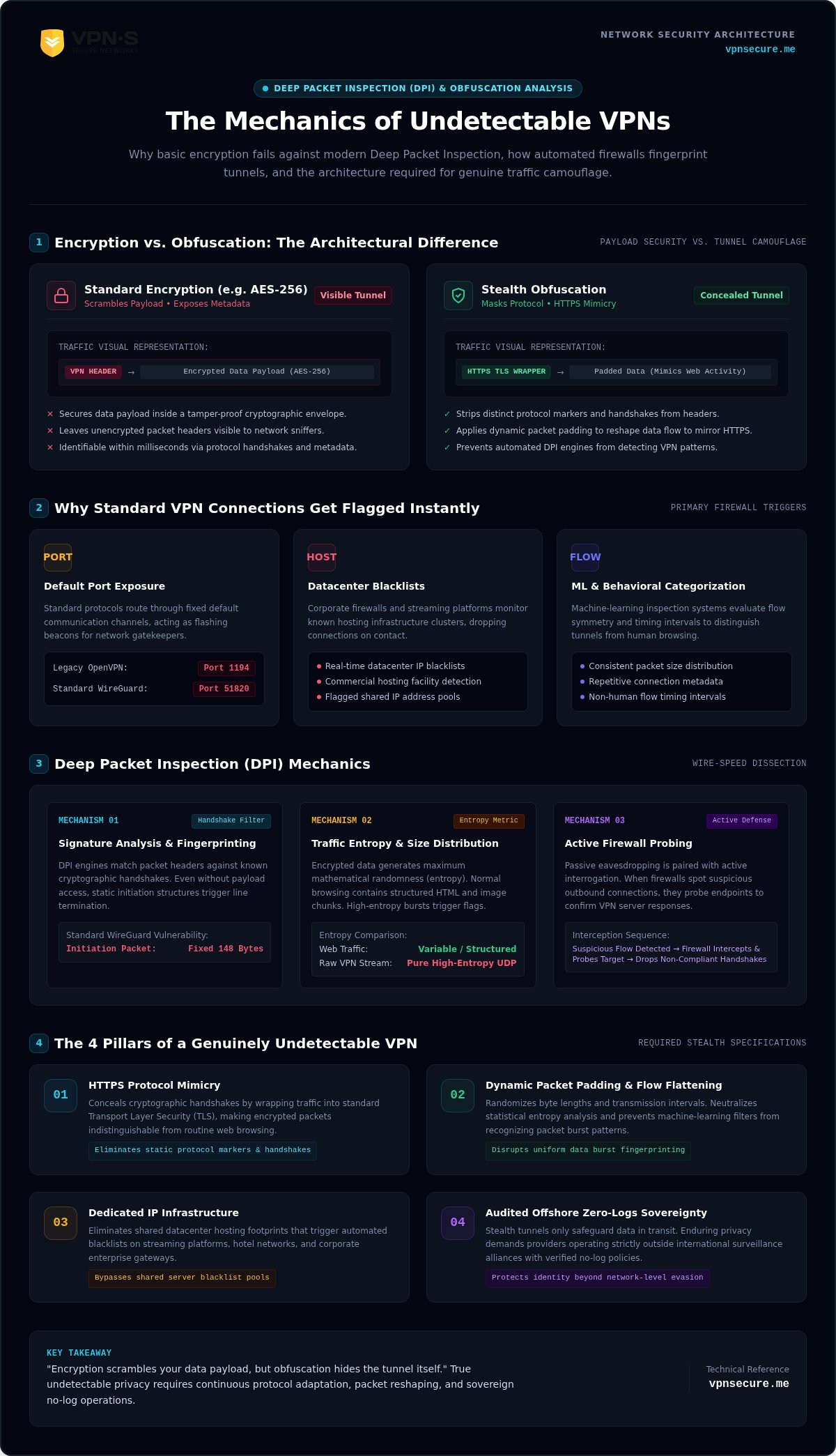
Encryption scrambles your data payload, but obfuscation hides the tunnel itself.
Standard VPN tunnels fail because they produce distinct behavioral footprints. When you stream video or browse the web through a conventional connection, your packets flow in consistent sizes toward known data hosting clusters. Network firewalls evaluate these patterns instantly. If your outbound packets display identical byte distributions while routing to a hosting facility instead of a residential ISP, the gatekeeper flags your line, regardless of how secure the internal cipher might be.
Encryption vs. Obfuscation: The Crucial Difference
Standard AES-256 encryption secures your payload inside a tamper-proof envelope, but it leaves the external shipping label completely exposed to anyone inspecting the wire. Network sniffers identify OpenVPN or WireGuard handshakes within milliseconds by analyzing unencrypted packet headers. Obfuscation solves this vulnerability by stripping distinct protocol markers and padding data lengths, reshaping your entire data stream so it mirrors standard HTTPS web traffic.
Why Standard VPN Connections Get Flagged Instantly
Modern network inspection targets specific structural weaknesses in default configurations. Firewalls drop standard tunnels through three primary triggers:
- Default Port Exposure: Legacy OpenVPN traffic defaults directly to port 1194, while WireGuard listens on port 51820. Both act as flashing beacons for network administrators.
- Public Datacenter Blacklists: Streaming platforms and corporate routers maintain real-time lists of known server hosting ranges, dropping shared commercial IPs on contact.
- Machine Learning Categorization: Modern deep packet inspection systems monitor flow symmetry and timing intervals, isolating machine-generated tunnels from human web browsing.
Circumventing these filters isn’t about finding a static toggle switch. It requires continuous protocol adaptation to keep your packets blending into routine network noise.
Deep Packet Inspection: How Modern Firewalls Expose VPN Tunnels
Basic packet filtering used to check only source ports and destination IP addresses. Modern firewalls don’t stop there. Deep Packet Inspection (DPI) tears into packet payloads at wire speed, dissecting communication sequences to expose the underlying architecture. National telecom operators and enterprise network appliances deploy DPI engines to strip away user autonomy, actively throttling encrypted traffic or dropping essential VOIP calls. If you want a genuinely undetectable vpn, you have to counter the exact analytical mechanisms network gatekeepers use against you.
Signature Analysis and Protocol Fingerprinting
DPI engines match packet headers against a catalog of known cryptographic handshakes. Standard WireGuard, for example, uses a fixed 148-byte initiation packet that reveals its presence immediately. When an automated firewall spots these static header sequences, it severs the line instantly. Even if an unmanaged tunnel attempts to wrap its data in basic Transport Layer Security, the unusual handshake parameters trigger network filters that expect standard browser behaviors.
Traffic Entropy and Packet Size Distribution
Encrypted data generates high mathematical randomness, known as entropy. Normal web traffic doesn’t look like pure statistical chaos; it contains predictable file transfers, image chunks, and structured HTML responses. When a DPI monitor sees an unyielding stream of maximum-entropy UDP packets, it raises an immediate flag. Advanced filtering systems also analyze packet size distributions and transmission intervals. If your connection lacks dynamic packet padding and flow flattening, those uniform data bursts betray your tunnel without decrypting a single byte.
Active Probing: The Advanced Firewall Playbook
Passive eavesdropping is only half the threat. When sophisticated firewalls detect a suspicious outbound connection, they deploy active probing:
- The firewall intercepts the session and replays identical connection requests directly back to your destination server.
- If the remote server drops the connection, stalls, or returns an unverified cryptographic response, the firewall marks the IP as a proxy node.
- The upstream router blacklists the destination IP address across the entire network within seconds.
Defeating these aggressive network sweeps requires resilient routing and dynamic obfuscation techniques. If you need a reliable tunnel that evades deep inspection while keeping your communications private, exploring an audited privacy solution with aggressive obfuscation to bypass network filters ensures your traffic consistently passes strict active verification checks.
Obfuscation Technologies: Which Stealth Methods Actually Work?
Switching your connection to port 443 solves nothing on modern networks. Decades ago, routing traffic through the standard HTTPS port slipped past basic filters. Today, deep packet analyzers inspect everything behind the port number. If a firewall expects a standard web certificate exchange on port 443 but encounters an encrypted tunnel handshake instead, it severs the route instantly. Building a genuinely undetectable vpn requires genuine protocol camouflage, not just superficial port manipulation.
| Stealth Technology | Evasion Capability | Throughput Speed | Setup Complexity |
|---|---|---|---|
| Standard OpenVPN (TCP 443) | Poor | Moderate | Low |
| TLS Wrapping (Stunnel / WSS) | High | Moderate to Slow | Moderate |
| Shadowsocks / SOCKS5 | Very High | Fast | Moderate to High |
| XOR / Scramble Patches | Low to Moderate | Fast | Low |
TLS and SSL Encapsulation (Stunnel & WSS)
TLS tunneling wraps your entire encrypted tunnel inside a secondary, fully compliant Transport Layer Security session. Network monitors inspecting the flow see standard HTTPS web traffic identical to an online banking session. The downside comes down to physics. Encapsulating an already encrypted tunnel inside another TLS wrapper creates significant protocol overhead, noticeably reducing your connection speed.
Shadowsocks and SOCKS5 Proxy Camouflage
Shadowsocks was engineered specifically to defeat aggressive national firewalls. Rather than presenting static protocol signatures, it uses asymmetrical encryption to make outbound packets look like unstructured random web traffic. Standalone SOCKS5 proxies offer blistering speeds by routing only application traffic, but they lack the system-wide operating system protections provided by fully encapsulated network tunnels.
Scramble, XOR Ciphers, and Pluggable Transports
XOR patches alter standard OpenVPN packet headers using a simple mathematical mask to disrupt signature scanners. While this easily defeats primitive enterprise firewalls, modern deep packet analyzers quickly identify the resulting high-entropy data stream. Advanced pluggable transports like Obfs4 modify packet size distributions and inject dynamic timing delays. That heavy timing manipulation keeps your packets off automated blacklists, but it introduces substantial latency spikes that ruin real-time voice and video calls.
Selecting the right stealth method means balancing defensive camouflage with usable performance. Relying on basic port tricks leaves you exposed, while layered protocol masking keeps your encrypted footprint hidden under heavy surveillance.
How to Make Your VPN Connection as Undetectable as Possible
Relying on default client settings leaves obvious clues on the wire. Making your connection an undetectable vpn demands a calculated setup that hardens both the network layer and your local operating system. Take control of your encrypted footprint using this practical deployment blueprint:
- Select an Obfuscated Protocol: Enable stealth encapsulation or protocol scrambling inside your client software to strip recognizable packet headers.
- Force Transmission via TCP Port 443: Lock your outbound traffic to the standard web security port so external filters treat the stream like standard browsing.
- Disable Leaky Network Protocols: Shut down system-level IPv6 and WebRTC inside your browser to stop unauthorized identity disclosures.
- Route Through Strategic Geographies: Connect to resilient nodes designed to handle strict network restrictions smoothly.
- Deploy a Dedicated IP Address: Replace noisy datacenter pools with an exclusive, clean IP address that mimics residential behavior.
Network Configuration and Protocol Selection
Default configurations rely on UDP for maximum speed, but restricted environments drop unclassified UDP streams without warning. Switching to TCP establishes reliable connections that mimic standard internet browsing sessions. Binding that traffic directly to port 443 helps your data blend into normal web activity. When you need dependable routing across restrictive regions, consult this global server coverage guide to pick locations optimized for resilience rather than raw server counts.
Plugging Critical DNS, IPv6, and WebRTC Leaks
Network firewalls spot unpatched leaks faster than protocol anomalies. If your operating system sends DNS queries outside your encrypted tunnel, your real browsing destinations leak to local network logs instantly. Disable IPv6 entirely at the network adapter level unless your VPN provider provides verified dual-stack routing; otherwise, IPv6 requests quietly bypass your tunnel. Finally, disable browser WebRTC interfaces using browser flags or secure extensions to stop websites from pulling your true local IP address behind your back.
The Dedicated IP Advantage for Stealth
Shared server addresses carry significant risks. When hundreds of users route through a single public IP, streaming services, financial platforms, and corporate firewalls flag the address as a hosting facility. This reputation trigger unleashes endless CAPTCHA prompts or complete access blacklists. Securing an exclusive Dedicated IP sidesteps automated reputation blacklists entirely, maintaining uninterrupted access for remote business systems and private international VOIP calls. Travelers who rely on stealth tunnels to access geo-restricted content like live UK television will find that a dedicated IP is equally essential for a reliable VPN for BBC iPlayer abroad, bypassing broadcaster blacklists that instantly flag shared datacenter addresses.
Take charge of your network footprint today. You can secure a dedicated IP with stealth obfuscation to shut down snooping firewalls and navigate the web on your own terms.
Beyond Network Evasion: Why Jurisdiction and Zero-Logs Complete the Shield
Protocol obfuscation only disguises your data while it travels between your device and the destination server. Once your packets exit the tunnel, the technical disguise ends. If the provider operating those exit nodes logs session timestamps, real IP addresses, or traffic volumes under legal compulsion, your stealth shield breaks down. A genuinely undetectable vpn cannot rely purely on cryptographic tricks on the wire; it requires ironclad legal sovereignty that stops third parties from seizing connection records after the fact. Understanding how a VPN to protect browsing history works at the connection level reveals why offshore zero-log architecture is just as critical as protocol camouflage.
The Five Eyes Surveillance Reality
Domestic privacy laws rarely protect you against multinational intelligence alliances. Under agreements like the Five Eyes, member nations legally circumvent domestic wiretapping bans by sharing intelligence intercepted across foreign borders. When a VPN service operates within these jurisdictions, national security letters and gag orders can force engineers to log user sessions in total secrecy. To see how sovereign operational structures prevent these traps, explore the annual VPN privacy overview to understand zero-exposure network design.
The Bahamian Privacy Framework
Legal jurisdiction acts as the ultimate backstop behind network camouflage. VPN Secure has operated out of the Bahamas since 2012, positioning its operations completely outside the Five Eyes alliance and aggressive surveillance treaties. Bahamian judicial precedent requires local court orders before foreign investigators can demand enterprise records. Because our infrastructure runs an audited no-log operational framework, there are no connection records, traffic logs, or user session histories stored on non-volatile media. Foreign agencies cannot seize data that was never recorded in the first place.
Total Digital Autonomy Across All Hardware
Achieving true network stealth requires running airtight defenses across every screen you own. Securing a desktop workstation means nothing if your smartphone leaks location beacons over an unencrypted cellular connection. You can configure your entire workstation and mobile fleet using this cross-platform ecosystem setup to lock down traffic across every operating system. True digital autonomy demands both network stealth and an independent offshore haven. Deploy an undetectable vpn built on audited offshore infrastructure and browse the global internet entirely on your own terms.
Reclaim Your Digital Sovereignty with Intelligent Obfuscation
Relying on basic encryption while navigating restrictive networks is a losing strategy. Network monitors don’t need to crack your cipher to sever your line; they flag the static handshakes and dirty datacenter footprints left behind. Building a genuinely undetectable vpn requires dynamic protocol camouflage that blends with regular web browsing, paired with clean routing that bypasses automated blacklists entirely.
Technical stealth is only as dependable as the legal framework backing it. Real security demands infrastructure operating outside domestic surveillance treaties, where zero-log policies are upheld by law rather than marketing rhetoric. Since 2012, VPN Secure has maintained an offshore base in the Bahamas, operating entirely beyond the reach of Five Eyes agreements. Combined with an audited zero-log architecture, optimized servers across 40+ countries, and exclusive dedicated IP options, you gain an uncompromising shield against network interference.
Don’t let aggressive firewalls dictate how you communicate, work, or access information. Take control of your encrypted footprint today. Arm your connection with offshore privacy from VPN Secure and experience the open web without restrictions.
Frequently Asked Questions
Is any VPN truly 100% undetectable in 2026?
No provider can guarantee absolute mathematical invisibility on a network. An undetectable vpn works by using cryptographic camouflage to mimic standard HTTPS browsing sessions rather than vanishing completely. Your internet service provider can always see the timestamps, volume, and destination IP address of your connection. What effective stealth tools prevent is automated classification, active probing identification, and immediate protocol-level filtering by intermediate network firewalls.
How do internet service providers detect standard VPN usage?
Internet service providers identify connections by checking destination port numbers and inspecting unencrypted packet headers. Standard configurations broadcast distinct cryptographic handshakes that network monitors recognize instantly. Telecommunication providers also maintain extensive databases of known commercial hosting facilities. When your traffic routes steadily into an IP block registered to an enterprise server farm instead of a typical residential web host, automated systems immediately flag the tunnel.
What is VPN obfuscation and how does it hide traffic?
VPN obfuscation scrambles packet metadata and headers to strip away recognizable protocol signatures. Instead of broadcasting clear handshakes that announce a private tunnel, obfuscation wraps data inside secondary transport layers like TLS. This transformation makes your encrypted stream resemble ordinary web browsing to external network sniffers. It neutralizes passive traffic analysis by shaping packet sizes, ensuring your line avoids automated inspection rules.
Can Deep Packet Inspection block obfuscated stealth VPNs?
Advanced deep packet inspection engines can disrupt obfuscated connections through active probing and behavioral entropy scanning. When an appliance detects high-entropy data flowing to an unfamiliar destination, it sends automated challenge packets directly to the receiving server. If that remote node fails to respond like a genuine web host, the firewall blacklists the address. Modern evasion requires servers engineered to handle active probes gracefully without exposing their underlying proxy mechanisms.
Does using an undetectable VPN slow down internet browsing?
Stealth protocols carry a measurable speed penalty compared to standard connections. Wrapping encrypted data within secondary TLS sessions or scrambling packet headers creates processing overhead and increases total packet size. While basic web browsing and streaming remain smooth on high-performance networks, users will notice higher latency during competitive gaming. The trade-off is deliberate: you sacrifice marginal throughput to gain reliable connectivity across heavily filtered networks.
Why do streaming platforms block VPNs if my IP is hidden?
Streaming services block connections by monitoring the reputation of destination addresses rather than decrypting traffic payloads. When thousands of subscribers stream media simultaneously through a shared datacenter IP, security systems flag the cluster as an automated proxy. The platform doesn’t need to crack your encryption; it simply blacklists the shared server address. Switching to an exclusive Dedicated IP bypasses this footprint by providing an untainted address. The same IP reputation mechanics that affect general streaming platforms make clean dedicated addresses equally critical when using a VPN for BBC iPlayer abroad, where the broadcaster’s detection systems are among the most aggressive in the industry.
Is using an undetectable stealth VPN legal in restricted regions?
Legality depends entirely on local national laws and specific telecommunications regulations. Several jurisdictions restrict or outright prohibit non-state-approved encryption software, while others permit private networks solely for registered business operations. Using an undetectable vpn to camouflage your network activity does not grant immunity from regional legal frameworks. Users should review their local regulatory landscape before connecting across restricted borders.
How does a dedicated IP address make VPN connections stealthier?
A dedicated IP provides a unique, unshared address that you alone control, preventing the abusive behavioral triggers tied to shared hosting pools. Commercial shared IP addresses trigger fraud detection systems and aggressive verification puzzles because multiple unrelated accounts access services through the exact same gateway. An exclusive address looks like an ordinary private connection, bypassing automated streaming filters and stabilizing sensitive remote access logins. For a deeper look at how encrypted tunnels shield your web activity from ISPs and data brokers, the complete VPN to protect browsing history privacy guide explains exactly what gets exposed without proper encryption in place.