




What if choosing a VPN outside Five Eyes changes less than you think? The alliance shares intelligence, but membership alone doesn’t determine what a VPN provider must disclose. That depends on the laws and courts that apply to the provider, which may be different from the countries where its servers are located.
It’s reasonable to ask whether a VPN outside five eyes offers stronger privacy. A provider based beyond the alliance’s member jurisdictions may face a different legal environment, but an offshore address isn’t a privacy force field. A no-logs claim matters only when the provider’s policies and practices support it, and its technical design affects what information may exist to disclose.
This guide explains what Five Eyes, Nine Eyes, and Fourteen Eyes mean for VPN users, and how jurisdiction fits into the bigger picture. Use the checklist to examine logging policies, ownership, transparency, and technical safeguards. That way, you can compare providers using more than a map or a marketing slogan, and decide whether an offshore VPN fits your privacy priorities.
Key Takeaways
- A VPN outside five eyes operates beyond the alliance of the United States, United Kingdom, Canada, Australia, and New Zealand, but location alone doesn’t determine how the provider handles data.
- To understand what a provider could disclose, identify the company operating the service, the legal process that may apply, the information it retains, and whether its systems can retrieve it.
- Compare providers by their logging policies, ownership transparency, security practices, and supporting evidence instead of treating location as a privacy guarantee.
- Before choosing or renewing a VPN, check its data practices, policy details, and evidence for its claims.
- VPN Secure identifies as Bahamas-based. Consider this relevant context alongside its policies and practices, not proof of immunity from legal requests.
What Does VPN Outside Five Eyes Mean for Your Privacy?
A VPN provider outside Five Eyes is a service operated by a company legally based outside the United States, United Kingdom, Canada, Australia, and New Zealand, the alliance’s five members. That location may matter when authorities seek information from the provider. It doesn’t tell you, by itself, what the service collects or can disclose.
Five Eyes is an intelligence-sharing partnership. Its members cooperate on intelligence matters, but that doesn’t mean every member automatically receives every person’s data. The Five Eyes intelligence alliance has broader historical and political context than a simple list of countries. Treat the label as a starting point for research, not a verdict on a VPN’s privacy.
Which countries are in Five Eyes, Nine Eyes, and Fourteen Eyes?
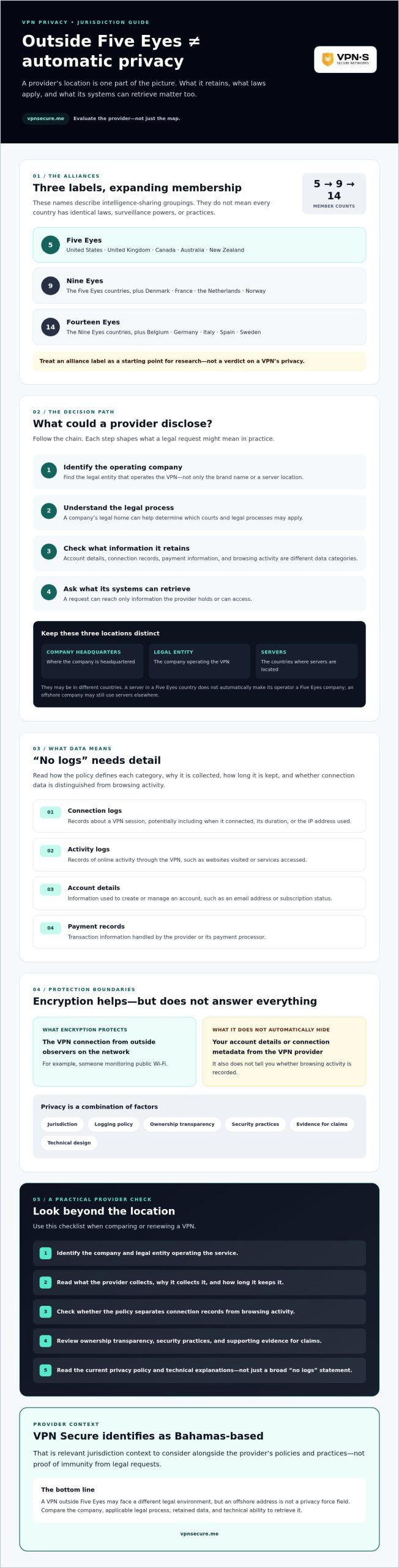
Five Eyes comprises the United States, United Kingdom, Canada, Australia, and New Zealand. Nine Eyes is commonly described as those five plus Denmark, France, the Netherlands, and Norway. Fourteen Eyes adds Belgium, Germany, Italy, Spain, and Sweden. These labels describe intelligence-sharing groupings. They don’t mean every country has identical laws, surveillance powers, or practices.
Why does a VPN user’s provider jurisdiction matter?
A company’s legal home can help determine which courts and legal processes may apply to it. Start by separating three details that are often blurred together: the company’s headquarters, the legal entity operating the VPN, and the locations of its servers. They may be in different countries. A server in a Five Eyes country doesn’t automatically make its operator a Five Eyes company, and an offshore company may still use servers elsewhere.
Legal exposure is only part of the picture. A request can reach only information the provider holds or can access. Account details and connection records create different privacy considerations from browsing activity the provider doesn’t record. If a service collects little data, there may be less available to disclose, but you still need to examine its policy and technical design.
A VPN outside Five Eyes may reduce exposure to some jurisdictions, but it can’t promise anonymity or immunity from lawful requests. Assess the provider’s legal entity alongside its logging policy, ownership, security practices, and evidence for its claims. Jurisdiction matters, but it isn’t the whole picture.
How VPN Jurisdiction, Data Requests, and Logging Fit Together
A privacy claim is useful only when you know what it covers. To assess a VPN, follow the chain: identify the company’s operating legal entity, determine which legal process may apply, find out what information the provider holds, and ask whether its systems can retrieve that information. A VPN outside five eyes may face a different legal environment, but its location doesn’t answer the other questions.
Encryption protects the VPN connection from outside observers on the network, such as someone monitoring public Wi-Fi. It doesn’t automatically hide your account details or connection metadata from the VPN provider, and it doesn’t tell you whether the provider records browsing activity. Check those issues separately in the provider’s current privacy policy and technical explanations.
What information could a VPN provider hold?
Providers may handle several types of information. Check how the policy defines each one:
- Connection logs: Records about a VPN session, potentially including when it connected, its duration, or the IP address used.
- Activity logs: Records of online activity through the VPN, such as websites visited or services accessed.
- Account details: Information used to create or manage an account, such as an email address or subscription status.
- Payment records: Transaction information handled by the provider or its payment processor.
Account or payment information may be needed to provide a subscription, while browsing records are a separate category. Don’t rely on a broad “no logs” label alone. Check what the provider says it collects, why it collects it, how long it keeps it, and whether the policy distinguishes connection data from browsing activity.
Can a foreign government request VPN user data?
A foreign authority can’t automatically access a VPN provider’s data just because the service has servers or customers in that country. Whether a request can be made, recognized, or enforced depends on applicable law, the provider’s legal and operational circumstances, and the type of information sought. International frameworks can support cooperation in some cases. The Council of Europe’s Budapest Convention on Cybercrime is one example, but it doesn’t mean every request is automatically granted.
Specific obligations vary, so claims about a particular country or provider need current legal verification. For a practical comparison, check the operating entity, the provider’s published data practices, and any available evidence supporting its claims. You can also review VPN service information as part of your research, then apply the same checklist you use for other providers.
Does Choosing a VPN Outside Five Eyes Guarantee Privacy?
No. Choosing a VPN outside Five Eyes doesn’t guarantee privacy or anonymity. A provider’s location can shape its legal context, but it can’t tell you what information the company collects, who controls it, or how well its systems protect it. Apply the same scrutiny to providers inside the alliance: location alone doesn’t prove a service is unsafe, and an offshore address doesn’t prove it’s trustworthy.
What an offshore location can, and cannot, tell you
“Offshore” is a clue to investigate, not a shield from every legal request. A provider’s headquarters, operating legal entity, and server locations can all differ. A company may be based in one country and operate servers in several others. Check each detail separately, and avoid assuming an offshore VPN is automatically safer, more private, or beyond legal reach.
Assess the whole service, not just the map:
- Jurisdiction: Which legal entity operates the service, and where is it established?
- Logging policy: What does the provider define as logs, and what does it say it retains?
- Ownership: Can you identify the company and the people or organizations behind it?
- Security practices: Does the provider explain how it protects accounts, connections, and stored data?
- Independent evidence: Are audits or transparency reports available, and do they cover the claims you care about?
Why a no-log claim needs more than a headline
“No logs” sounds clear, but the details determine what it means. Does the policy rule out browsing activity only, or does it also address connection metadata? Are there exceptions for account operation, troubleshooting, or security? How long is any collected data retained? Read the policy rather than assuming the slogan covers every type of information.
Independent audits and transparency reports can help, but only when you can verify the evidence exists and understand its scope. An audit may assess a particular system or point in time, not every part of a provider’s operation. Don’t treat “audited” as a universal stamp of approval. For a closer look at what evidence a no-logs claim needs, read this no-log VPN audit guide.
A VPN outside five eyes may suit your privacy priorities, but base the decision on evidence. Compare the provider’s legal identity, policy, ownership, security explanations, and verifiable proof. A balanced assessment is more useful than blind trust or blanket suspicion.
How to Evaluate a VPN Outside Five Eyes: A Practical Checklist
Use this checklist before choosing a provider or renewing a subscription. A VPN outside five eyes may be relevant to your privacy goals, but your decision should rest on more than geography. Check what the company says, what it can demonstrate, and whether those claims apply to the service you plan to use.
- 1. Identify the operator. Find the legal entity behind the VPN, where it’s based, and who owns or controls it. Don’t confuse the brand name, headquarters, and server locations.
- 2. Read the privacy policy closely. Look for plain explanations of data collected, retained, and shared. Check whether the policy distinguishes account details and connection information from browsing activity, and whether it explains exceptions.
- 3. Check for data minimization. Ask whether the provider explains why it needs each category of information and how long it keeps it. Less collection can mean less data to protect or disclose, but verify the details rather than assuming.
- 4. Look for evidence. Check whether security or no-logs claims have supporting evidence, such as an independent assessment or transparency reporting. Confirm what was examined, when, and whether the evidence covers the apps and systems you use.
- 5. Confirm the claim’s scope. Do the policy and security statements apply to every app, server, and account type, or are there stated exceptions? Check the policy’s update date and compare it with the provider’s current explanations.
Quotable rule: A provider’s jurisdiction describes the legal context; its data-handling practices determine what information it collects, retains, and may be able to retrieve.
Signals that deserve closer scrutiny
Pause when a provider promises total privacy or says it keeps “nothing” without defining what those words mean. Broad promises aren’t proof of wrongdoing, but they leave important questions unanswered. Look for a specific policy, clear ownership information, a visible update date, and independent evidence with a defined scope. If those details are missing, ask the provider or compare alternatives before relying on the claim.
Your needs matter, too. If you’re choosing a VPN for a trip, consider travel-specific risks alongside provider jurisdiction. This secure VPN travel guide can help you think through that context.
Use the same checklist for any provider, including VPN Secure. Review VPN Secure’s service information and weigh its published details against these questions before deciding whether it fits your needs.
VPN Secure’s Bahamas Base: How to Assess the Provider, Not Just the Map
VPN Secure identifies as Bahamas-based, a detail that may matter when comparing a VPN outside five eyes. But a provider’s stated location isn’t a guarantee of privacy or protection from legal process. Verify the current operating entity and which company is responsible for the service. Then look beyond its address to the provider’s current policies and available evidence.
What VPN Secure’s stated jurisdiction means in practice
VPN Secure describes its service as no-log and says it offers encrypted connections across servers in more than 40 countries. These are company claims, not proof that the service retains no data or that its practices have been independently verified. The Bahamas base refers to the provider’s stated location; it doesn’t mean all its servers are there. Server location and company identity are separate details.
Don’t infer how a particular data request would be handled from the Bahamas address alone. That would require current, verified information about the operating entity and relevant legal circumstances. Jurisdiction helps frame the question, while the provider’s data practices help answer it. Check what the privacy policy says the service collects, retains, or shares, and look for verifiable evidence supporting its claims.
When an offshore VPN provider may fit your privacy priorities
An offshore provider may be worth considering if its jurisdiction aligns with your preferences, but weigh that alongside the safeguards you need. Review whether the privacy policy is clear, whether encryption and security practices are explained, whether the apps support your devices, and whether transparency claims have evidence behind them. Check whether those details apply across the service, including its apps, servers, and account types.
VPN Secure’s subscription service is one option to evaluate using the same criteria as any other provider. Confirm its current operating entity, read its privacy information, and assess what evidence is available before deciding whether its stated Bahamas base and company-described no-log policy suit your needs.
If you’re weighing those details, review VPN Secure’s service and privacy information and compare it with your requirements.
Choose Your VPN With Evidence, Not Assumptions
A VPN outside five eyes can offer a different jurisdictional context, but location alone can’t guarantee privacy or anonymity. Consider how the provider’s legal home, data policies, ownership, and technical practices fit together. Check what information the service collects and retains, and look for evidence supporting its privacy claims.
VPN Secure states that it’s based in the Bahamas and describes its service as no-log. Treat these as company claims to assess, not proof of immunity from legal requests or independently verified privacy practices. Before choosing, review the current operating entity, privacy policy wording, and any supporting evidence available.
Privacy decisions don’t have to rely on guesswork. Ask clear questions, verify the answers, and choose the service that best fits your priorities.
Frequently Asked Questions
What does it mean when a VPN is outside Five Eyes?
It generally means the VPN’s operating company is based outside the United States, United Kingdom, Canada, Australia, and New Zealand, the Five Eyes members. The alliance involves intelligence cooperation, but that doesn’t mean every member receives every user’s information. A VPN outside five eyes may have a different legal context. Check the provider’s legal entity separately from its headquarters, brand, and server locations.
Is a VPN outside Five Eyes safer for privacy?
Not automatically. A provider’s jurisdiction can be relevant to the legal processes that may apply, but it doesn’t reveal what data the company collects, retains, or protects. Compare the privacy policy, ownership disclosures, security practices, and available independent evidence. An alliance-country provider may collect little data and explain its practices clearly; an offshore provider may offer fewer details. Judge the evidence, not just the map.
Can Five Eyes countries access VPN user data?
There’s no automatic access simply because a VPN serves users or operates servers in a Five Eyes country. Whether authorities can request or obtain information depends on applicable law, the provider’s circumstances, and what data it holds or can retrieve. Account records, connection metadata, and browsing activity are different categories. Don’t assume a provider can hand over data it doesn’t collect, or that it can ignore every lawful request.
Does a VPN outside Five Eyes keep no logs?
No. Being outside the alliance doesn’t determine whether a provider logs activity or connection details. “No logs” is a provider’s claim that needs a clear definition. Check which data types it covers, any exceptions, and how long information is retained. Also check whether the claim applies across the apps, servers, and account types you use. Jurisdiction and logging policy are separate parts of a privacy assessment.
What is the difference between Five Eyes, Nine Eyes, and Fourteen Eyes?
Five Eyes refers to the United States, United Kingdom, Canada, Australia, and New Zealand. Nine Eyes is commonly described as those five plus Denmark, France, the Netherlands, and Norway. Fourteen Eyes commonly adds Belgium, Germany, Italy, Spain, and Sweden. These labels refer to intelligence-sharing groupings, not identical laws or surveillance practices. Membership alone doesn’t show what information a VPN provider collects or what it may be required to disclose.
Is the Bahamas part of the Five Eyes alliance?
No, the Bahamas isn’t one of the Five Eyes members. VPN Secure identifies as Bahamas-based, but that stated location is context, not proof of immunity from legal process or a guarantee of privacy. Verify the current operating entity and review the provider’s policy and supporting evidence. Also distinguish the company’s stated base from its server locations, which may be in other countries.
How can I verify a VPN provider’s no-log claim?
Start with the current privacy policy. Check what the provider calls a log, what information it collects or retains, why it needs that data, and whether exceptions apply. Look for independent audits or transparency reports only when you can verify they exist and understand what they cover. Confirm the evidence applies to the relevant apps and systems, and check the policy’s update date. A slogan alone isn’t proof.
Ready to compare VPN Secure with your privacy requirements? Review VPN Secure’s service and privacy information alongside the checklist above.