




What if your VPN’s “no-log” promise is actually just a pinky swear that crumbles the moment a federal subpoena hits the desk? It is a hard truth to swallow, but most users are operating under a false sense of security. If your provider is based within the reach of the Five Eyes alliance, your activity isn’t just monitored; it’s practically archived. Understanding VPN data privacy laws is no longer a niche hobby for tech enthusiasts. It is your final line of defense in an era where global GDPR fines surpassed €5 billion in 2025 and state surveillance is at an all-time high.
You probably feel overwhelmed by the complex web of international regulations and contradictory marketing jargon. We get it. You want a shield, not a law textbook. This guide will discover why the legal home of your VPN determines whether your data is actually private or just waiting for a government order. We will explore the specific benefits of the Bahamian jurisdiction, including how the current legal framework protects you while the country moves toward even stronger 2025 standards. By the end, you will have a clear framework for evaluating any VPN’s legal home so you can navigate the web on your own terms.
Key Takeaways
- Understand why a VPN jurisdiction acts as a legal kill switch, overriding any marketing promises about no-log policies.
- Learn how VPN data privacy laws in Five Eyes countries can force providers to log your data in secret using gag orders.
- Discover the specific legal protections offered by Bahamian sovereignty and the Data Protection (Privacy of Personal Information) Act.
- Master a two step audit process to verify a provider’s true registration and check for government interference via warrant canaries.
- See why being based in the Bahamas since 2012 makes a VPN legally incapable of complying with foreign data retention demands.
The Jurisdiction Trap: Why Your VPN’s Home Base Is Its Weakest Link
Your VPN’s home base is the most critical part of your security stack, yet it is usually the most ignored. Jurisdiction is the legal framework a provider must obey. It is the physical and legal location where the company is incorporated and where its officers reside. If a VPN is registered in London, it follows UK law. If it is based in Washington D.C., it answers to US federal courts. It is that simple. Your data is only as private as the laws of the country where your VPN is headquartered.
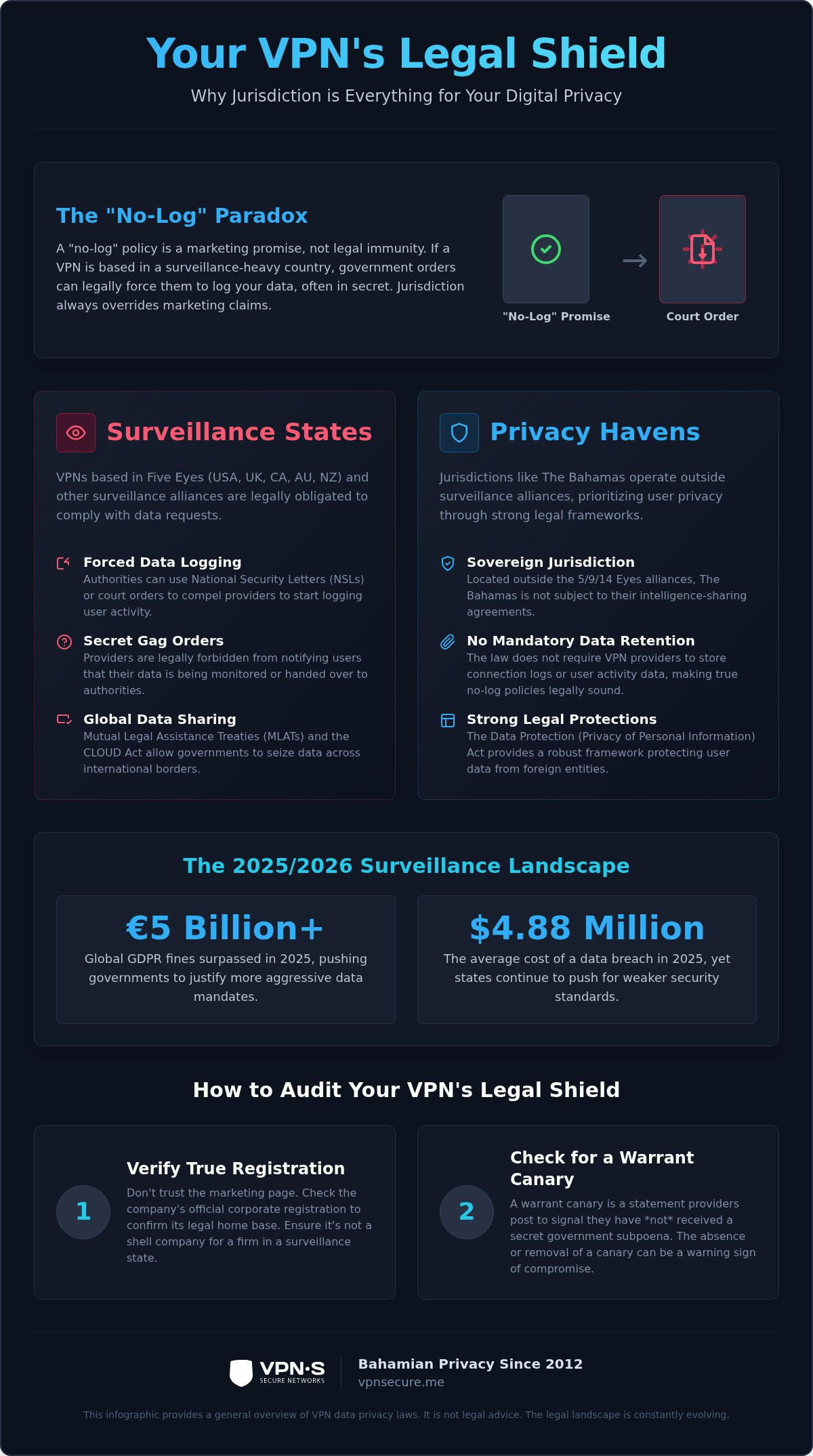
This creates the “No-Log” Paradox. A no-log policy is a business practice, but it is never a legal immunity. If a government issues a valid court order or a wiretap mandate, the VPN provider must comply or face massive fines and jail time. In a surveillance state, a marketing promise is just a line item in a budget. When a judge signs a warrant, that “no-log” promise becomes legally void. You are left choosing between a “Safe Haven” that protects you and a “Surveillance State” that treats your privacy as a suggestion.
Subpoenas and National Security Letters
The legal pressure is real and often invisible. In many Western jurisdictions, authorities use National Security Letters (NSLs) to bypass traditional oversight. These often come with gag orders that legally prevent a VPN provider from notifying its users that their data is being intercepted. The US CLOUD Act further complicates this by allowing authorities to seize data even if it is stored on a server located in another country. Jurisdiction overrides any marketing ‘no-log’ claim every single time. If the law says they must log your activity, they will log it, and they likely won’t be allowed to tell you why.
The 2026 Surveillance Landscape
We are seeing a massive shift in VPN data privacy laws as we move through 2026. Governments are no longer just asking for metadata; they are demanding backdoors into encryption protocols. Global GDPR fines surpassed €5 billion in 2025, and states are using that regulatory momentum to justify new, aggressive data retention mandates. The average cost of a data breach reached $4.88 million in 2025, yet governments continue to push for weaker security standards to facilitate state monitoring.
Traditional “safe” countries in Europe are tightening their grip on digital borders. If your VPN is registered within the Five Eyes intelligence alliance, your data is effectively part of a global intelligence-sharing network. You aren’t just hiding from one agency; you are trying to outrun a collective of the world’s most powerful surveillance machines. By 2026, at least 47 countries have enacted mandatory data retention laws specifically targeting VPN providers, which is why understanding your no log vpn jurisdiction has become the single most important factor in evaluating any provider. To stay truly private, you must look toward sovereign jurisdictions like the Bahamas that sit outside these alliances and prioritize individual autonomy over state interference.
Decoding VPN Data Privacy Laws: 5 Eyes vs. Offshore Havens
Choosing a VPN based in a surveillance state is like locking your front door but handing the key to the local police department. Most users think a “no-logs” claim is an absolute shield. It isn’t. The real battleground is the network of international treaties that dictate VPN data privacy laws. These agreements turn your digital footprint into a shared resource for global intelligence agencies. If your provider is in the wrong country, your data is never truly yours.
The primary mechanism for this data sharing is the Mutual Legal Assistance Treaty (MLAT). These treaties allow countries to bypass local privacy hurdles to share evidence. If the US wants data held by a UK company, an MLAT streamlines the process. This legal bypass makes it easy for authorities to hop borders and collect information that would otherwise be protected by local laws. It is a global intelligence dragnet that rarely makes the headlines.
The Five Eyes Alliance in 2026
The core of this surveillance machine is the Five Eyes alliance. This group includes the United States, United Kingdom, Canada, Australia, and New Zealand. They operate on a “collect once, share with all” model. If one member intercepts your traffic, the other four have immediate or near-immediate access to it. This alliance has expanded into the Nine Eyes and Fourteen Eyes, pulling in most of Europe and parts of Asia. You can read our full breakdown of Five Eyes vs 9 Eyes vs 14 Eyes VPN to see how deep the rabbit hole goes.
GDPR vs. Offshore Privacy Laws
Don’t let the GDPR fool you. While it is excellent for protecting you from greedy corporations, it is practically useless against a state sword. GDPR provides a “Right to be Forgotten,” but most EU nations have a secondary “Duty to Retain” for national security purposes. These retention laws often force companies to store connection logs for months or years, regardless of what their privacy policy says.
Offshore jurisdictions like the Bahamas operate differently. They prioritize individual privacy over international requests. The current VPN data privacy laws in this region are built on sovereignty. For example, the data protection laws in The Bahamas are undergoing modernization with the 2025 Act to align with international standards without sacrificing the core principle of user autonomy. By positioning yourself in a neutral territory, you gain a legal “kill switch” that surveillance states simply cannot override. It’s time to move your digital life to offshore VPN protection that actually stands its ground.
The Bahamas Advantage: Why ‘Offshore’ Isn’t Just for Billionaires
Privacy shouldn’t be a luxury reserved for the ultra-wealthy. While billionaires hide their assets in offshore accounts, you should be hiding your digital life in offshore jurisdictions. The Bahamas offers a level of digital sovereignty that most Western nations abandoned years ago. It is a sovereign nation with a legal system designed to protect personal autonomy rather than facilitate state surveillance. When you analyze VPN data privacy laws globally, the Bahamas stands out because it simply refuses to play the surveillance game.
The Bahamas is not a member of any major global surveillance alliances. There is no “backdoor” agreement or secret treaty that forces Bahamian companies to hand over data to foreign agencies. This independence is codified in the Data Protection (Privacy of Personal Information) Act. While a new, GDPR-modeled Data Protection Act was passed in late 2025, it remains under consultation as of September 2026. This means the current framework still offers a unique shield against overreaching international requests. It places the burden of proof on the accuser, not the individual.
No Mandatory Data Retention
The biggest threat to your privacy is mandatory data retention. In the UK and Australia, strict laws require telecommunications providers to store your metadata for up to two years. In the Bahamas, those laws don’t exist. There is no legal requirement for a VPN to keep logs of your activity. This legal void creates a fortress for your data. If the information isn’t recorded, it can’t be seized. It’s a simple, effective defense that surveillance states hate. You can’t be forced to give up what you don’t have.
Sovereign Legal Protection
Foreign agencies can’t just “fish” for data on Bahamian servers. If a US agency wants information, they can’t just send a subpoena to Infinite Quant Ltd and expect a result. They must prove to a Bahamian court that a serious crime has been committed under Bahamian law. Vague “fishing expeditions” are legally thrown out of court. As a Bahamian-registered entity, we operate under these strict protections. The Bahamas treats your digital presence with the same respect it treats your physical property. You aren’t just a user; you are a protected individual under a sovereign legal shield.
How to Audit Your VPN’s Legal Shield Before You Buy
Marketing is easy. Law is hard. Don’t fall for a “we care about privacy” banner on a homepage. Most VPN providers hide their real legal ties behind layers of shell companies and flashy website designs. To find the truth, you have to look past the interface. You need to verify the legal machinery that dictates how your data is handled when a government comes knocking. Auditing your provider’s legal standing is the only way to ensure your VPN data privacy laws actually favor you instead of a state agency.
- Locate the parent company registration: Don’t look at the marketing office in London or New York. Find where the business is incorporated. This is the only jurisdiction that matters.
- Check the Warrant Canary: Look for a recent, cryptographically signed statement. If it hasn’t been updated, assume the worst.
- Analyze the fine print: Scour the privacy policy for terms like “troubleshooting logs,” “session duration,” or “connection timestamps.” These are often loopholes used to bypass no-log claims.
- Verify the jurisdiction’s history: Has this country ever handed over data to the FBI, Europol, or the Five Eyes alliance? A clean track record is mandatory.
The Warrant Canary: Your Early Warning System
A warrant canary is a “dead man’s switch” for your privacy. Because authorities in surveillance states can legally forbid a company from admitting they’ve been served a secret warrant, the company simply stops saying they haven’t. If a canary disappears or misses an update, the silence is a scream. It means the legal shield has been pierced. You should treat a missing canary as a direct signal to move your data elsewhere. You can learn more about why these audits are critical in our guide to the No-Log VPN Audit.
Evaluating the ‘No-Log’ Claim
An audit is only as good as the jurisdiction that oversees it. A “zero logs” claim from a provider based in the US, UK, or EU is a massive red flag. These regions have the legal power to force a company to start logging in secret, rendering any previous audit irrelevant. When you audit a provider, use our no log vpn jurisdiction checklist to systematically verify that your provider’s legal home actually protects your data from government subpoenas. Look for the Infinite Quant Ltd registration as a mark of Bahamian protection. This registration ensures that your data is governed by sovereign laws that prioritize your autonomy over foreign intelligence requests. If you’re ready to stop guessing and start protecting your traffic, it is time to choose Bahamian VPN protection that stands up to scrutiny.
VPN Secure: Bahamian Privacy Built for the Modern Internet
We didn’t build VPN Secure to fit into the existing global surveillance system. We built it to bypass it. Since 2012, our mission has been clear: providing a digital shield that actually holds up under pressure. While other providers play word games with their terms of service, we anchored our entire operation in the Bahamas. This wasn’t a random choice. It was a strategic move to ensure that VPN data privacy laws work for you, not against you. We answer to Bahamian courts, not foreign intelligence agencies.
Our commitment to your autonomy is absolute. We operate under a strict no-log policy that is verified by the very jurisdiction we call home. Because Bahamian law does not mandate data retention, we simply don’t keep the information that governments want to seize. No connection logs. No activity logs. No compromise. You get the peace of mind that comes from knowing your provider is legally incapable of betraying your trust. It is the difference between a marketing promise and a legal reality.
Offshore Servers, Global Speed
Privacy shouldn’t come at the cost of performance. We provide access to high-speed servers in 40+ countries, but here is the critical part: they all operate under our Bahamian legal umbrella. You can bypass geo-restrictions, unlock streaming content, and circumvent VOIP blocks in restrictive regions without inheriting the legal baggage of those locations. Whether you are working from a cafe in Paris or traveling through Southeast Asia, your traffic remains protected by the sovereign laws of the Bahamas. We make this level of elite protection accessible to everyone, with pricing starting at just $2.99/mo for those who want a robust entry point into offshore privacy.
Your Shield Against the Five Eyes
The modern internet is a minefield of data collection. Between ISP tracking and the reach of the Five Eyes alliance, your digital footprint is constantly under threat. If you want to understand exactly how to hide your IP address from ISPs and government surveillance agencies, our complete privacy guide walks you through every method available in 2026. VPN Secure acts as your vigilant ally, offering multi-device support so you can protect your entire digital life, from your smartphone to your laptop. We provide the tools you need to take back control of your data and browse on your own terms. Don’t leave your personal information at the mercy of outdated VPN data privacy laws in surveillance-heavy nations. It is time to choose a guardian that is as independent as you are. Secure your privacy with VPN Secure today and experience the freedom of a truly private internet.
Secure Your Digital Borders Today
You now understand that VPN data privacy laws aren’t just technical fine print; they are the legal walls of your digital home. If your provider is registered in a surveillance state, those walls are made of glass. We’ve exposed how global alliances turn your private traffic into a shared government asset. The only real solution is a sovereign jurisdiction that prioritizes your autonomy over international subpoenas. The Bahamas isn’t just a location; it is your final line of defense.
VPN Secure has acted as a vigilant ally for individuals since 2012. We operate outside the Five Eyes alliance to ensure your no-log protection is a legal certainty, not a marketing gimmick. It is time to stop being a target and start being a ghost. You can try our Bahamian-based protection with complete confidence thanks to our 30-day money-back guarantee. Take Control of Your Privacy with VPN Secure and start browsing on your own terms. Your digital freedom is worth defending.
Frequently Asked Questions
Is a VPN based in the Bahamas legal?
Yes, it is perfectly legal. The Bahamas is a sovereign nation with established business laws. Using a VPN based here follows the same legal standards as any other international service. The difference is that the local legal framework, specifically the Data Protection (Privacy of Personal Information) Act, protects the user rather than the surveillance state. It is a legitimate, recognized business hub for privacy-focused technology that operates with full transparency.
Can the US government force a Bahamian VPN to log data?
No, the US government has no direct jurisdiction over Bahamian companies like Infinite Quant Ltd. To request any information, a US agency must go through the Bahamian court system. They must prove a crime occurred under Bahamian law. Since there are no mandatory data retention laws in the Bahamas, there is no log to seize even if they tried. We operate entirely outside the reach of secret US subpoenas and gag orders.
What is the difference between Five Eyes and Fourteen Eyes?
The difference is the scale of the global surveillance dragnet. The Five Eyes is the core alliance (US, UK, Canada, Australia, NZ) that shares almost all intelligence. The Fourteen Eyes is a broader group that includes most of Europe. They use Mutual Legal Assistance Treaties to bypass local VPN data privacy laws and share your data across borders. Staying outside all these alliances is the only way to remain truly invisible to state monitoring.
Does a no-log policy matter if the VPN is in the US?
It matters very little when a secret warrant is involved. US laws allow authorities to serve National Security Letters with gag orders. These can legally force a provider to start logging a specific user while forbidding them from admitting it. In this scenario, the “no-log” policy is legally overridden by the state. Jurisdiction is the only thing that makes a no-log claim enforceable in a court of law rather than just a marketing promise.
Are offshore VPNs slower than US-based ones?
Physical location does not dictate speed; network infrastructure does. We maintain high-speed servers in 40+ countries. While our legal headquarters is in the Bahamas, you connect to the server closest to your physical location. This gives you the speed of a local connection with the legal protection of an offshore jurisdiction. You get the best of both worlds: lightning-fast browsing and a sovereign legal shield that US-based providers simply cannot offer.
What happens if a VPN company is bought by a company in a Five Eyes country?
The VPN immediately becomes subject to the laws of the parent company’s country. If a US firm buys a Bahamian VPN, the US government can then use domestic laws to demand data from the entire organization. This is why we have remained an independent, privately owned entity under Infinite Quant Ltd since 2012. We refuse to compromise our Bahamian status because it is our most valuable asset for protecting your digital autonomy and long-term privacy.
How do I know if my VPN is actually based in the Bahamas?
You must verify the legal entity in the Terms of Service or registration documents. Don’t trust a flag on a website. Look for the registered business name, such as Infinite Quant Ltd, and check the official Bahamian corporate registry. Many providers use “marketing offices” in the US or UK while claiming offshore status. If the parent company isn’t registered in the Bahamas, you aren’t protected by Bahamian VPN data privacy laws or sovereign legal standards.
Is the Bahamas better for privacy than Switzerland or Panama?
The Bahamas offers unique sovereignty and a specific refusal to join major intelligence alliances. While Switzerland and Panama are popular, they have faced increasing pressure from the EU and US to harmonize their data laws. The Bahamas maintains a robust, independent legal framework that prioritizes individual autonomy. We chose this jurisdiction in 2012 specifically because it provides the most resilient shield against the modern surveillance landscape and international data sharing treaties that compromise other regions.