




Your government doesn’t want you to hear your family’s voices, and your ISP is more than happy to pull the plug on your privacy. In 2026, the digital border around your smartphone is tighter than ever, with authorities in the UAE and beyond still aggressively blocking WhatsApp and FaceTime. Learning how to bypass VOIP restrictions isn’t just a technical workaround; it’s an act of digital autonomy. You’re tired of being forced into expensive, monitored local phone plans just because a firewall says you can’t use the apps you love.
We agree that silence shouldn’t be a state-mandated setting. You deserve to talk to anyone, anywhere, without looking over your shoulder or being drained by roaming fees. This guide promises to show you exactly how to unblock your favorite communication tools using high-performance encryption that outsmarts even the most advanced censorship. We’ll preview the specific tools, like using a Bahamas-based shield starting at just $2.99 per month, that you need to turn your phone back into a global powerhouse. From defeating Deep Packet Inspection to choosing the right protocols, you’re about to regain control of your connection.
Key Takeaways
- Identify the digital muzzles used by ISPs and how Deep Packet Inspection identifies your private calls to block them.
- Master the technical secrets to bypass VOIP restrictions using stealth obfuscation that makes your data invisible to government censors.
- Follow a proven three-step setup to optimize your connection for speed and total privacy on any restricted network.
- Explore why a Bahamas-based shield provides a critical layer of protection against surveillance and invasive data logging.
- Learn how to reclaim your digital freedom and connect with family for as little as $2.99 per month.
The Digital Muzzle: Why Your VOIP Calls Are Being Blocked
You hit the call button and wait. The screen hangs on a “Connecting…” loop that never ends. Most people restart their routers or toggle their Wi-Fi, assuming it’s a simple speed issue. It isn’t. In 2026, that silence is usually a deliberate act of interference. Governments and ISPs use these digital muzzles to control how you communicate and who you talk to. Whether you’re in the UAE, Saudi Arabia, or China, the goal is to stop you from using free services that they can’t easily monitor or monetize. If you want to bypass VOIP restrictions, you have to recognize that this isn’t a technical glitch; it’s a direct hit on your personal autonomy.
The Economic Motive Behind the Block
Follow the money. State-owned telecommunications companies have a massive financial monopoly to protect. With the global VOIP services market estimated at US$ 201.97 billion in 2026, these giants don’t want you calling home for free. They want you paying for overpriced international minutes and local roaming packages. This aggressively targets expats and travelers who rely on WhatsApp or FaceTime to stay connected with their families. Many travelers are turning to international travel esim data plans to avoid these inflated costs while maintaining the reliable data connection required for VOIP apps. While some local ISPs offer “approved” alternatives, these apps are rarely a safe bet. They often serve as windows for government surveillance, forcing you to trade your privacy for the ability to make a simple phone call.
Signs Your ISP is Throttling or Blocking VOIP
Protocol blocks are far more surgical than general internet throttling. You’ll notice that your text messages send perfectly and your browser loads pages quickly, but your voice calls fail the second they start. Another red flag is the “silent call” phenomenon. This is when you can hear the recipient clearly, but they can’t hear a word you say. This happens because your ISP uses Deep Packet Inspection (DPI) to analyze your traffic in real-time. They aren’t just looking at your data volume; they’re looking at the “shape” of your packets. If the data looks like a Skype or FaceTime call, they kill the connection instantly. It’s a protocol-specific execution that doesn’t care how fast your base internet speed is. To bypass VOIP restrictions effectively, you need a way to hide that data shape before the ISP’s border guards can spot it.
Deep Packet Inspection: The Tech Keeping You Quiet
Think of Deep Packet Inspection (DPI) as an aggressive border guard standing between your phone and the rest of the world. While traditional firewalls only look at the “envelope” of your data to see where it’s going, DPI rips the envelope open to see what’s inside. It’s a method of packet filtering that examines the data part of a packet as it passes an inspection point. If the content looks like a voice call, the ISP makes a split-second decision to kill the connection. This technology is the backbone of state-level censorship, as highlighted in reports like Freedom on the Net, which tracks the global rise in digital control and surveillance.
How ISPs Identify VOIP Traffic
To successfully bypass VOIP restrictions, you have to understand that your ISP isn’t just watching your speed. They’re watching your behavior. Apps like Skype and FaceTime leave unique “fingerprints” in your data stream. Even if the call is encrypted, the timing and size of the packets give you away. VOIP traffic is usually “bursty,” sending small packets of data at very specific intervals to maintain a real-time conversation. Metadata acts as a digital snitch, revealing your communication patterns to anyone watching. Standard encryption protects what you say, but it doesn’t hide the fact that you’re saying it.
The Problem with Standard VPN Protocols
Many users turn to basic VPNs, only to find they still can’t connect. This happens because standard VPN protocols like OpenVPN are easily spotted by advanced firewalls. They look for traffic on port 1194, which is the default for OpenVPN. If an ISP sees a massive stream of encrypted data on a known VPN port, they simply throttle or block it. “Free” VPN services are especially vulnerable. They’re often the first to be blacklisted because they use static IP ranges that governments can easily identify. You need a tool that doesn’t just encrypt, but actually disguises your traffic to look like regular web browsing. Taking a moment to check your current security setup can reveal why your calls are still dropping despite having a VPN active. Without specialized obfuscation to bypass VOIP restrictions, your VPN is just another target for the DPI border guards.
VPN vs. The World: Why Most Options Fail (And How to Win)
Generic VPNs are built for casual browsing, not for digital combat. If you try to use a standard service in a country like the UAE or China, you’ll find it’s about as effective as a paper shield. These services use obvious protocols that give themselves away to your ISP instantly. To truly bypass VOIP restrictions, you need a tool engineered specifically for restricted environments. The difference between a basic VPN and a stealth-capable one is the difference between being heard and being silenced. Most providers fail because they don’t hide the fact that you’re using a VPN in the first place. Before committing to any provider, use our secure VPN checklist to spot real privacy from marketing fluff and avoid services that leave you exposed.
The Stealth Advantage: Making VPN Traffic Undetectable
Obfuscation, or “Stealth VPN,” is your secret weapon against censorship. While Deep Packet Inspection looks for the unique signature of a VPN, obfuscation “scrambles” your packet headers. This makes your encrypted data look like ordinary HTTPS traffic. By mimicking the same type of data used for secure banking or online shopping, you slip past the ISP’s filters undetected. It’s also vital to use Port 443; since this is the standard port for all web traffic, an ISP can’t block it without breaking the entire internet. We also prioritize high-speed servers to eliminate the lag that usually comes with heavy encryption, ensuring your calls remain crystal clear without the dreaded delay.
Jurisdiction Matters: Why Bahamas is Your Best Bet
Where your VPN lives is just as important as how it works. If your provider is based in a “Five Eyes” country, they can be legally forced to hand over your data or install backdoors. This is why VPN Secure’s Bahamas base is so critical for your privacy. Operating outside these intrusive surveillance alliances provides a legal shield that most competitors simply can’t offer. Our strict “No-Log” promise means we don’t store your history, your IP address, or your communication patterns. If the data doesn’t exist, there’s nothing for a government to seize. It’s a low-risk, high-security play that allows you to bypass VOIP restrictions with total peace of mind, starting at just $2.99 per month.
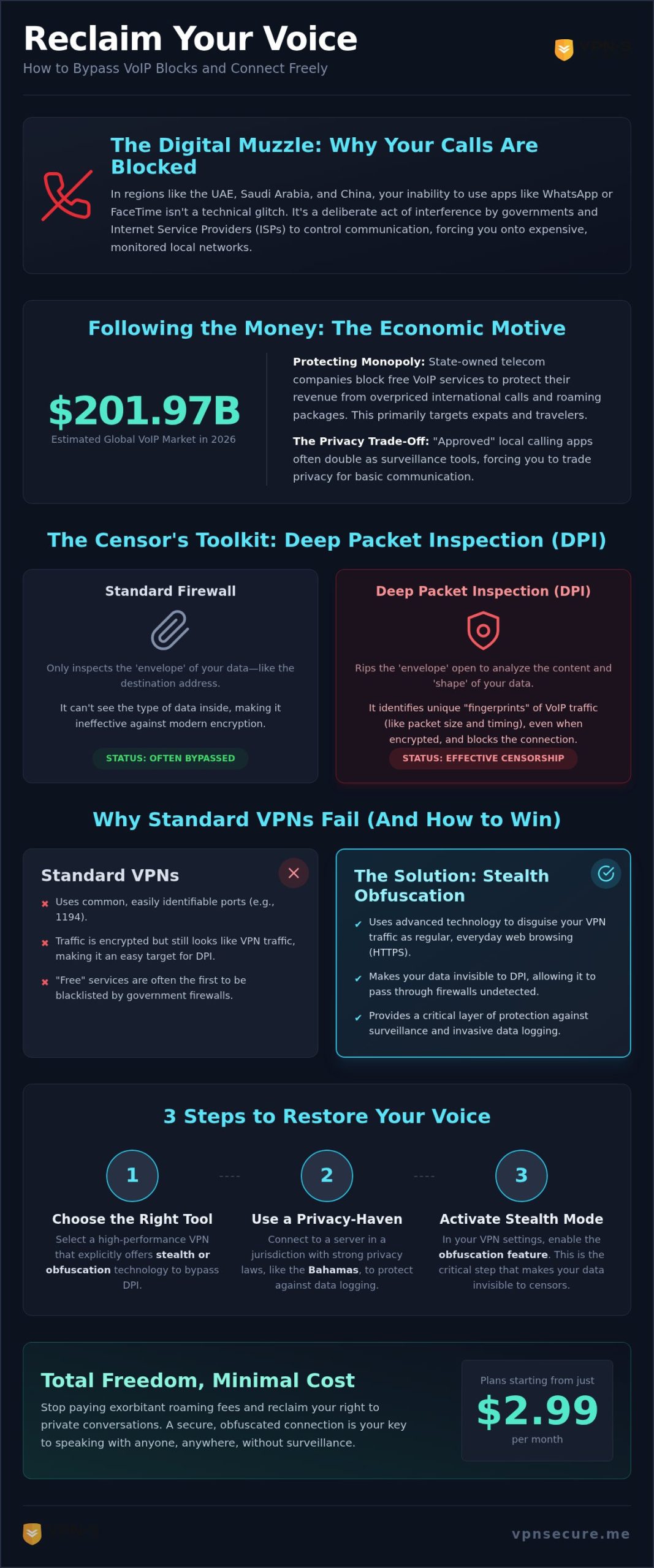
3 Steps to Restore Your Voice: Setting Up for Success
Restoring your digital voice isn’t a matter of luck; it’s a matter of configuration. If you’ve been staring at a “Calling…” screen, it’s time to stop guessing and start executing. Follow these three steps to ensure your connection is both invisible and stable. You don’t need a degree in network engineering to get this right, but you do need to be methodical.
Step 1: Pick your battleground. You need a server that is physically close enough to minimize lag but located in a country with zero VOIP censorship. For users in the Middle East, connecting to a server in Europe often provides the best balance of speed and freedom. Don’t settle for the first one you try. Test several locations to find the lowest latency for your specific network. Proximity matters, but political jurisdiction matters more.
Step 2: Force the right protocol. Speed is useless if you’re blocked. While UDP is technically faster for streaming, it’s also much easier for ISPs to identify. To reliably bypass VOIP restrictions, switch your settings to Stealth or OpenVPN over TCP. This wraps your traffic in a layer of obfuscation that mimics standard web browsing. It might be slightly slower than a raw connection, but it’s the only way to stay under the radar.
Step 3: Lock the gate. Enable your Kill Switch immediately. If your VPN connection blips for even a millisecond, your device will attempt to send data through your regular ISP. Without a Kill Switch, your ISP will instantly see the VOIP packets and kill the call. This feature ensures that if the VPN isn’t active, no data moves at all. It’s your ultimate safety net against accidental discovery.
Configuring Your Device for VOIP
Managing your connection on mobile requires an extra layer of caution. Always activate your VPN before you even think about opening WhatsApp or FaceTime. If you need to complete SMS verification without using your primary line, RentalNumbers.com offers a reliable solution. Modern smartphones often use GPS to verify your location, which can conflict with your VPN’s IP address. Disable location services for your communication apps to prevent these leaks. If you’re traveling, these affordable VPN monthly plans are the best way to test these configurations without being locked into a long-term contract. You get the protection you need for the duration of your trip without the baggage of a multi-year commitment.
Sometimes, the call connects, but you’re met with dead air. This “one-way audio” is a classic sign that your ISP is dropping specific data packets. If this happens, switch from UDP to TCP in your protocol settings. TCP is more “talkative” and ensures every packet arrives, making it harder for filters to silently drop your audio. Finally, never ignore an update notification. We constantly refine our obfuscation techniques to stay ahead of new DPI signatures. Keeping your app updated is a non-negotiable part of your defense strategy. Ready to speak freely again? Start your secure subscription today and take back your autonomy.
VPN Secure: Your Shield Against VOIP Restrictions
You’ve seen the mechanics of the block. You know how DPI works. Now you need a guardian that doesn’t just promise privacy but delivers it through geographic and technical superiority. VPN Secure has been on the front lines of digital freedom since 2012. We’ve watched censorship evolve from simple IP blocks to advanced AI-driven filtering, and we’ve stayed one step ahead every time. We don’t just help you bypass VOIP restrictions; we provide a permanent end to the digital muzzle.
Choosing a defender shouldn’t feel like a gamble. We’ve priced our Monthly VPN Subscription at just $2.99 to make high-grade encryption accessible to everyone, from expats to weekend travelers. There’s no “free” tier here because free services are the first to sell your data to the highest bidder. Instead, we offer a 30-day money-back guarantee. This gives you a risk-free window to test our servers in 40+ countries. Because we operate out of the Bahamas, we exist outside the reach of the Five Eyes surveillance alliance. Our no-log policy isn’t a marketing slogan; it’s a structural reality. If there’s no data to find, there’s nothing for an ISP or government to seize.
Why We Are Different
We’ve stripped away the corporate fluff to focus on raw, powerful encryption. You won’t find unnecessary bloatware in our apps. What you will find is unlimited bandwidth that supports crystal-clear HD video calls, even on restrictive networks. Whether you’re calling home from a cafe in Dubai or a hotel in Beijing, our infrastructure is built to handle the load. We support every device in your arsenal, from your iPhone and Android to your travel laptop. If you primarily work from a computer, our secure VPN for PC gives your desktop the same impenetrable protection against ISP monitoring and geo-blocks. You shouldn’t have to choose which device gets to be private.
Take Back Your Freedom Today
Stop letting your ISP dictate who you can talk to and how much it should cost. Every time a call drops or a message fails to send, they win. It’s time to flip the script. Join the thousands of users who rely on VPN Secure to stay connected with their families without the fear of surveillance or the sting of international roaming fees. You have the right to a private conversation. We provide the tools to enforce it. Take back your digital autonomy and bypass VOIP restrictions on your own terms. The silence ends today.
Take Back Your Voice and Your Freedom
Your digital voice is your own. It shouldn’t be a commodity traded by state-owned telcos or a target for invasive Deep Packet Inspection. You’ve learned that standard encryption isn’t enough to stay connected in 2026; you need the specific stealth technology and offshore jurisdiction required to successfully bypass VOIP restrictions. By choosing a provider that operates outside the reach of global surveillance alliances, you ensure your private conversations stay exactly that: private.
We’ve been protecting digital autonomy since 2012 with a strict no-log policy and a secure base in the Bahamas. There is no reason to let a government firewall stand between you and your family. With our 30-day money-back guarantee, you can test our high-performance servers with zero risk to your wallet. It’s time to stop the silence and start talking on your own terms. Reclaim your connection and speak freely once again. The tools are ready when you are.
Get VPN Secure for $2.99 and unblock your calls now
Frequently Asked Questions
Is it legal to bypass VOIP restrictions with a VPN?
Legality depends entirely on your current location. In some regions, like the UAE, using a VPN to bypass VOIP restrictions is a legal gray area that can technically result in fines. You should always be aware of the specific laws in your country before connecting. We provide the technical shield to protect your privacy, but you are responsible for how you navigate your local regulations while using our tools.
Can my ISP see that I am using a VPN to make calls?
Not if you use the right settings. A standard VPN connection might be visible as encrypted data on a known port, which can trigger an ISP to throttle your speed. However, our stealth technology scrambles your packet headers to make your traffic look like regular HTTPS web browsing. This ensures your ISP sees nothing more than routine internet activity, keeping your private communication completely hidden from their inspection tools.
Why does my WhatsApp call still fail even with a VPN on?
This usually happens because of a data leak or an identified server IP. If your Kill Switch isn’t active, your real location might leak the moment your connection dips. Some ISPs also maintain lists of known VPN server ranges. To fix this, try switching to a different server location and ensure you’ve enabled “Stealth” mode. It’s often a simple configuration issue that prevents you from successfully bypassing the block.
Will using a VPN for VOIP calls use more data?
Yes, but the difference is negligible for most users. Encryption adds a small amount of overhead to your data packets, typically increasing your total usage by about 10%. This is a minor trade-off for the ability to bypass VOIP restrictions and avoid the predatory pricing of local telecommunications monopolies. You’ll still save a significant amount of money compared to paying for international roaming or local long-distance calling packages.
Which VPN protocol is best for unblocking Skype and FaceTime?
Stealth or OpenVPN over TCP are your best bets for restricted networks. While UDP is technically faster for voice traffic, it’s much easier for Deep Packet Inspection to identify and kill. TCP is more “talkative” and mimics the behavior of standard web traffic, making it harder for an ISP to silently drop your audio packets. Using Port 443 with these protocols provides the most reliable path through aggressive government firewalls.
How do I fix lag or delay during a VPN-protected call?
Lag is usually a matter of physical distance. Try switching to a server that is geographically closer to you; for example, if you are in the Middle East, a server in Europe often provides lower latency than one in the United States. Also, make sure you aren’t running other high-bandwidth applications in the background. Reducing the distance your data travels is the fastest way to ensure your voice calls remain crystal clear.
Does VPN Secure work on both mobile and desktop for calls?
Yes, our Monthly VPN Subscription covers all your devices. You can install the app on your iPhone for WhatsApp calls or use it on your travel laptop for a professional Skype meeting. For users who need comprehensive desktop protection, our secure VPN for PC guide walks through exactly how to configure your computer to defeat ISP monitoring and unlock restricted content in 2026. We provide the same high-level obfuscation and Bahamas-based privacy across all platforms. You shouldn’t have to sacrifice your autonomy on one device just because you’re switching from a smartphone to a computer; our shield stays with you everywhere.