




What if an offshore address tells you less about your privacy than a VPN’s logging policy? The phrase VPN Bahamas jurisdiction can sound like a shield from surveillance, but a provider’s legal home is only one part of the picture. It doesn’t make a company immune from legal requests or prove that it keeps no records.
It’s reasonable to look closely at where a VPN is based. The Bahamas isn’t part of the Five Eyes, Nine Eyes, or Fourteen Eyes intelligence alliances, but that fact alone can’t guarantee what happens to your data. A provider’s policies, legal obligations, transparency, and technical safeguards matter too.
In this guide, you’ll learn what jurisdiction means for a VPN provider, what a Bahamian base can and can’t tell you, and how to weigh it against evidence of logging practices and security protections. VPN Secure, founded in 2012 and based in the Bahamas, describes its service as no-log and says it encrypts internet traffic across major devices. We’ll distinguish those claims from what location alone can establish, so you can assess privacy using more than a flag on the map.
Key Takeaways
- Separate a VPN provider’s headquarters, corporate registration, server locations, and your own location. Each can raise different legal questions.
- The VPN Bahamas jurisdiction may shape which laws are relevant, but Five Eyes membership alone doesn’t explain every possible cross-border request.
- Compare what a provider says it collects and retains with its privacy policy and any evidence that supports those claims.
- Use a practical checklist to identify the contracting company and assess its data practices, transparency, and technical protections.
- Put a Bahamian base in context: company location is one factor to weigh, not a substitute for examining how the service handles data.
VPN Bahamas jurisdiction explained: provider base, server location, and your location
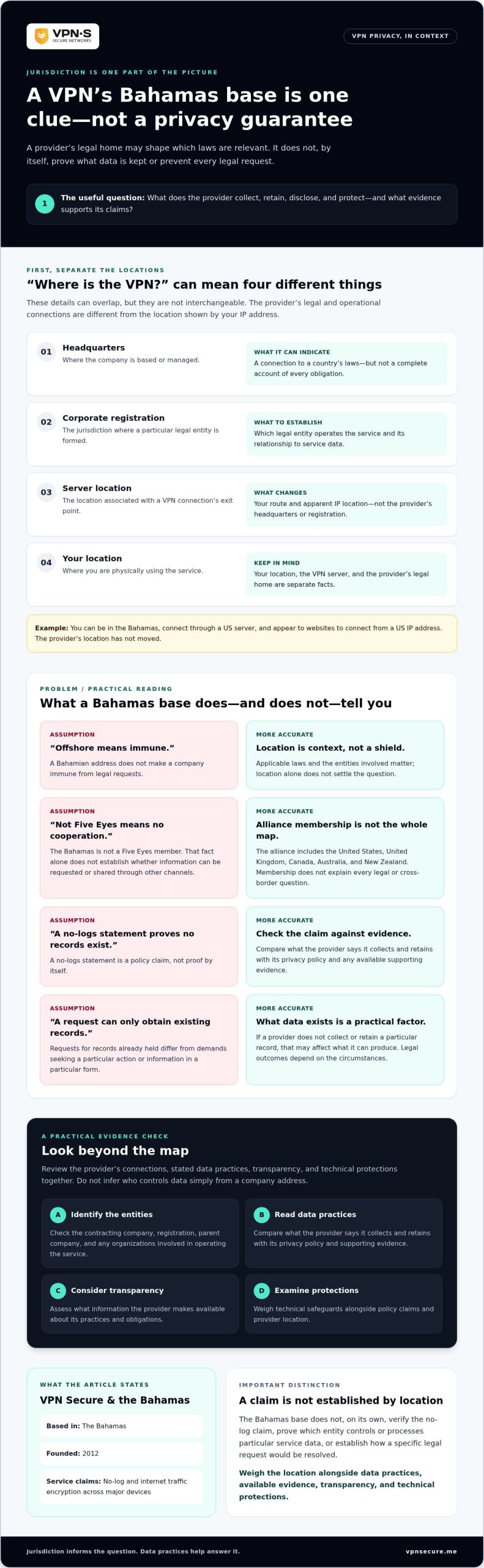
Jurisdiction concerns the laws that may be relevant to a company and its operations. But “where a VPN is based” can refer to different things: its headquarters, the country where its company is registered, the location of its servers, or the country where you’re connecting from. These details can overlap, but they aren’t interchangeable. The VPN Bahamas jurisdiction question concerns the provider’s legal and operational connections, not simply the location shown by your IP address.
Keep these four locations distinct:
- Headquarters: Where the company is based or managed.
- Corporate registration: The jurisdiction where a particular legal entity is formed.
- Server location: The location associated with the VPN connection’s exit point.
- Your location: Where you’re physically using the service.
A provider may also use affiliates, infrastructure operators, or data processors. Their roles can matter, but don’t assume which entity controls data or which laws apply without checking reliable, current company and legal details. A company’s legal home can shape its obligations, depending on the facts and applicable law.
What does VPN provider jurisdiction mean?
Jurisdiction is not a magic privacy switch. A provider’s registered company, its management, and the organizations involved in running its service may have different relationships to the data and infrastructure. Those relationships can affect the legal questions that arise, but the company’s address alone doesn’t settle them. For example, VPN Secure is based in the Bahamas and names Infinite Quant Ltd as its parent company. That fact alone doesn’t establish which entity controls or processes particular service data.
Is a Bahamas-based VPN the same as a VPN server in the Bahamas?
No. A server’s location is the location associated with a particular VPN exit connection. You can be in the Bahamas, choose a US server, and appear to websites to connect from a US IP address. The VPN company hasn’t moved: connecting through that server changes your route and apparent IP location, not the provider’s headquarters or corporate registration.
This distinction also helps keep claims in perspective. A provider’s home country is separate from intelligence-sharing arrangements such as the Five Eyes intelligence-sharing agreement. Neither server location nor alliance membership, by itself, proves how a provider handles your data. An offshore address alone doesn’t establish anonymity, strong security, or immunity from legal process. Treat location as one clue, then assess the provider’s data practices and protections.
How Bahamas jurisdiction relates to Five Eyes and cross-border data requests
A Bahamian base can matter, but it doesn’t put a VPN beyond the reach of every government. The Bahamas is not a member of Five Eyes, an intelligence-sharing alliance involving the United States, the United Kingdom, Canada, Australia, and New Zealand. That distinction is relevant context, not a guarantee that information can never be shared or requested through other channels.
Is the Bahamas part of Five Eyes?
No. The Bahamas is not a Five Eyes member. The alliance’s name can sound like a complete map of government surveillance, but it isn’t a universal list of laws that binds every VPN company. For background on the partnership, see this overview of the Five Eyes intelligence-sharing agreement.
Membership and international cooperation are separate questions. A country’s absence from the alliance doesn’t, by itself, establish what information its authorities can request, what assistance may be available, or how a particular request would be handled. Those outcomes depend on applicable laws, the entities involved, and the circumstances. Don’t turn “not in Five Eyes” into “no cooperation is possible.”
Can a VPN jurisdiction prevent government data requests?
No jurisdiction provides an automatic shield from all lawful requests. A request might seek records a company already holds. A different demand could seek to require an action, such as producing information in a particular form. Whether a company can be required to create or retain new information is a separate legal question, not something you can infer from its offshore address.
For a VPN, the practical question is also what data exists to respond to a request. If a provider doesn’t collect or retain a particular record, that may affect what it can produce. But a no-logs statement is a policy claim, not proof by itself. Assess the provider’s stated data practices and available evidence alongside its location.
Specific conclusions about Bahamian statutes, regulators, treaties, or cross-border procedures require current authoritative legal sources. The relevant law may depend on which company entity operates the service, where data or infrastructure is handled, and the nature of the request. Don’t treat a general description of VPN Bahamas jurisdiction as legal advice or a promise of immunity.
VPN Secure is based in the Bahamas and describes its service as no-log, but location alone can’t establish how any particular request would be resolved. For more context on the service, explore VPN Secure’s privacy-focused VPN service.
Does Bahamas jurisdiction make a VPN more private? Compare the evidence
A favorable legal location can be relevant, but it can’t make up for collecting more data than necessary or explaining data practices vaguely. To assess a VPN Bahamas jurisdiction claim, look at the whole privacy picture, not just the country on a company profile.
Jurisdiction is one factor in VPN privacy, not a standalone guarantee. Use this comparison to see what to examine:
| Factor | What to look for |
|---|---|
| Jurisdiction | Which company entities are involved and where they operate. Location alone doesn’t prove what data is collected or how requests are handled. |
| Data collected | Specific categories, such as account details, connection records, activity data, or diagnostics. |
| Retention policy | Whether the policy states how long each data type is kept and explains deletion or retention practices clearly. |
| Transparency | Clear explanations of legal requests and any relevant public reporting or supporting evidence. |
| Technical protections | How traffic is encrypted and what account protections are described. These reduce certain risks but don’t make you fully anonymous. |
What matters beyond a VPN company’s country?
Read the privacy policy for named data categories and retention periods, rather than relying on broad phrases like “we respect your privacy.” Look for an explanation of how the company handles legal requests and what transparency information it provides. Then assess technical protections and account practices. Encryption can protect traffic in transit, but it doesn’t erase information a service collects or guarantee anonymity.
How can you assess a no-logs claim?
“No logs” is a policy statement. To assess how confidently you can rely on it, check whether the provider defines connection, activity, diagnostic, and account data separately. A claim is easier to evaluate when its scope is clear and supporting evidence is available.
Keep the evidence in view. A provider’s own description is not the same as an independent audit or other corroboration, and don’t assume an audit exists unless it’s documented. A focused review of no-log VPN audits and evidence can help you understand what those materials do and don’t establish. Compare the policy’s promises with the evidence you can actually examine.
A practical checklist for evaluating an offshore VPN privacy claim
An offshore address may catch your eye, but don’t stop there. Use this checklist to compare the company behind the service, its data practices, and the evidence it makes available. The VPN Bahamas jurisdiction question becomes clearer when you examine the details in a consistent order.
Which company entity provides the VPN service?
Start with the company named in the service’s terms and privacy policy. That’s the entity your agreement may identify, but ownership, the contracting company, infrastructure operators, and data processors can be related without being the same. A parent company’s name alone doesn’t establish who processes particular data or carries each legal responsibility. Note the entity names and roles the provider actually describes.
What should a privacy policy and transparency record tell you?
Look for plain explanations of data categories, purposes, retention, and user rights. A transparency page, where available, should give dated and specific information about government demands rather than broad assurances. These details help you assess the provider’s disclosures, but they can’t predict how a future request will be handled. For alliance background, consult the article on VPNs outside Five Eyes; weigh that context alongside the provider’s actual data practices.
Work through these checks:
- Identify the contracting company. Find the legal entity named in the terms and privacy documentation. Note any separate parent company, service operator, or data processor the provider identifies.
- Map the data. Look for specific categories, such as account information, connection data, activity data, and diagnostics. Check the stated purpose for each, rather than relying on a blanket “private” claim.
- Check retention language. See whether the policy explains what is kept, for how long, and how deletion is handled. Vague phrases make it harder to understand the real limits.
- Compare claims with evidence. Distinguish the provider’s own statements from documented audits or other corroboration. Don’t treat a no-logs promise as independently verified unless supporting evidence is available.
- Review transparency and protections. Look for dated disclosures about legal demands, if published, and clear descriptions of encryption and account safeguards. Neither guarantees anonymity or a particular legal outcome.
Use the same test every time: identify the entity, map the data, check retention, weigh evidence, and review transparency and safeguards. This gives you a grounded comparison instead of relying on an offshore label alone.
Ready to assess a service through that lens? Explore VPN Secure’s VPN service and review its privacy information alongside the protections it describes.
VPN Secure and Bahamas jurisdiction: put location in context
VPN Secure was founded in 2012 and is based in the Bahamas. Infinite Quant Ltd is its parent company. These facts give you a starting point for considering VPN Bahamas jurisdiction, but they don’t establish which entity handles particular service data, what legal process may apply, or what information a provider could produce.
What does VPN Secure’s Bahamian base mean for users?
A Bahamian base is relevant context, not a promise of immunity from government requests or international cooperation. A company’s location can inform your assessment of its legal environment, but it can’t settle every question about how the service operates. Keep the distinctions clear: corporate structure, data handling, and legal obligations are related issues, not interchangeable facts.
VPN Secure describes its service as no-log and says it encrypts internet traffic across major devices. Those statements explain how the service presents its privacy approach. They aren’t, by themselves, independent proof of logging practices or a guarantee of a particular outcome. To assess the no-log claim, compare the privacy policy’s specific descriptions of data collected and retained, then consider any supporting evidence that’s publicly available.
Encryption is another meaningful part of the picture. It helps protect internet traffic, but it doesn’t establish what account information may be handled, how long any data is kept, or how a legal demand would be addressed. No single company fact answers every privacy question.
How to take the next step with a privacy-first VPN
Use one framework rather than letting the offshore label carry all the weight. Put the provider’s legal location beside its data collection and retention disclosures, transparency about legal demands, and technical safeguards. Look for clear, specific policies and evidence that supports the claims. If a detail is unclear, treat it as an unanswered question, not as proof of either strong or weak privacy.
That’s the balanced takeaway: VPN Secure’s Bahamian base matters, and its stated no-log approach and encryption are relevant points to consider. But jurisdiction alone can’t prove anonymity, security, or immunity from legal process. Your assessment is stronger when it weighs location alongside policy clarity, transparency, and technical protections.
Explore VPN Secure’s VPN service and review its privacy information as part of your own comparison.
Make your privacy choice with the full picture
VPN Bahamas jurisdiction can shape which laws may be relevant, but a provider’s location alone can’t promise anonymity or immunity from legal requests. Server location and your own location are separate from a company’s legal home, and being outside an intelligence-sharing alliance doesn’t rule out other forms of cooperation.
Look beyond the map. Compare the provider’s data collection and retention policies, transparency about legal demands, and technical protections. A no-logs statement is a claim to assess, not independent proof by itself.
VPN Secure was founded in 2012 and is based in the Bahamas. The service describes itself as no-log and encrypts internet traffic across major devices. Use those facts as context, then weigh them alongside the privacy information and evidence available.
Ready to explore a VPN with a Bahamian base? Explore VPN Secure’s privacy protection. Review the details and make your next privacy decision with the full picture.
Frequently Asked Questions
Is the Bahamas part of the Five Eyes alliance?
No. The Bahamas isn’t a member of Five Eyes, an intelligence-sharing alliance among Australia, Canada, New Zealand, the United Kingdom, and the United States. That matters as context, but membership isn’t a complete map of international cooperation or legal authority. A provider’s location outside the alliance doesn’t prove that information can’t be requested or shared through other legal channels in particular circumstances.
Does a VPN’s Bahamas jurisdiction make my internet activity anonymous?
No. VPN Bahamas jurisdiction doesn’t make your activity anonymous by itself. A VPN can encrypt traffic between your device and the VPN service and change the IP address websites see, but it doesn’t erase account information or prevent every form of tracking. Your privacy also depends on what the provider collects, its retention practices, and how you use websites and apps while connected.
Can a Bahamas-based VPN receive government data requests?
It’s possible for a VPN company to receive a government request, but what may be requested or required depends on applicable law, the entities involved, and the specific circumstances. A request for existing records is different from a demand to create or retain new information. The provider’s location alone can’t establish how a request would be handled or what information it could produce.
Is a VPN server in the Bahamas the same as a VPN based in the Bahamas?
No. A Bahamas-based VPN describes the provider’s business location or corporate connections. A VPN server in the Bahamas refers to a connection exit point associated with that country. A provider headquartered elsewhere could operate or use a Bahamian server, while a Bahamas-based provider could route your connection through another country. Choosing a server changes your apparent IP location, not the provider’s corporate home.
How can I verify whether a VPN really keeps no logs?
Start with the privacy policy. Look for specific definitions of connection, activity, diagnostic, and account data, plus clear retention language. Then compare those statements with available supporting evidence, such as a documented independent audit, if one exists. A provider’s no-logs statement describes its policy; it isn’t independent proof on its own. Be cautious of broad claims that don’t explain what “logs” means.
What matters more: VPN jurisdiction or a no-logs policy?
Neither should be judged alone. Jurisdiction helps frame which laws may be relevant, while a no-logs policy describes what the provider says it collects or retains. For a stronger assessment, compare the policy’s detail and supporting evidence with transparency about legal demands and technical protections. A favorable location can’t make vague data practices clear, and a policy claim doesn’t settle every legal question.
Does using a VPN in the Bahamas change which laws apply to the provider?
Not by itself. Connecting from the Bahamas, or selecting a Bahamas-based server, doesn’t relocate the VPN company or automatically change its corporate jurisdiction. Which laws may apply can depend on the provider’s legal entities, operations, and the circumstances involved. Your own location may raise separate questions, but the connection location alone can’t determine the laws relevant to the provider.