




Your VPN is a lock, but if you’re using the wrong protocol, you’ve basically left the key in the door for anyone to find. Getting VPN encryption protocols explained shouldn’t feel like a PhD in computer science, yet most guides bury the truth under piles of useless jargon while your connection speed suffers. You’re likely tired of the “spinning wheel of death” or finding your favorite apps blocked the moment you step into a restricted region. It’s a frustrating reality in 2026, especially with 47 countries now enforcing strict data retention mandates that target your private information.
We believe digital freedom is a right, not a luxury. In this guide, you’ll master the technical backbone of digital privacy and learn exactly which protocol keeps your data invisible to prying eyes. We’ll show you how to encrypt internet traffic VPN effectively by choosing a configuration that balances raw speed with ironclad security. From understanding why WireGuard delivers 40% faster transfers to dodging the surveillance traps of Five Eyes jurisdictions, you’re about to get the tools you need to navigate the web on your own terms. It’s time to stop settling for a weak shield and start using a protocol that actually works.
Key Takeaways
- Get the technical backbone of digital privacy with these VPN encryption protocols explained, focusing on the rules that authenticate your identity and scramble your data.
- Compare the heavy hitters like WireGuard and OpenVPN to find the perfect balance between lightning-fast streaming and unblockable stealth.
- Avoid the dangerous traps of outdated protocols like PPTP that leave your personal data exposed to even the most basic hacking attempts.
- Learn how to bypass regional blocks on VOIP and streaming services by using protocols designed to mask your VPN traffic from censors.
- Understand why your protocol choice must be backed by a provider outside the Five Eyes jurisdiction to ensure your logs never fall into the wrong hands.
Decoding the Digital Shield: What Are VPN Protocols?
Think of your internet connection as a public highway. Without protection, every packet of data you send is like an open postcard that your ISP, government, or a local hacker can read at will. A Virtual Private Network (VPN) changes the game by creating a private lane just for you. But what actually builds that lane? That is where we get VPN encryption protocols explained. A VPN protocol is the set of rules that determines exactly how your data travels between your device and the server.
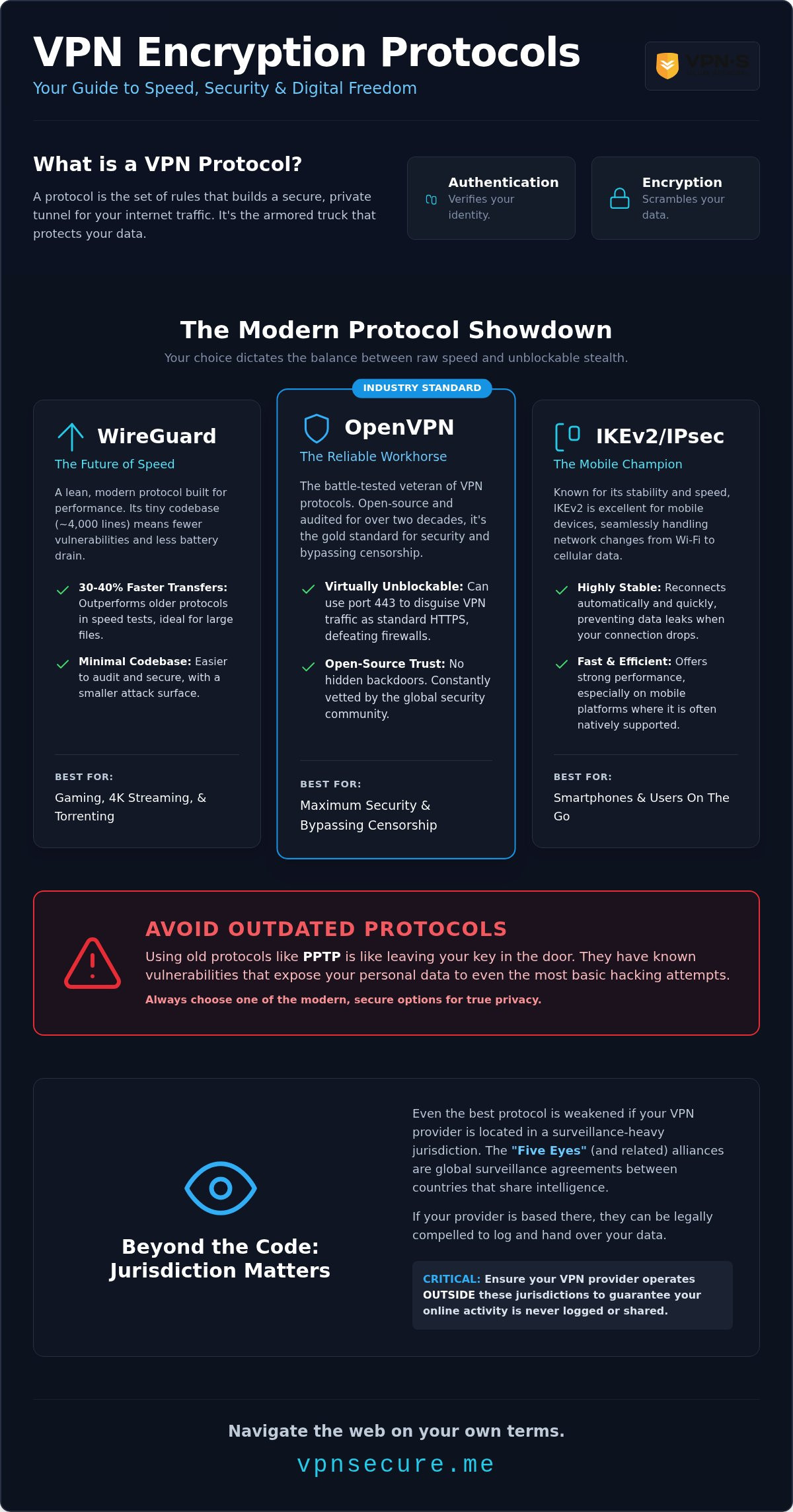
It handles two critical tasks: authentication and encryption. Authentication proves you are who you say you are; encryption scrambles your data into gibberish. Think of the protocol as the armored car and the encryption as the heavy safe bolted inside it. You need both to survive. If you have a world-class safe but transport it in a cardboard box, a sophisticated actor will just steal the whole box. Without a strong protocol, even the best encryption can be intercepted or bypassed by those who want to monitor your activity.
The Anatomy of a Secure Connection
The process starts with tunneling. This creates a private path through the public internet, shielding your activity from prying eyes. Once the tunnel is established, encryption kicks in. It turns your private conversations, like WhatsApp calls in the UAE, into unreadable code that looks like static to anyone trying to listen in. Behind the scenes, the protocol manages two distinct streams. The control channel handles the security “handshake,” while the data channel carries your actual traffic. If the control channel is weak, the entire connection is at risk.
Why One Size Does Not Fit All
Choosing a protocol isn’t a “set it and forget it” task. It’s about finding the right balance for your specific needs. The eternal tradeoff in digital networking is speed versus security. Some protocols prioritize heavy, multi-layered encryption that might slow down a 4K stream but will keep a state-level surveillance agency out of your business. Others are built for raw performance, stripping away unnecessary overhead to give you the fastest possible connection.
Compatibility also plays a massive role. A protocol that works flawlessly on your Windows PC might fail on your iPhone due to how mobile operating systems handle background connections. A VPN protocol is a sophisticated bypass tool designed to strip away ISP surveillance and return control of your digital footprint to you. Choosing the right one is the difference between true autonomy and a false sense of security.
The Heavy Hitters: OpenVPN, WireGuard, and IKEv2 Compared
Not all protocols are created equal. Some are relics of a slower, less secure internet; others are the future of digital autonomy. Having VPN protocols explained clearly is the only way to avoid a slow, leaky connection that leaves you exposed. In 2026, the landscape is dominated by three giants: OpenVPN, WireGuard, and IKEv2. Your choice dictates whether you can stream 4K without buffering or if you’ll get flagged by a government firewall the moment you log on.
OpenVPN: The Reliable Workhorse
OpenVPN is the battle-tested veteran. It’s been the industry standard for over two decades for a good reason. Because it’s open-source, the global security community constantly audits its code. There are no hidden backdoors for intelligence agencies to exploit. Its biggest strength is versatility. It can run on any port, including port 443, which makes your VPN traffic look like standard HTTPS web traffic. This makes it virtually unblockable. If you’re in a region with heavy censorship, this is your primary shield. It’s the gold standard for anyone who needs to ensure their traffic stays invisible to prying eyes.
WireGuard: The Future of Speed
WireGuard is the new speed king. It arrived with a promise to fix the bloat found in older protocols. It succeeded. While OpenVPN has hundreds of thousands of lines of code, WireGuard has around 4,000. This lean architecture means fewer vulnerabilities and significantly less battery drain on your mobile devices. Recent data shows WireGuard can deliver 30 to 40 percent faster speeds for large file transfers compared to OpenVPN in cross-border workflows. It’s the obvious choice for gaming, torrenting, or high-definition streaming. If you want an annual VPN subscription that doesn’t feel like a digital anchor, WireGuard is the protocol you need.
Mobile users should also keep an eye on IKEv2/IPsec. It’s the specialist for those on the move. Ever notice your VPN drop when you walk out of your house and switch from Wi-Fi to 5G? IKEv2 solves that. It uses a feature called MOBIKE to maintain the tunnel during network handoffs without forcing you to reconnect. It’s fast, secure, and incredibly resilient for smartphones.
Choosing between these options is a matter of priority. Use OpenVPN for maximum stealth and bypassing government firewalls. Switch to WireGuard for raw performance and efficiency. Stick with IKEv2 for a rock-solid mobile experience. Most people don’t need a hundred confusing settings; they just need these VPN encryption protocols explained so they can pick the right tool for the job. Don’t let a provider choose for you, take control of your own connection parameters.
Speed vs. Stealth: Why Protocol Choice Matters for VOIP and Streaming
Digital gatekeepers like Netflix and Hulu aren’t just content providers; they’re hunters. They actively scan for VPN signatures to block your access and keep you locked within regional borders. If you’ve ever seen a “VPN detected” error, your protocol leaked your true nature. This is where getting VPN encryption protocols explained moves from theory to survival. You need a protocol that doesn’t just encrypt but also hides the fact that you’re using a VPN at all. Speed is useless if you’re blocked before the first frame loads.
Bypassing Geo-Restrictions and Throttling
For streaming, the choice between UDP (User Datagram Protocol) and TCP (Transmission Control Protocol) is vital. UDP is the speed king. It sends data without waiting for a confirmation, making it perfect for high-def video where a dropped frame is better than a buffering wheel. However, TCP is more reliable for bypassing strict firewalls that might throttle non-standard traffic. If you’re trying to access your home library while traveling, we’ve got you covered with our guide on unblocking WhatsApp in UAE and other restricted zones. We optimize these settings to ensure your connection remains stable even when your ISP is trying to slow you down.
The VOIP Challenge: FaceTime and Skype
VOIP services are often the first targets for state-level censorship because they threaten the revenue of local telecom monopolies. In regions like the Middle East, standard protocols like WireGuard might be fast, but they’re sometimes too “visible” to sophisticated filters. This is where OpenVPN shines. By running OpenVPN on port 443, your traffic is indistinguishable from standard banking or shopping traffic. It’s the ultimate stealth move for FaceTime or Skype calls in restricted regions.
For those who need absolute reliability, a dedicated IP VPN adds another layer of unblockable power. Since you aren’t sharing an IP address with thousands of other users, services like Netflix are far less likely to flag your connection as a VPN. VPN Secure optimizes these protocols so you don’t have to be a network engineer to stay connected to your family and your content. Having VPN encryption protocols explained means knowing that sometimes, being invisible is just as important as being fast. We give you the tools to be both.
Avoiding the Traps: Outdated Protocols You Should Never Use
Speed is irrelevant if your encryption is Swiss cheese. While modern providers push for faster connections, some still cling to legacy technology that should have been retired a decade ago. When you get VPN encryption protocols explained by an expert, such as the professional consultants at Insoft Services, the first lesson is simple: just because a protocol is available doesn’t mean it’s safe. Using the wrong one is like putting a titanium lock on a cardboard door. If your provider only offers the following relics, you aren’t being protected; you’re being lied to.
Point-to-Point Tunneling Protocol (PPTP) is a digital fossil. Developed in the 90s, it’s now so vulnerable that basic hackers can crack it in minutes using widely available tools. PPTP is a “privacy theater” rather than actual security, offering a false sense of protection while your data remains essentially transparent. Similarly, L2TP/IPSec is often pitched as a reliable middle ground, but it lacks the modern cryptographic foundations needed to stop state-level snooping. There are persistent, documented concerns that the NSA has compromised this protocol, making it a liability for anyone seeking true digital autonomy.
Then there is SSTP. Because it’s owned by Microsoft, it lacks the transparency of open-source alternatives like OpenVPN or WireGuard. You’re forced to trust a massive corporation’s proprietary code without the ability for independent security experts to audit it for backdoors. In the world of digital privacy, “trust us” is never a valid security strategy.
The risk of using these protocols goes beyond weak encryption. Legacy tech often lacks the integration for a reliable Kill Switch. If your connection flickers for a millisecond, these protocols might fail to cut your internet traffic, leaking your real IP address and location to every site you’re visiting. You might think you’re invisible while you’re actually broadcasting your identity to the world. Don’t let your security be compromised by a provider that refuses to update its infrastructure; instead, you can look to a reliable infrastructure provider like Snel.com, which offers the modern VPS and dedicated server solutions needed for high-performance security.
How to Audit Your Current VPN Settings
Don’t assume your app is using the best settings by default. Many providers use “Auto” settings that prioritize the fastest (and often weakest) protocol to make their service look better in speed tests. Follow this 3-step check to reclaim control:
- Open your VPN app and navigate to the Settings or Connection menu.
- Look for a tab labeled Protocol or Tunneling.
- If it’s set to “Auto,” manually switch it to WireGuard or OpenVPN.
If those options aren’t there, you’re using a tool that’s fundamentally broken. It’s time to switch to a service that respects your need for ironclad defense. Secure your digital life today with a Monthly VPN Subscription that puts modern, audited protocols at your fingertips. Now that you’ve had these VPN encryption protocols explained, you have no excuse for staying exposed.
Beyond the Code: Why Encryption Needs the Right Jurisdiction
You’ve had the technical side of VPN encryption protocols explained, but there’s a legal side that matters just as much. Encryption is useless if a court order forces your provider to hand over logs. If your VPN is based in a country that mandates data retention, your protocol is just a shiny lock on a door the government already has the master key to. It doesn’t matter how strong your tunnel is if the provider is legally compelled to record every move you make within it.
VPN Secure operates from the Bahamas for a very specific reason. We stay outside the reach of the Five Eyes intelligence alliance. Our no-log policy is a legal commitment, not just a marketing slogan. We don’t keep your data because Bahamian law doesn’t require us to, and we’ve built our infrastructure to ensure we couldn’t hand over your history even if someone asked. True digital autonomy happens when you combine the strongest protocols with the safest jurisdiction.
The Five Eyes Threat
VPNs based in the US, UK, or other Five Eyes nations are inherently compromised. These governments can issue secret subpoenas and national security letters that force providers to log user data. Worse, they often include gag orders that prevent the company from ever telling you they’ve been compromised. The “Offshore Advantage” of Bahamian privacy laws provides a necessary shield against this state-level overreach. You can explore how we prioritize your freedom in our guide on affordable VPN monthly plans, which shows you how to get real privacy without falling into a multi-year trap.
The Final Verdict: Which Protocol Should You Choose?
The choice is now in your hands. After having VPN encryption protocols explained throughout this guide, the path forward is clear. Use WireGuard for raw speed, seamless gaming, and high-definition streaming. It’s the most efficient way to protect your traffic without feeling the “VPN tax” on your connection. Switch to OpenVPN when you need maximum stealth to bypass strict firewalls or unblock VOIP services in restricted regions.
VPN Secure simplifies this choice by giving you direct control in our apps. We don’t hide these vital settings behind vague “Auto” buttons that prioritize our server load over your security. Take control of your data today. Stop letting your ISP, government, or a streaming giant dictate what you can see or do online. Your digital life belongs to you; we’re just the ally that makes sure it stays that way.
Take Back Control of Your Digital Footprint
Now that you’ve had VPN encryption protocols explained, you have the knowledge to stop being a passive target. You know that WireGuard is your engine for speed and OpenVPN is your cloak for bypassing heavy censorship. Choosing the right protocol isn’t just about technical settings; it’s about reclaiming your autonomy from ISPs and government snoops. Even the best code fails if the provider is under the thumb of the Five Eyes alliance.
Security is only as strong as its weakest link. By combining high-security protocols with our Bahamas-based jurisdiction, you ensure your data remains your business alone. We back our verified no-log policy with servers in over 40 countries to keep you connected anywhere. Don’t leave your privacy to chance or outdated “Auto” settings that compromise your safety for their convenience.
Get VPN Secure for $2.99/mo and encrypt your traffic now. With our 30-day money-back guarantee, you can test our ironclad defense risk-free. Your internet should be yours to explore on your own terms.
Frequently Asked Questions
Which VPN protocol is the most secure for online banking?
OpenVPN and WireGuard are the gold standards for sensitive financial transactions. OpenVPN is the veteran choice for banking because its open source code has been audited for decades by the global security community. WireGuard uses state of the art cryptography that is just as secure but significantly faster. Both ensure your credentials stay encrypted with AES-256 or ChaCha20, making it impossible for hackers to sniff your passwords. Never use outdated protocols like PPTP for banking; they are practically transparent to modern intruders.
Is WireGuard really faster than OpenVPN for streaming Netflix?
Yes, WireGuard is substantially faster for high bandwidth tasks. Its lean code base of about 4,000 lines reduces the “VPN tax” on your connection compared to the 100,000 plus lines found in OpenVPN. This efficiency often translates to 30 to 40 percent faster speeds for high definition streaming. If you want to watch Netflix in 4K without the constant spinning wheel of death, WireGuard is the protocol to pick. It delivers raw performance while keeping your traffic invisible.
Can I use a VPN to unblock WhatsApp calls in Dubai?
You certainly can, provided you use the right configuration. Standard protocols are often detected and throttled by local ISPs in the UAE. To unblock WhatsApp or FaceTime in Dubai, we recommend using OpenVPN on port 443. This makes your encrypted traffic look like standard HTTPS web browsing, allowing you to bypass the VOIP blocks that local telecom monopolies use to control your communication. It is about taking back your right to speak freely regardless of your location.
What happens if my VPN protocol is outdated?
Using an outdated protocol like PPTP is a massive risk to your digital identity. These legacy systems have known vulnerabilities that hackers can exploit in minutes to view your private traffic. You also lose access to modern safety features like a reliable Kill Switch, which prevents your data from leaking if the connection drops. If your provider hasn’t updated their infrastructure to support WireGuard or OpenVPN, your privacy is an illusion. It is time to switch to a modern shield.
Does a VPN protect me on public hotel Wi-Fi?
Hotel Wi-Fi is a playground for packet sniffers and man in the middle attacks. A VPN acts as a necessary shield by creating an encrypted tunnel between your device and our servers. Even if a hacker controls the hotel router, they will only see scrambled, unreadable code instead of your emails or login details. Having VPN encryption protocols explained helps you understand that this secure tunnel is what keeps your digital life private in hostile public networks.
Why does my VPN connection keep dropping on my phone?
Mobile connections often drop because the protocol cannot handle the switch from Wi-Fi to 5G. If you’re on the move, switch to the IKEv2/IPsec protocol. It is specifically designed for mobile stability and uses a feature called MOBIKE to maintain your secure tunnel during network handoffs. This prevents the constant disconnects that plague other protocols. If you still experience drops, ensure your app is updated and your battery saver isn’t killing the VPN process in the background.
Is it legal to use a VPN to bypass government censorship?
In the vast majority of countries, using a VPN is entirely legal. Governments often try to restrict access to information or VOIP services, but using a tool to protect your privacy is a fundamental right. Even in regions with growing regulations, the target is usually the content or the provider, not the individual user. Operating from the Bahamas keeps us outside the reach of shifting legal traps, ensuring your logs stay nonexistent and your activity remains your business.
How do I change the protocol in my VPN app?
Stop letting “Auto” settings decide your security level. Open your VPN app and head to the Settings or Connection menu. Look for a section labeled “Protocol” or “Tunneling” and manually select the one that fits your needs. Choose WireGuard for raw speed or OpenVPN for maximum stealth. Having VPN encryption protocols explained empowers you to take the wheel. If your current provider hides these options, they are prioritizing their server load over your digital autonomy.