




Your internet provider is actively sabotaging your game day. It is the bottom of the ninth or the final lap of a Grand Prix, and suddenly, the screen freezes into a spinning circle. You pay for high-speed fiber, yet your ISP throttles your connection the moment they detect a high-traffic broadcast. It feels like you are being punished for being a fan. We agree that it is time to take back control of your screen and stop letting middle-men dictate what you can watch.
By choosing a high-performance VPN for sports streaming, you can reclaim your bandwidth and bypass every digital fence the broadcasters put up. This guide promises to show you exactly how to eliminate 4K buffering, hop over regional blackouts, and secure your connection through an offshore shield that keeps your viewing habits private. We are diving into the technical tactics you need to stop ISP lag and unlock global catalogs from the EPL to the NBA with zero interference. It is time to watch the game on your terms, without the artificial limits.
Key Takeaways
- Shatter regional blackouts by bypassing the IP-based licensing traps that local broadcasters use to lock you out of your favorite games.
- Master the difference between bandwidth and latency to ensure your 4K stream stays ahead of the social media spoilers.
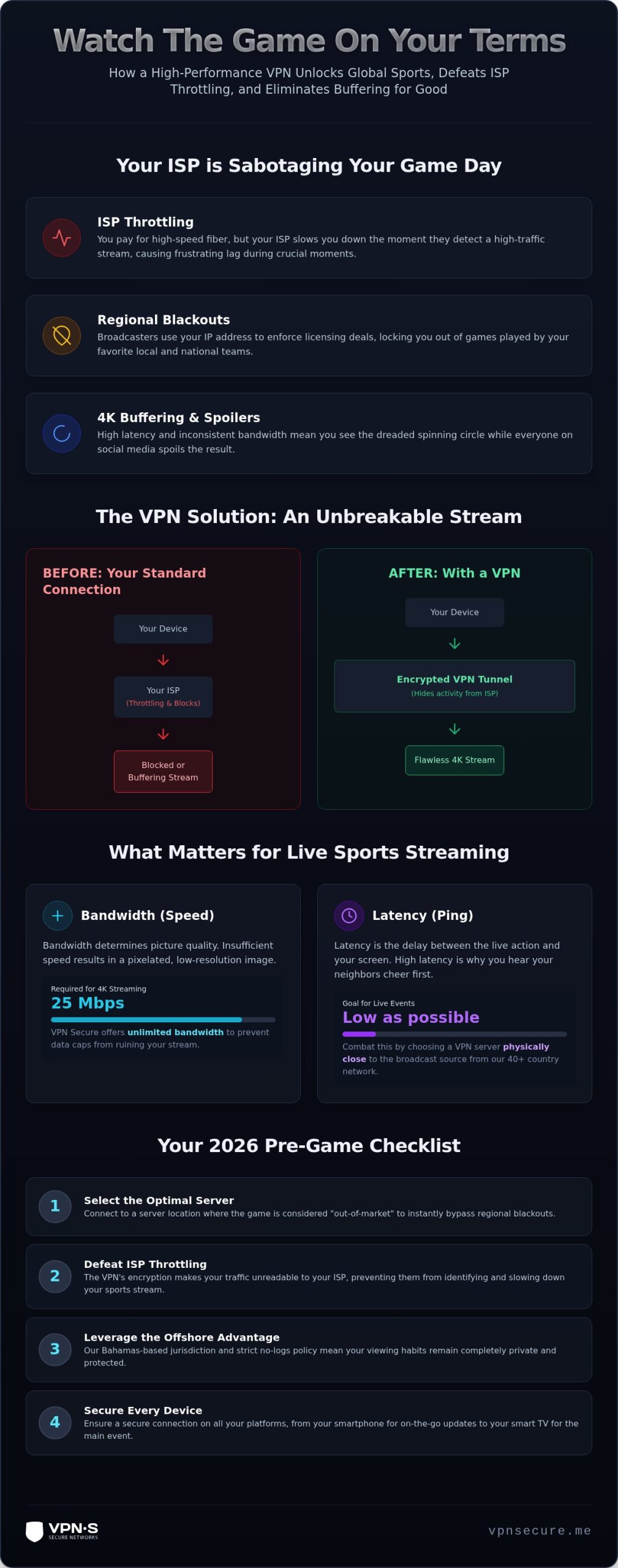
- Defeat ISP throttling by using a VPN for sports streaming to encrypt your data, making it impossible for providers to slow your connection during high-traffic events.
- Follow our 2026 pre-game checklist to select the optimal server location and secure every device from your phone to your smart TV.
- Leverage the offshore advantage of a Bahamas-based jurisdiction to protect your viewing habits with a strict no-logs policy and unlimited bandwidth.
The Blackout Nightmare: Why You Can’t Watch Your Team
You sit down, jersey on, ready for kickoff. You open your streaming app only to see a cold, grey screen with a message: “This content is not available in your region.” It is a digital punch in the gut. This is the licensing trap in action. Broadcasters spend billions on exclusive rights to show games in specific territories. To protect these massive investments, they use Geo-blocking technology to build a wall around their content. They don’t care about your loyalty; they only care about their contracts.
Your IP address acts as a digital passport that broadcasters check at the gate. Every time you connect, your device broadcasts your location to the world. If that location falls inside a restricted zone, you are shut out instantly. In 2026, this fragmentation has reached a breaking point. With rights split between legacy networks, tech giants, and niche platforms, the “blackout” has become a standard part of the fan experience. You are being forced to navigate a maze of restrictions just to support your team.
How Geo-Restrictions Detect You
Streaming platforms use sophisticated IP mapping to link your connection to a specific zip code. This allows them to enforce blackouts with surgical precision. Geo-blocking is a technology that uses your IP to deny access to live feeds based on your physical location. Even if you try to hide, poor software often falls victim to DNS leaks. These leaks act like a hole in your pocket, dropping clues about your real location even when you think you are covered. Without a secure, leak-proof VPN for sports streaming, your true identity is always one click away from being exposed.
The Rise of Regional Sports Networks (RSNs)
Ironically, your local team is often the hardest one to watch. Regional Sports Networks (RSNs) pay for the “in-market” exclusivity, which means local streaming apps are forced to black out the game to protect cable TV ratings. It is a system designed to punish the local fan. Using a VPN for sports streaming allows you to flip the script. By shifting your digital location to a city where the game is considered “out-of-market,” you bypass the RSN restrictions entirely. You aren’t breaking the game; you are just choosing a better seat in a different city. It is the only way to reclaim your autonomy as a viewer in an era of corporate gatekeeping.
Speed vs. Latency: What Actually Matters for Live Sports
Raw speed is a vanity metric. You can have a 1Gbps connection, but if your latency is high, you are essentially watching a replay. When using a VPN for sports streaming, you are fighting two distinct battles: throughput and delay. Most providers shout about their Mbps while ignoring the ping that actually ruins your experience. To get the technical breakdown, it helps to understand the relationship between Speed vs. Latency. One determines the quality of the picture, while the other determines when that picture actually reaches your eyes.
The Latency Factor
Latency is the time it takes for data to travel from the broadcast server to your device and back. High latency is why your neighbor cheers three seconds before you see the goal. It kills the immersion. During high-concurrency events like the World Cup or the Super Bowl, server load spikes and latency usually follows. We combat this with a network of high-performance servers in 40+ countries. By choosing a server physically close to the broadcast source, you minimize the distance your data travels. This keeps your feed in sync with the live action, ensuring you aren’t the last person on social media to see the score.
Unlimited Bandwidth for 4K
Streaming in 4K isn’t just a luxury; it’s a requirement for modern sports. A crystal-clear 60fps feed requires roughly 25Mbps of consistent bandwidth. If your VPN or ISP caps your data, your stream will degrade into a pixelated mess right as the tension peaks. Encryption overhead is another silent killer. Every layer of security adds a small amount of data to your connection. Our infrastructure is optimized to handle this overhead without choking your stream.
If you aren’t ready for a long-term commitment, you can check out The Truth About Affordable VPN Monthly Plans: Privacy Without the 2-Year Trap to see how we prioritize your freedom. We provide unlimited bandwidth on every plan because we know a weekend sports marathon shouldn’t be cut short by a data limit. For the ultimate edge, you might consider an Annual VPN Subscription to lock in consistent, high-performance streaming for the entire season.
ISP Throttling: The Hidden Reason Your Stream Buffers
Your ISP is watching you. Every time you connect, they use Deep Packet Inspection (DPI) to look inside your data packets and see exactly what you are doing. If they detect a high-definition sports feed consuming massive amounts of data, they pull the emergency brake. This isn’t a conspiracy; it’s a documented business practice. For example, the FTC lawsuit against AT&T proved that major providers have a history of intentionally slowing down customer data to manage their own costs. They want to preserve their network capacity, and your 4K stream is the first thing they sacrifice.
Beyond DPI, there is the “peering” problem. ISPs often refuse to upgrade the connections between their networks and the servers where sports content lives. They intentionally create bottlenecks to force streaming companies to pay “interconnection fees.” When you use a VPN for sports streaming, you bypass these artificial traffic jams. By encrypting your data, you make your traffic invisible to the ISP’s filters. They see scrambled data rather than a live NBA game, forcing them to treat your connection like regular, unthrottled traffic. It is the only way to ensure the bandwidth you pay for is the bandwidth you actually get.
Bypassing the Speed Brake
A VPN creates an encrypted tunnel between your device and our offshore servers. This shield prevents your provider from seeing that you are pulling 25Mbps for a 4K broadcast. ISP throttling is a proactive measure used to manage network congestion at your expense. Because the ISP can’t identify the traffic type, they can’t apply specific “speed brakes” to your stream. This is why many users find their connection is actually faster and more stable during peak hours when using a VPN for sports streaming. You are effectively skipping the line while everyone else is stuck in the provider’s artificial slow lane.
Testing for Throttling
Catching your provider in the act is simple. Run a speed test on your standard connection during a major game, then connect to a VPN server and run it again. If your VPN speed is significantly higher or more stable, you’ve caught them throttling you. Other signs include buffering that only occurs during live events or a sudden drop in video quality when the stadium crowd gets loud. Don’t let your provider dictate your experience; use a secure shield to keep your bandwidth under your control.
The Ultimate Sports Streaming Checklist for 2026
Preparation is the difference between watching the winning goal and staring at a buffering wheel. Broadcasters are getting smarter, using historical cache data and DNS checks to catch you. Your VPN for sports streaming is only as good as its configuration. Don’t leave your game day to chance; follow this methodical approach to ensure your shield is active and your connection is invisible.
Step-by-Step Configuration
Start by downloading the native app for your device. Don’t rely on browser extensions; they are often too weak to handle high-bandwidth 4K streams and lack the system-wide protection you need. Once installed, select a server in the region where the game is legally available or “out-of-market.” Our network offers servers in 40+ countries, giving you plenty of options to find a clear path to the broadcast.
Next, dive into the settings menu. You must enable the Kill Switch and IPv6 Leak Protection. The Kill Switch is your ultimate safety net. If your internet connection drops for even a millisecond, it cuts all traffic to prevent your true IP address from leaking to the broadcaster. Without it, one tiny glitch results in an instant blackout. Finally, clear your browser cache or open an incognito window. Broadcasters often check old cookies to verify your location, so starting fresh is mandatory for a clean connection.
Streaming on the Big Screen
Watching on a small phone screen isn’t the stadium experience you want. Most modern fans use an Android TV or Fire Stick. Using a dedicated VPN for sports streaming on your TV ensures you get the full resolution without the lag. If you are using a device that doesn’t support native apps, such as certain gaming consoles, our Smart DNS alternative provides a workaround by rerouting your DNS queries without the full encryption overhead. This is vital for maintaining speed on hardware with limited processing power.
Whether you are at home or on the move, your setup needs to be bulletproof. If you are watching from a hotel or public network, check out our guide on Secure VPN for Travel in 2026: Why Your Privacy Needs an Offshore Shield to understand the risks of unsecured Wi-Fi. Before the game starts, perform these verification steps:
- Visit an IP checker tool to confirm your virtual location matches your selected server.
- Run a DNS leak test to ensure your ISP isn’t quietly broadcasting your real location.
- Check your speed to ensure you have the 25Mbps required for a stable 4K feed.
Ready to lock in your connection for the entire season? Get an Annual VPN Subscription and take back control of your sports experience today.
VPN Secure: The Offshore Advantage for Global Sports Fans
Choosing a VPN for sports streaming isn’t just about finding a server; it’s about finding a sanctuary. We operate out of the Bahamas. This jurisdiction sits outside the reach of the Five Eyes surveillance alliance. It means we don’t answer to the same corporate or government data demands as providers based in the US or Europe. When you use our shield, you are placing your data in a region that prioritizes individual autonomy over corporate licensing interests.
We offer high-performance servers in 40+ countries. This gives you a global passport to any league on the planet. Whether you need an IP in London for the Premier League or a New York address for the NBA, our network is built for high-concurrency events. You don’t have to choose which screen to protect. Our service supports multiple simultaneous connections. You can stream the main event on your Android TV while tracking live betting odds or fantasy stats on your tablet with zero drop in performance.
Privacy Without the ‘Streaming Strike’
Your viewing habits belong to you. In the US or EU, broadcasters can pressure providers to hand over user logs to identify fans bypassing regional blocks. Because we are based in the Bahamas, a Bahamas-based VPN is not subject to the same data subpoenas as US or EU providers. We’ve maintained a strict no-log policy since 2012. If we don’t have the data, we can’t give it away. You can learn more about why a No-Log VPN Audit is the only way to prove a provider is actually protecting you.
Ready for Kickoff?
Speed is our priority. Our VPN for sports streaming is designed for a one-click connection so you don’t miss the opening whistle. We don’t believe in trapping you with complex setups or data caps. You get unlimited bandwidth for buffer-free 4K on every plan. If you are skeptical, test us out. We offer a 30-day money-back guarantee. Use it during the next major tournament to see how we handle the pressure. It’s time to stop letting broadcasters dictate your experience. Get VPN Secure and Stream Your Team Today and take back your digital freedom.
Take Back Your Digital Sideline
Broadcasters and ISPs shouldn’t have the power to decide what you watch or how you watch it. You now have the technical blueprint to dismantle regional blackouts and stop ISP throttling in its tracks. It’s about autonomy; you pay for your bandwidth, and you deserve to use every bit of it. By deploying a robust VPN for sports streaming, you turn your connection into an invisible tunnel that bypasses corporate gatekeepers and artificial speed limits.
We provide the ultimate shield for fans who refuse to settle for a spinning buffer wheel. Our Bahamas-based jurisdiction offers a genuine offshore advantage, keeping your data far beyond the reach of intrusive surveillance. We’ve stayed true to our no-log policy since 2012, ensuring your stream is your business alone. With unlimited bandwidth for crystal-clear 4K, you can finally enjoy the game as it was meant to be seen. It’s time to stop letting your provider dictate the score of your streaming experience.
Stream Sports Without Limits – Get VPN Secure Now
The game is waiting for you. Step onto the field with the protection you deserve and never miss another kickoff.
Frequently Asked Questions
Is it legal to use a VPN for sports streaming?
Using a VPN is legal in the vast majority of jurisdictions worldwide. While using a VPN for sports streaming might technically conflict with a broadcaster’s terms of service, it remains a legitimate tool for digital privacy. You are simply choosing which server handles your data. We operate from the Bahamas to ensure your right to choose remains your own, far away from the reach of overreaching corporate legal departments.
Will a VPN slow down my live sports stream?
A high-quality VPN shouldn’t noticeably slow your connection. In fact, if your provider is intentionally capping your speeds during big games, our service can actually make your stream faster. We provide unlimited bandwidth and high-speed servers in 40+ countries to handle 4K feeds. By bypassing artificial bottlenecks, you get the raw performance you pay for instead of the throttled version your ISP wants to give you.
Can I use a VPN to watch sports on my Smart TV?
You can definitely use our service on your Smart TV. We offer native apps for Android TV and Amazon Fire Stick to bring the stadium experience to your living room. For devices like gaming consoles that don’t support native apps, our Smart DNS feature provides a reliable workaround. This ensures your big screen remains a blackout-free zone without requiring complex hardware setups or technical headaches. It is your screen, after all.
Does a VPN help with regional blackouts for local teams?
A VPN is the most effective way to beat regional blackouts. These restrictions rely on your IP address to pin you to a specific zip code. By connecting to a server in a different city, you appear “out-of-market” to the broadcaster. This simple shift allows you to watch local games that are otherwise blocked in your home territory. It is your connection, so you should decide your virtual location without interference.
What is the best server location for streaming the Premier League or NBA?
The best location depends entirely on where the broadcast rights are held. For the Premier League, a UK-based server is often the best choice for local commentary and high-quality feeds. For the NBA, you should select a US server in a state where the game isn’t being played locally. Matching your virtual location to the right broadcast territory is the secret to unlocking every match on the calendar without regional interference.
Why does my streaming service still block me even when I’m using a VPN?
Streaming services use several tactics to identify VPN users, including checking your browser cache and monitoring for DNS leaks. If you are still blocked, try clearing your cookies or using an incognito window to remove old location data. Ensure your Kill Switch is active to prevent your real IP from slipping through. Our Bahamas jurisdiction helps us stay ahead of these corporate filters by providing a more resilient offshore shield for your data.
Can I use a free VPN to watch live sports?
You should avoid free VPNs for live sports. These services often lack the bandwidth required for high-definition video, leading to constant buffering. More importantly, free providers frequently sell your browsing data to third parties to cover their costs. We don’t offer a free tier because quality infrastructure requires investment. Choosing a VPN for sports streaming with a proven no-log policy is the only way to protect your privacy and your stream.
How do I stop my ISP from throttling my sports stream?
You stop throttling by making your traffic invisible. ISPs use Deep Packet Inspection to identify and slow down high-bandwidth video streams during peak hours. Our encryption wraps your data in a secure tunnel that your provider cannot peer into. Because they can’t see that you are streaming 4K sports, they have no reason to pull the speed brake. It forces them to treat your connection like standard web traffic, giving you full speed.