





















VPN & Privacy
VPN options for Mac compared by privacy, protocols, and protection
A Mac’s polished interface isn’t a privacy shield. Yes, MacBook Air and MacBook Pro can use a VPN, and macOS includes a client that supports L2TP,...
In short
A VPN for China should be installed, configured, and tested before departure. Choose a service with an obfuscation mode, several nearby server options, support you can reach without relying on blocked services, and a fallback plan. Access can change without notice, so no provider can guarantee a connection.
Key takeaways
Table of contents
China's internet restrictions can affect communications, work tools, maps, cloud storage, news sites, and entertainment services. A VPN may help with privacy and access, but the useful question is not simply which VPN is "best." It is whether the service is prepared for restrictive networks, works on the devices you will carry, and gives you realistic options if a connection changes.
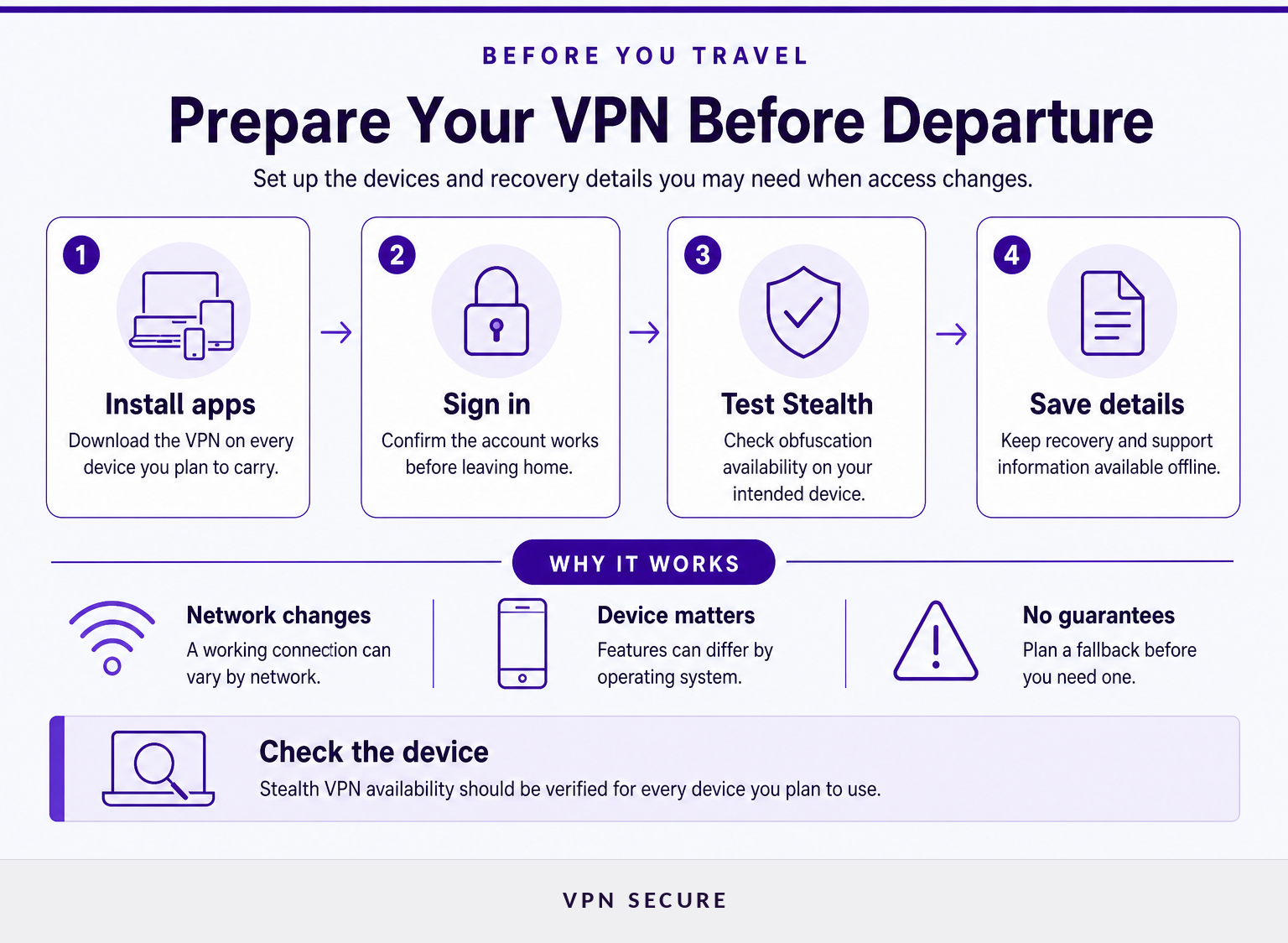
Set up and test the VPN while you still have unrestricted internet access. Download the apps for every device you expect to use, sign in, confirm the connection works, and save essential setup details where you can reach them offline.
Do not wait until you are at the airport or hotel. The account sign-in page, app store listing, knowledge base, or email-based password reset process may be unavailable or unreliable when you need them most.
Start with the apps you will actually use. A work laptop may need different settings from a personal phone, and a VPN feature available on desktop may not be available on every mobile platform. VPNSecure states that its Stealth VPN mode is available for Windows, macOS, and Linux, so travelers should verify device compatibility before relying on it for a particular connection. Review the available Stealth VPN features before departure.
Keep a short offline note with your account email, recovery method, normal connection settings, and a support route. If the flight itself is stressful, this guide to CBT exercises for flight anxiety explains the approach and includes exercises intended for use before flying.
The practical rule is simple: complete the setup while every part of the process is easy to reach.
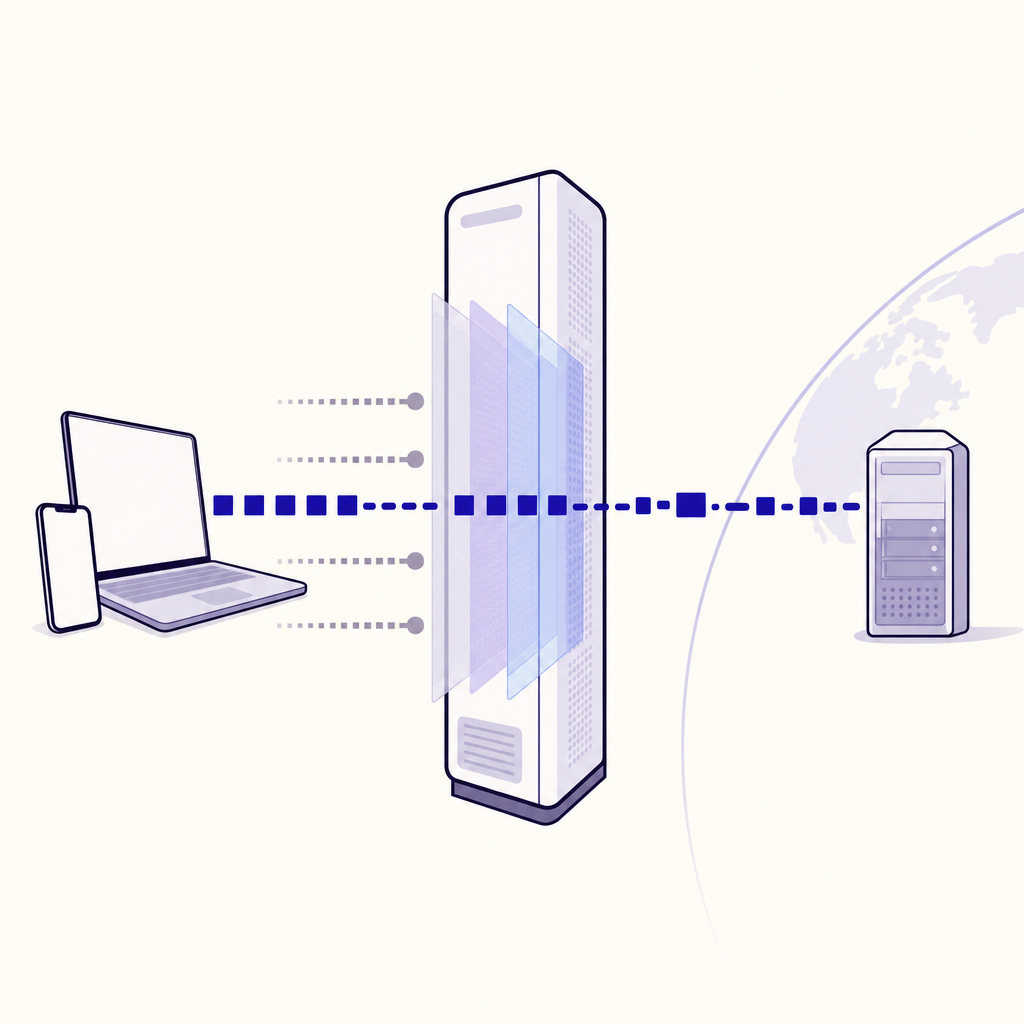
Obfuscation, flexible connection options, and reliable support matter more than a long feature list. A standard VPN connection can be detected or disrupted, so travelers should look for a mode designed to make VPN traffic less recognizable.
Network filtering is not static. A 2023 USENIX Security study documented the Great Firewall's ability to identify and block some fully encrypted circumvention traffic using traffic characteristics rather than the readable content of a connection. A later 2025 USENIX study found targeted inspection and blocking of some QUIC connections in China beginning in April 2024. Those findings explain why a VPN that connects normally on one network may fail on another, or work one week and struggle the next.
For travelers, the important capabilities are:
No feature overrides a restrictive network every time. A VPN should be treated as one part of travel preparation, not as a promise that every website, call, or app will always be available.
The best choice is a VPN that gives you a tested primary connection and sensible alternatives, not a guarantee it cannot keep.
Usually, no. A server located in China gives an overseas user a Chinese IP address, while a traveler inside mainland China normally needs a stable route to a server outside mainland China.
This distinction causes a great deal of confusion. A person abroad might use a China-based server to reach a service that expects a Chinese IP address. A traveler in China who wants to reach an international service instead needs a connection that can leave the local network and reach an external server.
Check a provider's VPN server locations before subscribing or traveling. Look for several plausible external locations rather than assuming one named country will work best everywhere. Your hotel Wi-Fi, local mobile network, device, and the service you are trying to use can all affect the result.
A China IP solves an overseas location problem; a traveler in mainland China usually needs a resilient external connection.
China regulates international network connections, and the legal position is not something travelers should reduce to a one-line claim. Anyone with a business, employment, journalism, research, or personal situation carrying higher legal risk should obtain qualified advice relevant to their circumstances.
The currently effective 2024 revision of China's Regulations on the Administration of International Networking of Computer Information states that direct international networking must use state-provided international channels and that units and individuals must not establish or use other channels for international networking. The regulation is broad, does not function as traveler-specific legal advice, and should not be read as a guarantee about enforcement in a particular city or situation. Read the officially published regulation text and follow applicable local rules.
American citizenship does not remove the need to comply with the laws that apply where the connection is used. A VPN is not a legal shield, and it does not make unlawful activity lawful.
The responsible approach is to understand the regulation, avoid assumptions, and seek professional advice where the consequences matter.
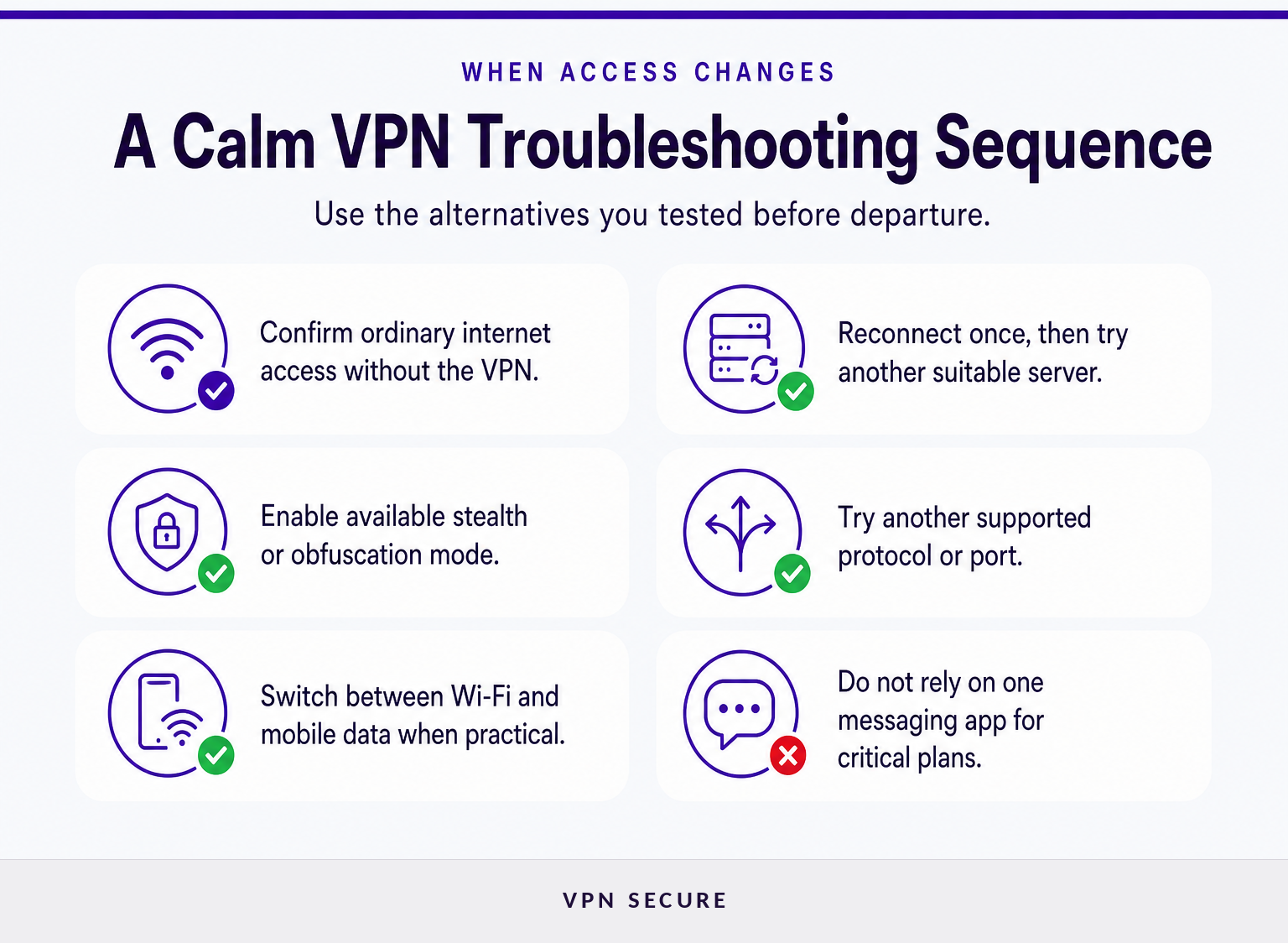
Do not repeatedly retry one failed setting. Check whether the problem is the local network, then try the connection alternatives you prepared before travel.
Start with a calm sequence:
Avoid depending on a single messaging app, cloud document, or login process for critical travel information. Keep flight details, hotel details, emergency contacts, and key work files available offline where possible.
A failed connection is a reason to use your prepared alternatives, not a reason to assume one setting will work everywhere.
Set up the communications and work services you cannot afford to lose before you leave. Test them on your actual devices, understand their local availability, and keep important details offline.
Communications needs differ. Someone checking a family group chat faces a different problem from a remote worker accessing a company account protected by multifactor authentication. If WhatsApp is part of your travel plan, review is WhatsApp blocked in China? before departure rather than discovering its status while abroad.
Also consider dependencies outside the VPN itself. For example, password recovery may require a particular email inbox, banking alerts may require a mobile number, and work systems may reject unfamiliar IP addresses or countries. Coordinate with an employer's IT team before travel if company systems have access rules.
A VPN can improve your options, but offline copies and pre-arranged access methods prevent one network problem from disrupting the whole trip.
Yes, VPN services exist for travelers to China, but service availability can change by network, location, device, and time. Choose a provider with an obfuscation option, install it before departure, and test it on each device. A VPN should be treated as a prepared access tool, not a guaranteed bypass for every restriction.
Americans can technically carry and use VPN software while traveling, but nationality does not change the laws and network rules that apply in China. China's international networking regulations are broad, and enforcement can be context-specific. Travelers with professional, legal, or safety-sensitive needs should seek qualified advice before relying on a VPN.
No VPN can honestly promise that it will work consistently across every Chinese network in 2026. Network filtering changes, and researchers have documented evolving detection methods. The better question is whether a VPN offers obfuscation, alternative connection settings, multiple external locations, device support, and troubleshooting information prepared before travel.
The key decision is preparation: install, test, document, and create a fallback plan before you arrive.
Choose a VPN based on the devices and services you will actually use, then test the full setup before your trip. Review VPNSecure's Stealth VPN options, save the connection details you need offline, and leave with a fallback plan rather than a guarantee.
Keep reading
A Mac’s polished interface isn’t a privacy shield. Yes, MacBook Air and MacBook Pro can use a VPN, and macOS includes a client that supports L2TP,...

A VPN for accessing region-locked games can change the IP location a game sees, but it won’t automatically change your Steam store region. Steam...

A VPN won’t make your iPhone invisible, but it can add a useful layer of privacy. A VPN for iPhone and iOS privacy encrypts your internet traffic and...
No logs, ever. Start with Free with ads in under a minute.