





















VPN & Privacy
Best VPN for China: What Travelers Need to Know Before They Go
Planning a trip to China? Learn which VPN features matter, why Stealth VPN helps, how to prepare before departure, and what legal and access limits to consider.

Reading the news shouldn’t become a privacy risk when you travel. A VPN for reading news abroad encrypts your internet traffic and routes it through a server you choose, keeping your browsing private on hotel and airport Wi-Fi and your connection to your own accounts stable, subject to each service’s terms.
Public Wi-Fi while traveling can raise privacy concerns. A VPN encrypts traffic between your device and the VPN server, helping protect it from people monitoring the local network. It can’t guarantee that every site will work or override local rules.
This guide explains how VPN encryption works, how server choice affects speed, and what to check about local rules before you travel. It also covers a VPN’s limits and how to browse unfamiliar news sites more safely.
A VPN encrypts your connection and routes it through a remote server. This can help protect your traffic and keep your real IP address private from the sites you visit.
Encryption scrambles traffic between your device and the VPN server, making it unreadable to others monitoring that connection. With the VPN connected, your internet service provider can’t read that traffic or see its final destination.
For example, when you open an international newspaper on a café network, the VPN encrypts traffic between your device and its server. It doesn’t control what the newspaper website collects once you visit. Check a provider’s privacy policy and encryption details when choosing a service.
A secure web gateway is a separate service that applies security rules to web traffic, such as filtering risky or unwanted destinations. It isn’t the same as a VPN, so don’t assume a VPN includes gateway filtering.
Privacy features vary by service. A privacy policy describes how a provider handles connection data, while encryption protects traffic in transit. Check what each feature does. A virtual server location, for example, refers to the apparent location of your connection, not protection against every online risk.
VPN use is legal in most countries, but rules differ, so check them for your destination. Local law still applies when you travel.
VPN pricing, trial availability, and refund terms vary by provider and plan. Read the subscription terms before paying, and don’t assume a trial or refund is included.
To read news on a phone or computer, install the VPN app, sign in, choose a server location, and connect. Then open the news site in your browser or app. On a computer, confirm the VPN is connected before visiting the site, including in separate browser windows.
A VPN for reading news abroad should suit the devices and networks you use. Before choosing one, consider server locations, connection speed, privacy terms, and the devices you use.
Reliability depends on server performance and location. A faster server can help news pages load smoothly, but each news and streaming platform sets its own policy on VPN connections. If pages load slowly, try another nearby server.
If you use a phone and computer, check that the VPN supports both devices and works on your networks. A suitable VPN for reading news abroad balances speed, encryption, and clear privacy terms rather than promising access to every platform.
For speed, connect to a server near you. Wherever you connect, your use of each site remains subject to its own terms.
There’s no single country that suits every reader. A nearby server usually offers the fastest route, so start there and switch only if the connection is slow.
A VPN routes your connection through a remote server, changing the IP address a news website sees and keeping your real IP hidden from trackers. It encrypts your traffic between your device and the server, but it can’t guarantee that every site will accept VPN connections.
If your VPN connection is slow or drops, reconnect to another nearby server, then reload the page. Hotel or local network settings may also affect your connection.
Free VPNs vary in server choice, speed, and privacy terms. Limited locations or an inconsistent connection may make a free option unsuitable when you need a steady, private connection. Compare the available locations and terms with your reading or viewing needs before relying on one.
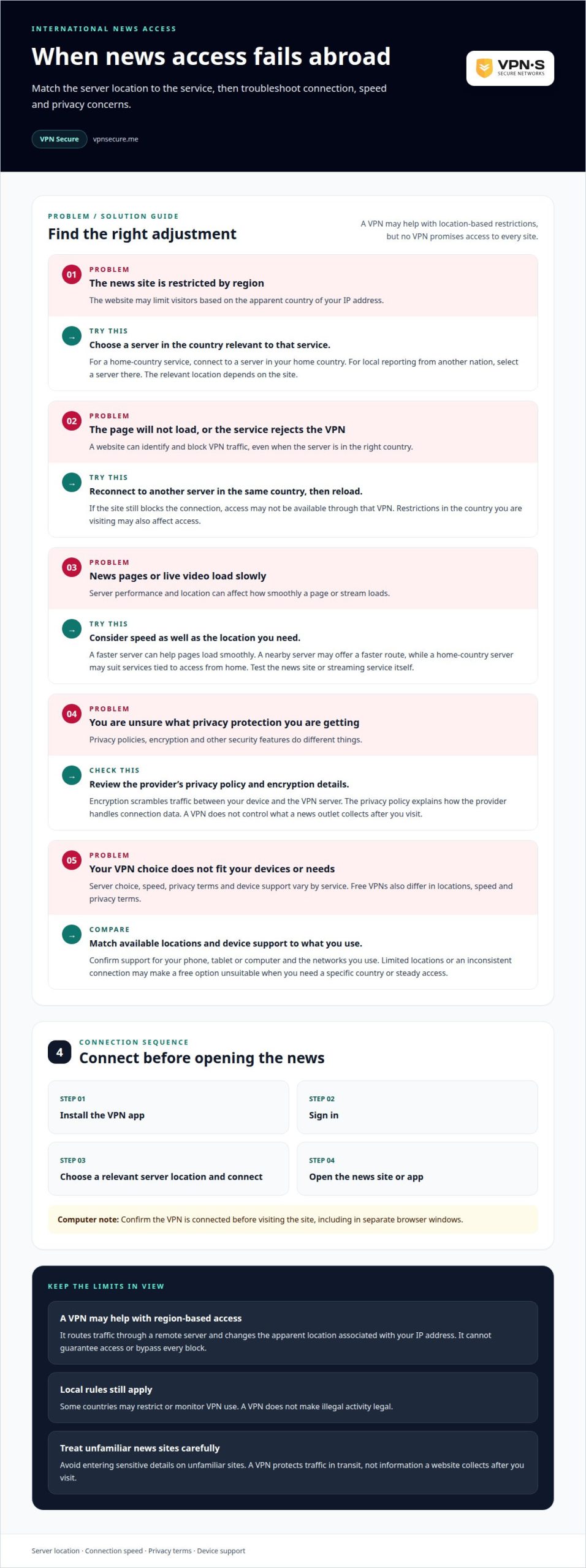
No VPN can promise access to every news site or streaming platform, and each site may choose not to accept VPN connections. Assess a service by how well its server locations, speed, privacy policy, and device support meet your needs.
Start with how you browse. If you’re abroad, choose a VPN with apps for your devices and servers near where you are staying, and remember that each service’s terms apply. The right location depends on speed, not a universal list of “best” VPN countries.
Speed matters for live video and busy news pages. A faster server can make loading smoother, while a distant or congested route may slow it down. Test the connection with the news website or streaming service you use. If pages load slowly, try another nearby server and reload the page.
Privacy is another important consideration. Read the provider’s privacy policy and review its encryption technology before choosing a service. A VPN protects traffic between your device and its server, but doesn’t control what a news outlet collects after you visit. Avoid entering sensitive details on unfamiliar news sites.
Device support matters if you switch between a phone, tablet, and computer. Confirm the VPN supports the devices you plan to use, then connect before opening the news app or browser. For streaming, test the service itself rather than assuming its video player will work just because the news homepage loads.
Free VPNs differ in server choice, speed, and privacy terms. These limitations may make them unsuitable when you need a steady, private connection. Compare their available locations and terms with your actual reading or viewing needs, and don’t assume a free service is a dependable one.
A news website may estimate your location from your IP address. A VPN routes your connection through a server elsewhere, changing the IP address the site sees and keeping your real IP private. For example, trackers on a news site see the VPN server’s address instead of yours.
Changing your apparent location doesn’t guarantee that a site will work, and each service’s terms still apply. A news outlet may decline connections from IP addresses associated with VPNs. Local law still applies too.
Privacy matters as much as convenience. On hotel or airport Wi-Fi, a VPN encrypts your traffic so others on the same network can’t see which news sites you read or intercept your logins. Choosing a no-logs provider means your browsing history isn’t stored on the VPN’s side either.
Before using a VPN while traveling, check the rules where you’re physically located. Then connect to a nearby server and load the page. If a site declines VPN connections under its own policy, respect that policy.
Results depend on the service and the network. A site may treat VPN connections differently from regular ones, and some hotel or office networks limit which connections they allow. Treat unfamiliar websites cautiously and avoid entering sensitive information on untrusted pages.
For encrypted connections while traveling, explore VPN access options for your news-reading needs.
VPNSecure helps travelers protect their internet traffic through an encrypted VPN connection. If you read news abroad on hotel or airport Wi-Fi, connect before you browse so your traffic stays private and your real IP address stays hidden from trackers.
Choose a Monthly VPN Subscription or Annual VPN Subscription to suit how you want to access the service. A Dedicated IP is also available for readers who need a consistent IP address. A VPN can support your privacy and secure connections abroad, but it can’t override local rules or guarantee that every news site will work.
If you’re weighing your options for secure news reading while traveling, contact VPNSecure to discuss your needs.
Before your next trip, decide which news services and accounts you’ll use, and set up the VPN app on each device before you leave. Keep local rules in mind, and use trusted networks and websites when handling sensitive information.
A VPN for reading news abroad can help you stay informed while adding privacy and security. Treat it as one part of your travel routine, not a way to override website controls or local rules. Your destination, the service you need, and the network you use all shape the right approach.
If you want to discuss a VPN setup for reading news while traveling, contact VPNSecure about your needs. A little preparation can help you stay connected to the reporting that matters, wherever your travels take you.
A VPN app creates an encrypted connection between your device and a VPN server, then routes your internet traffic through it. When you read news, websites see the VPN server’s IP address instead of yours. Signing in to a news account still identifies you to that service, and a VPN doesn’t replace careful account security.
A virtual private network, or VPN, routes your device’s internet connection through a remote server. Think of it as a protected connection layer for online activity, not a separate browser or news source. You still visit the same websites and apps, but your traffic takes a different route to reach them.
Choose a VPN based on your needs, not a ranking. For example, travelers should prioritize servers near where they are staying for speed. Also consider connection speed, supported devices, the provider’s privacy policy, and encryption technology. Test your essential news services over the VPN before relying on them abroad.
Use a VPN when you want an encrypted connection on a network you don’t trust, such as airport public Wi-Fi. It also keeps your connection to your own accounts consistent while you travel, subject to each service’s terms. Don’t treat it as complete protection: use strong, unique passwords and avoid entering sensitive details on unfamiliar websites.
Connect before opening the news app or signing in to any account, especially on hotel or airport Wi-Fi. Keep the VPN connected while using the service, and reconnect if your network changes or the connection drops.
You don’t need a VPN simply to read international news, but privacy needs and local rules vary. Rules on VPN use differ between countries, so check them for the places you travel. Workplaces may also require a VPN to access internal systems. Local law still applies when you use one.
Keep reading
Planning a trip to China? Learn which VPN features matter, why Stealth VPN helps, how to prepare before departure, and what legal and access limits to consider.

A Mac’s polished interface isn’t a privacy shield. Yes, MacBook Air and MacBook Pro can use a VPN, and macOS includes a client that supports L2TP,...

A VPN for accessing region-locked games can change the IP location a game sees, but it won’t automatically change your Steam store region. Steam...
No logs, ever. Start with Free with ads in under a minute.