


















VPN & Privacy
VPN options for Mac compared by privacy, protocols, and protection
A Mac’s polished interface isn’t a privacy shield. Yes, MacBook Air and MacBook Pro can use a VPN, and macOS includes a client that supports L2TP,...

A VPN’s no-logs policy is only as strong as the laws its provider operates under. If a provider can be legally required to keep records, a promise not to log carries less weight. That is why the choice of a Five Eyes vs 9 Eyes vs 14 Eyes VPN matters: jurisdiction decides which data-retention rules and legal requests a provider must follow.
This guide explains what these intelligence-sharing alliances are, which countries belong to them, and why jurisdiction matters when you compare no-logs claims. It also explains why VPNSecure operates from the Bahamas and how to check any provider’s jurisdiction before you subscribe, with a 30-day money-back guarantee if you want to test the service.
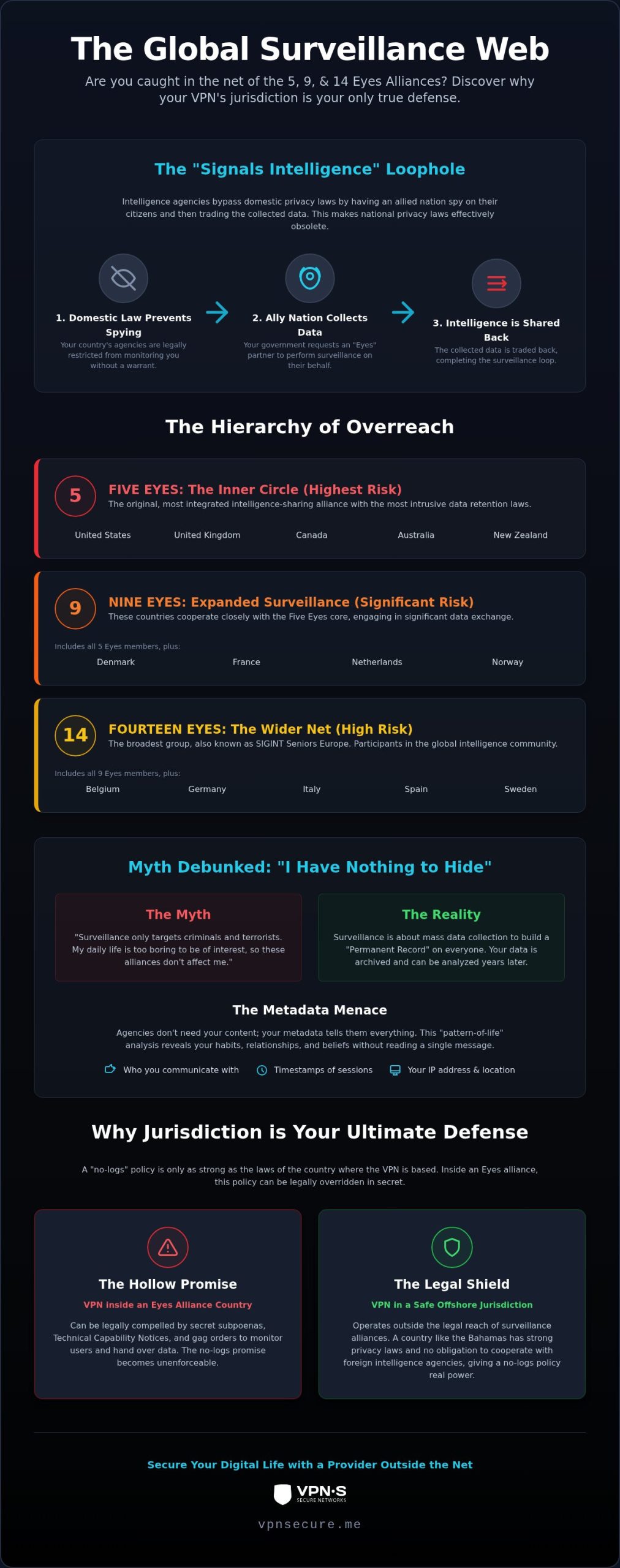
The 5, 9, and 14 Eyes are intelligence-sharing agreements between groups of countries. They cover Signals Intelligence (SIGINT): communications data that member agencies collect and exchange. The 14 Eyes grew out of the original post-war UKUSA arrangement and now includes a wider group of European partners.
Why does this matter for a VPN? Data held by a provider in one member country can, through lawful requests and sharing agreements, become available to agencies in another. Understanding the difference between a Five Eyes vs 9 Eyes vs 14 Eyes VPN helps you judge how far your records could travel.
The Five Eyes alliance is the core group: the United States, United Kingdom, Canada, Australia, and New Zealand. Its members share the closest level of intelligence cooperation, which traces back to the 1946 UKUSA Agreement. A VPN based in one of these countries is subject to that country’s data laws and legal requests.
The 9 Eyes adds Denmark, France, the Netherlands, and Norway. Their cooperation is less extensive than the core five, but it still includes significant data exchange. The 14 Eyes, officially known as SIGINT Seniors Europe, expands further to include:
These countries also take part in intelligence cooperation. A VPN provider operating within their borders can receive legal requests for user data, sometimes with confidentiality orders that stop it from telling users. Comparing a Five Eyes vs 9 Eyes vs 14 Eyes VPN means weighing those legal obligations.
“I have nothing to hide” misses how data works. Records collected today can be stored for years, combined with other sources, and analysed again as technology changes. Even encrypted data may become readable as decryption methods improve. Privacy is a fundamental right, not something you need only when you’re doing something wrong.
When you choose a Five Eyes vs 9 Eyes vs 14 Eyes VPN, you aren’t just picking a service; you’re deciding which laws govern your connection records. Large datasets are valuable precisely because they are aggregated: your records become part of a much larger pool used to profile behaviour. Limiting what is collected in the first place is the simplest protection.
You might think your encrypted messages are safe, but metadata tells its own story. Connection timestamps, IP logs, and session lengths can reveal patterns of who you contact and when. That can point to your health, beliefs, or daily routines without anyone reading the content. Where internet providers must retain this data, it becomes a detailed record of your online life.
Any large database is a target for attackers, and the more organisations that hold or share your data, the larger the attack surface. A single security lapse can expose records across every system that holds a copy. Keeping less data in fewer places is the most reliable way to limit what can leak, so choose a provider that keeps data collection to a minimum.
When you compare a Five Eyes vs 9 Eyes vs 14 Eyes VPN, you’re looking at different levels of legal exposure. Providers in Five Eyes countries sit inside the closest cooperation, Nine Eyes members slightly further out, and the wider 14 Eyes further still, though the exposure does not disappear. Whatever the marketing says, a provider must comply with the laws where it is based.
A provider in the US or UK can be legally required to keep certain records without being able to disclose the request. This is why an independent no-log vpn audit matters: without external verification and a suitable jurisdiction, “zero logs” is only a claim.
In the United States, the FBI can use National Security Letters (NSLs) to request user information without a court warrant, usually with non-disclosure requirements attached. In the UK, the Investigatory Powers Act allows authorities to require “technical capability” changes from service providers. Australia and Canada have also passed “assistance and access” style laws that place obligations on providers of encrypted services.
The Nine and 14 Eyes groups extend this cooperation across Europe. Countries like Germany, France, and Sweden have strong domestic privacy laws, but alliance membership means data can be shared with partner agencies on request. When choosing a Five Eyes vs 9 Eyes vs 14 Eyes VPN, a provider based outside these groups avoids that extra layer of exposure.
“Zero Logs” is a policy, not a legal guarantee. When you’re weighing a Five Eyes vs 9 Eyes vs 14 Eyes VPN, look past the website copy. A provider based in the United States or United Kingdom can receive a court order that requires it to keep records and also bars it from disclosing the order. A no-log policy is only as strong as the laws behind it. Understanding VPN data privacy laws and how they differ by jurisdiction tells you whether a provider’s promises will hold up.
In Five Eyes jurisdictions, local law can override a provider’s own policy. An offshore provider based in the Bahamas sits outside the UKUSA framework, so those alliance arrangements do not apply to it. Jurisdiction is a legal reality; “Zero Logs” is a promise that depends on it. Use our no log vpn jurisdiction checklist to see where your provider stands before trusting it with your data.
Some providers publish “warrant canaries”: statements that they have never received a confidential legal request. If the statement disappears, users are meant to take note. In practice, canaries are fragile, and their legal standing is untested in many places. Some providers that advertised “no logs” have been shown to hold records once legal requests arrived. Jurisdiction decides whether a provider can challenge an order in court or must comply.
RAM-only servers are a great technical hurdle because they wipe data upon every reboot. However, they aren’t a magic wand. If a court orders a VPN to monitor a specific user in real-time, RAM-only hardware won’t stop the software from sniffing traffic as it passes through the server. There is a massive difference between “not having data” and “being forced to collect data” moving forward. Technical features are useless if the legal foundation is rotten.
Don’t lock yourself into a long-term contract before you’ve checked a provider’s jurisdiction. Our guide on affordable VPN monthly plans shows how to get strong protection without a multi-year commitment. It’s time to switch to a provider that puts jurisdiction ahead of marketing hype and keeps your digital life private.
When comparing a Five Eyes vs 9 Eyes vs 14 Eyes VPN, the most important factor isn’t the server count or the encryption protocol. It’s where the company is legally based. A provider outside the UKUSA agreement is governed by different data laws, and those laws decide what it can be required to collect. Being outside the 14 Eyes is a strong foundation for privacy.
The Bahamas offers a jurisdiction without mandatory data retention for VPN providers. Operating from there means our no-logs policy is backed by the law we are subject to, rather than in tension with it. You shouldn’t have to wonder whether local law could quietly override your provider’s privacy promises. Learn more about how where your VPN lives determines the privacy protection it can offer.
The Bahamas is more than a tropical destination; for digital privacy, it’s a strong base. There are no mandatory data retention laws for VPN providers here. This independence from the UKUSA intelligence-sharing pact is why VPNSecure was founded here in 2012 by Infinite Quant Ltd. Our no-log policy isn’t just a promise; it fits the law we operate under, which doesn’t require us to keep connection metadata.
Don’t let marketing fluff dictate your security. Use this checklist to verify if your current provider is actually protecting you:
Securing your digital life shouldn’t be a luxury. You can get high-level protection for as little as $2.99 per month. We believe privacy is a right, not a subscription tier. To make the switch easier, we offer a 30-day money-back guarantee, so you can test the service with zero risk and start browsing privately on your own terms today.
You now understand that the choice of a Five Eyes vs 9 Eyes vs 14 Eyes VPN isn’t just about technical specs; it’s about which laws your provider must follow. Jurisdiction is the foundation for real privacy. Without a suitable legal home, every security claim depends on rules outside your control.
With a provider based in the Bahamas, your connection records sit outside the UKUSA framework. You can secure your connection with a no-log policy backed by its jurisdiction. Protect your data with VPNSecure, starting at $2.99/mo, a service based outside the 14 Eyes. We back our promise with a 30-day money-back guarantee, so you can try it with zero risk. Your internet, your rules.
A VPN based in a Five Eyes country is subject to strong legal powers. These nations, including the US and UK, can serve providers with confidential legal requests and non-disclosure orders, so a company could be required to keep data without being able to tell you. Even with a no-log policy, local law takes precedence over a provider’s own terms.
As of 2026, the 14 Eyes alliance includes the original Five Eyes (US, UK, Canada, Australia, and New Zealand) plus nine additional partners: Denmark, France, the Netherlands, Norway, Belgium, Germany, Italy, Spain, and Sweden. These nations share signals intelligence under their cooperation agreements. If your provider is registered in any of these fourteen countries, alliance data-sharing arrangements can apply to it.
Yes, authorities in alliance jurisdictions can legally require a provider to start logging a specific user. While a company can’t hand over data it hasn’t saved, a court order can require it to capture future traffic. This is why jurisdiction matters when comparing a Five Eyes vs 9 Eyes vs 14 Eyes VPN; it decides whether a company can challenge such demands.
The Bahamas is a strong privacy jurisdiction because it sits outside the Five Eyes, Nine Eyes, and 14 Eyes alliances. There are no mandatory data retention laws for VPN providers there. This allows services like VPNSecure to maintain a no-log policy that fits the law they operate under.
No, the home jurisdiction is far more important than the physical server location. While a server in a 14 Eyes country is subject to local law for the hardware, the legal entity governing your data is where the company is registered. If the company is based in the Bahamas, it isn’t bound by the UKUSA agreement, so alliance data-sharing arrangements don’t apply to its records.
The difference lies in the level of intelligence sharing and historical cooperation. The Five Eyes is the core group that shares the most sensitive signals intelligence under the 1946 UKUSA Agreement. The 14 Eyes is a broader extension that includes European partners who cooperate on intelligence but don’t have the same level of access as the core group. Both matter when you assess a provider’s jurisdiction.
You can verify this by checking the “About Us” page or the legal section of the provider’s Terms of Service. Look for the specific legal entity that owns the service and where it is incorporated. If the company is based in the US, UK, or any European member of the alliance, alliance arrangements apply. Choosing a Five Eyes vs 9 Eyes vs 14 Eyes VPN requires verifying that the headquarters is in a non-member country.
If your VPN is based outside the alliance and keeps no logs, there are no browsing records for it to hand over. If your VPN is based within the alliance, authorities can request the provider’s metadata or connection logs. Those may not show what you did in real time, but they can show when and how you connected. This is why a provider’s jurisdiction and its no-logs policy matter together.
Keep reading
A Mac’s polished interface isn’t a privacy shield. Yes, MacBook Air and MacBook Pro can use a VPN, and macOS includes a client that supports L2TP,...
Planning a trip to China? Learn which VPN features matter, why Stealth VPN helps, how to prepare before departure, and what legal and access limits to consider.

A VPN for accessing region-locked games can change the IP location a game sees, but it won’t automatically change your Steam store region. Steam...
No logs, ever. Start with Free with ads in under a minute.