





















VPN & Privacy
VPN options for Mac compared by privacy, protocols, and protection
A Mac’s polished interface isn’t a privacy shield. Yes, MacBook Air and MacBook Pro can use a VPN, and macOS includes a client that supports L2TP,...

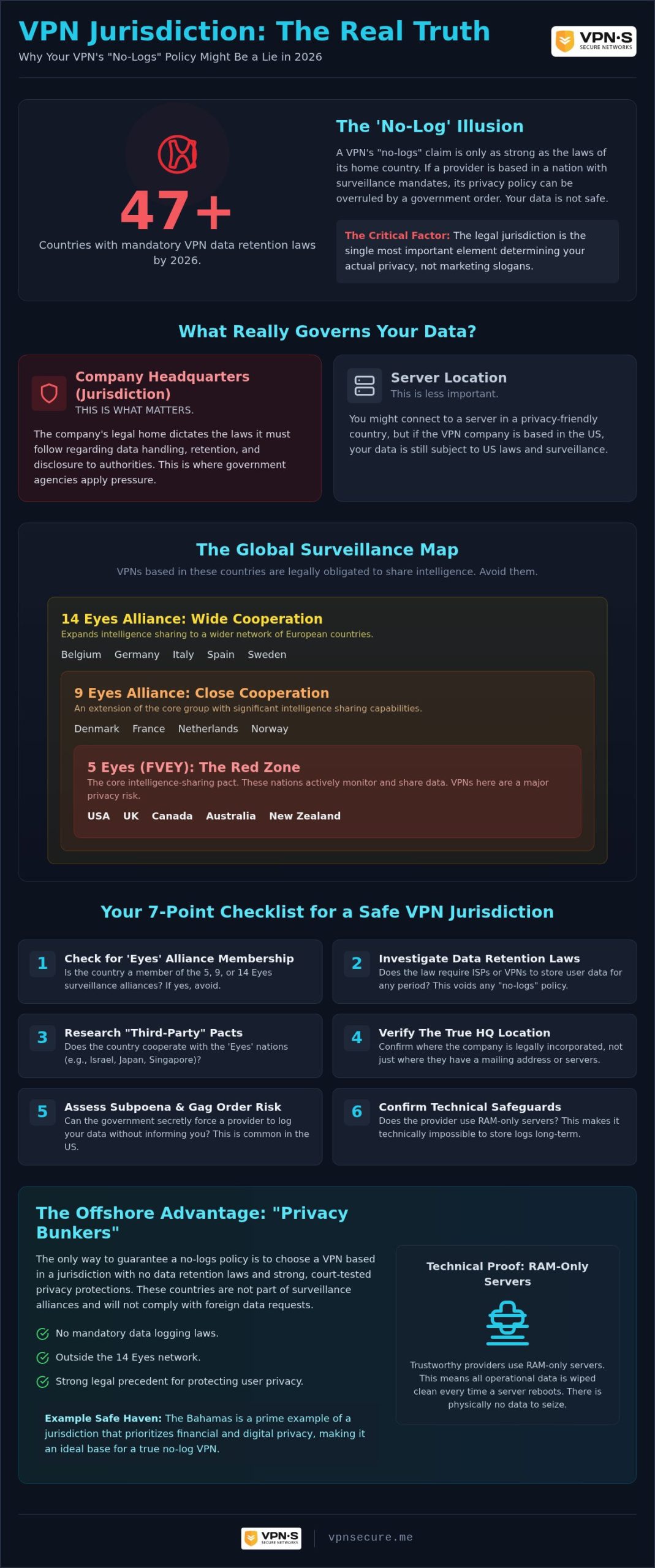
By 2026, at least 47 countries have enacted mandatory data retention laws specifically targeting VPN providers. That is more than double the number we saw just six years ago. If your provider is headquartered in one of these regions, their marketing claims are essentially worthless. A “no-logs” sticker means nothing if the local police can walk in with a warrant and force a server seizure. The reality is that your no log vpn jurisdiction is the only thing standing between your private data and a government subpoena.
You’re right to feel skeptical when every service on the market promises total anonymity. It’s frustrating to wade through technical jargon only to find out your “secure” connection is based in a Five Eyes country like the US or UK. This guide cuts through the noise. You will learn exactly how to spot a fake policy by analyzing the legal framework governing your provider. We break down which jurisdictions favor privacy and which don’t, provide a clear checklist to verify offshore claims, and show you why a privacy-friendly home like the Bahamas is a strong choice in 2026.
Most VPN marketing is a carefully crafted lie. You see the “No-Logs” badge plastered across every homepage, but in 2026, that claim is only as strong as the local law. If a provider is headquartered in a country with aggressive surveillance mandates, their privacy policy is a suggestion, not a rule. Governments don’t care about a marketing department’s promises when they have a court order in hand. Your no log vpn jurisdiction is the single most important factor in your digital defense because it determines who can legally force your provider to start logging your every move.
The conflict between marketing and law is a trap for the unwary. A provider can pass a third-party audit on Tuesday and be served with a secret data retention order on Wednesday. They haven’t technically lied about their past, but their future behavior is now set by the law. As data retention rules tighten in 2026, choosing a provider based in a privacy-friendly location like the Bahamas is no longer optional.
Jurisdiction is the specific legal framework that dictates how a company must handle, retain, and disclose user data. It is the legal “home” where the business is incorporated and pays its taxes. You must understand the critical difference between a server location and company headquarters. You might connect to a server in Switzerland, but if the company is based in Virginia, you are subject to United States law. Your data is governed by the laws of where the provider’s office sits, not where the physical hardware is located. That is why a provider’s legal home matters as much as its encryption.
One of the biggest legal risks to your privacy is a secret order such as a National Security Letter (NSL). In countries belonging to the Five Eyes (FVEY) intelligence alliance, authorities can issue these secret subpoenas to require a VPN provider to log a specific user’s activity. These letters almost always come with a gag order, so the provider cannot legally tell you that your “no-log” connection is being recorded.
Some companies use “Warrant Canaries” as a last-ditch effort for transparency, but these are often reactive and fragile. Once a court issues a valid order, the VPN’s privacy policy becomes legally irrelevant. The company must comply or face massive fines and jail time for its executives. This is why an offshore no log vpn jurisdiction is your only real shield. If the local law doesn’t allow for secret logging or foreign subpoenas, the government has no leverage to break the provider’s promise to you.
Intelligence-sharing between countries is not a conspiracy theory; it is a documented legal framework. What began as a Cold War pact between the US and UK now covers much of the Western world. If you choose a no log vpn jurisdiction located within these alliances, your provider can fall under data-sharing agreements between member countries, which limits what a “no-log” claim can guarantee.
The danger isn’t just about who is in the room. It is about the “Third-Party” loophole. Even countries that aren’t formal members of these alliances, such as Israel, Japan, or Singapore, are known to cooperate closely with the core members. This means your data can be harvested in one country and stored in another, far beyond the reach of the privacy policy you signed. To protect yourself, you must understand these legal ties before you trust a provider with your traffic. Understanding how to hide my ip address effectively starts with knowing which jurisdictions can legally expose it.
The core of this network is the Five Eyes (FVEY), consisting of the USA, UK, Canada, Australia, and New Zealand. These nations represent the “Red Zone” for privacy. In the United States, the Foreign Intelligence Surveillance Act (FISA) provides the legal teeth for the government to compel assistance from any tech company. The network expands through the 9 Eyes and 14 Eyes alliances to include:
Knowledge of the Five Eyes vs 9 Eyes vs 14 Eyes VPN hierarchy is the foundation of digital self-defense. If your provider’s headquarters is listed above, they are subject to mutual legal assistance treaties that can force them to hand over information to foreign governments without you ever knowing.
Alliances are only half the picture. Individual member states often have domestic laws that are even less friendly to privacy. Australia’s “Assistance and Access” Bill, for example, allows authorities to require individual engineers to build backdoors into secure software. In Europe, while the overarching Data Retention Directive was declared invalid, many local variations still exist that require ISPs and some service providers to store metadata for months. These laws can change overnight. A “safe” no log vpn jurisdiction in January could introduce retention rules by December. This is why staying ahead of the curve with offshore VPN subscriptions is the most reliable way to keep your data out of retention schemes.
A flashy website doesn’t guarantee your safety. You need a systematic way to vet your provider before you trust them with your traffic. In 2026, the stakes are too high for guesswork. Use this checklist to determine if your no log vpn jurisdiction is a fortress or a sieve. If a provider fails even one of these points, your data is at risk.
Don’t be fooled by a Panama address. If a VPN claims to be offshore but is owned by a parent company in the US or UK, they are still vulnerable. Under laws like the CLOUD Act, the US government can compel a parent company to produce data from its foreign subsidiaries. You must research corporate structures to ensure true independence. Look for entities like Infinite Quant Ltd that operate with a clear, singular focus on privacy. Be especially wary of private equity buyouts. When a massive investment firm buys a VPN, their priority is profit margins, not your anonymity. They often consolidate infrastructure and cut corners on privacy to satisfy shareholders, leaving your data exposed to the highest bidder or the most aggressive subpoena.
A promise is just words. An audit is evidence. You should always verify a no log vpn audit before you subscribe. However, not all audits are equal. A “Security Audit” only checks for bugs and vulnerabilities. You need a “Privacy Audit” or a “No-Log Verification.” This involves a third-party firm inspecting the server configurations to prove that data is actually being wiped in real-time. When reading an audit summary, skip the corporate fluff. Look for one specific phrase: “No evidence of log retention found.” If the report is filled with qualifiers or “limited scope” warnings, the provider is likely hiding a technical loophole that could compromise your identity.
Legal promises are just ink on a screen. Anyone can write a privacy policy, but building infrastructure that physically cannot log is a different challenge. In 2026, you shouldn’t trust a provider that still relies on traditional hard drives. Forensic data recovery is now too advanced. Seized hardware is a goldmine for authorities if it contains a physical disk. Your no log vpn jurisdiction should be supported by a technical architecture that makes data retention impossible by design.
RAM-only servers are your physical safeguard against data seizure. Traditional servers store data on hard disks that retain information even after the power is cut. RAM-only setups run entirely on volatile memory. The moment the server reboots or the plug is pulled, every byte of user data vanishes. It’s the only way to truly back up a “no-logs” claim. Authorities can seize the hardware, but they’ll find an empty shell with nothing to decode.
There is a critical catch. Technology cannot stop a provider from logging at the application level if they’re legally required to do so. This is where competitors often mislead you. RAM-only architecture prevents forensic recovery of past data, but it doesn’t prevent live logging if the local law requires it. You need a provider that combines diskless booting with a jurisdiction that doesn’t require logging or secret gag orders.
Technical security also requires a vigilant client. A system-level Kill Switch is mandatory. Without it, a momentary VPN drop leaves your real IP address exposed to your ISP and anyone watching the network. You can verify your protection by running DNS and IP leak tests. If your real location shows up for even a second, the shield is broken and your anonymity is gone.
Ultimately, VPN data privacy laws dictate how transparent a company can be about its technical flaws. If the law allows for secret mandates, you’ll never know if their “open source” code has been modified under duress. True transparency requires both the code and the right no log vpn jurisdiction to protect it from outside tampering. Secure your connection with an Annual VPN Subscription that uses verified RAM-only infrastructure to keep your data out of reach.
While many VPN providers play a shell game with their headquarters, the legal reality of 2026 calls for a genuinely independent base. “Offshore” isn’t just a term for high-stakes banking anymore; it’s a key layer of protection for your digital identity. When you select a no log vpn jurisdiction, you aren’t just choosing a location on a map. You’re choosing which laws apply to your data. The Bahamas is one of the few places where VPN providers face no mandatory data retention law.
VPNSecure has operated from this privacy bunker since 2012. We didn’t choose the Bahamas because of the weather. We chose it because under Bahamian law, a foreign request for data needs a locally valid warrant, and because we keep no logs, there is nothing to hand over. This independence is your guarantee that “no-logs” actually means zero data stored.
The Bahamian legal framework is fundamentally different from the compromised havens of the past. Unlike Switzerland or Panama, which have faced increasing pressure to sign Mutual Legal Assistance Treaties (MLATs) with the US and EU, the Bahamas maintains a strict stance on data sovereignty. There are no mandatory data retention laws for VPN providers here. This means we are not legally required to store your metadata, your IP addresses, or your timestamps. While a US-based provider can be required to log in secret under a gag order, our no log vpn jurisdiction allows us to maintain a verified zero-log environment.
Securing your data shouldn’t require a lifetime commitment to a compromised service. You can find affordable VPN monthly plans that offer the same offshore protection as our long-term subscriptions. With a network spanning 40+ countries and support for all your major devices, we provide the tools you need to navigate the web on your own terms. We’ve spent over a decade refining a service that prioritizes your autonomy over corporate compliance. Don’t settle for a provider that cowers under a subpoena. Choose a partner that is legally built to protect you. Protect your privacy—Get VPNSecure now.
Marketing promises are cheap, but legal protection is non-negotiable. You now have the framework to verify every “no-logs” claim by analyzing the no log vpn jurisdiction. Remember that a provider’s headquarters is their legal master. If they are in a 14 Eyes country, your data is already compromised before you even connect. By moving your digital presence to an offshore bunker like the Bahamas, you strip away the power of foreign subpoenas and secret gag orders.
Technical safeguards like RAM-only servers are essential, but they only work when supported by a legal system that respects your privacy. VPNSecure has been defending this line since 2012. We operate from the Bahamas, outside the 14 Eyes countries, to ensure your traffic remains your business alone. We offer a verified no-log policy and a 30-day money-back guarantee so you can test our offshore service without any risk. Your privacy is a right, not a subscription feature.
Shield your data with an offshore No-Log VPN: Start for $2.99/mo
No. US-based VPNs are never safe for anyone prioritizing total anonymity. Under the CLOUD Act and FISA, the US government can compel any domestic provider to start logging specific users in secret. Because these orders come with strict gag orders, you’ll never know your data is being harvested. If a provider is subject to US law, their “no-log” policy is legally secondary to a federal subpoena.
If a government subpoenas a true no-log VPN in a safe jurisdiction, the provider simply has nothing to hand over. However, in some jurisdictions, a subpoena can include a mandate to begin logging future traffic. This is why we operate from the Bahamas. Without physical disks or legal requirements to store metadata, a subpoena results in zero recovered data. It’s a technical and legal dead end for investigators.
While both are considered offshore havens, they are not the same. The British Virgin Islands is a British Overseas Territory, which can lead to different levels of pressure from the UK. The Bahamas is a fully sovereign nation with its own data protection framework. VPNSecure chose the Bahamas in 2012 specifically because its legal system favors individual autonomy and lacks the aggressive MLATs that often compromise other havens.
Yes, a VPN can be legally required to log your activity if it operates in a 14 Eyes country. Authorities use National Security Letters to force providers to monitor specific accounts. Your no log vpn jurisdiction is your only shield against this. In a privacy bunker like the Bahamas, there is no legal mechanism for foreign agencies to force a provider into a secret logging arrangement without a locally verified warrant.
You must look beyond the marketing page and verify the parent company. For example, VPNSecure is owned by Infinite Quant Ltd, a private company incorporated in the Bahamas. Check official corporate registries to ensure the provider isn’t a subsidiary of a US or UK firm. If the real owners are based in a 14 Eyes country, the offshore address is just a hollow shell designed to mislead you.
No audit can guarantee 100% safety because they only reflect the server state at the time of the inspection. An audit proves the provider has the technical capability to run without logs, but it cannot rule out a future court order changing that. You need the combination of a verified audit and a jurisdiction where foreign data demands and secret subpoenas have no direct legal force.
In 2026, the 14 Eyes alliance remains a broad intelligence-sharing network. The core Five Eyes are the USA, UK, Canada, Australia, and New Zealand. The Nine Eyes expansion includes Denmark, France, the Netherlands, and Norway. The full 14 Eyes group adds Belgium, Germany, Italy, Spain, and Sweden. If your VPN is headquartered in any of these nations, your data is subject to multi-national sharing agreements that can override your privacy protections.
Keep reading
A Mac’s polished interface isn’t a privacy shield. Yes, MacBook Air and MacBook Pro can use a VPN, and macOS includes a client that supports L2TP,...

Planning a trip to China? Learn which VPN features matter, why Stealth VPN helps, how to prepare before departure, and what legal and access limits to consider.

A VPN for accessing region-locked games can change the IP location a game sees, but it won’t automatically change your Steam store region. Steam...
No logs, ever. Start with Free with ads in under a minute.